


The collapse of a highway construction crane killed two people near Bangkok yesterday, with a Thai minister saying the building firm was also involved in a crane failure the day before that left 32 dead.
Car dashcam footage showed the moment the massive crane fell yesterday, unleashing clouds of dust as well as rubble across the area as several vehicles pulled over or reversed to avoid falling debris.
Motorcycle-taxi driver Booncherd La-orium said he no longer felt safe driving in the suburb outside Bangkok.
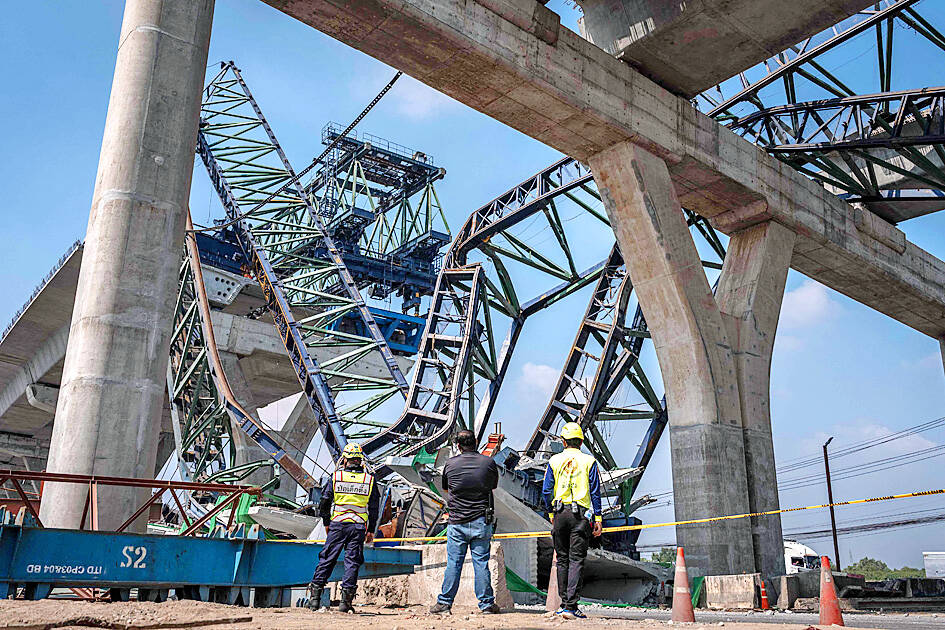
Photo: AFP
“I had goosebumps just thinking about how risky it is to be here. It could have happened to me,” the 69-year-old said. “I still can’t get over yesterday’s incident, and this morning I heard another one happened again.”
Thai Minister of Transport Phiphat Ratchakitprakarn linked firm Italian-Thai Development to the country’s second deadly crane collapse in two days, local media reported.
The company was contracted to build a section of a China-backed high-speed rail project where another huge crane fell on Wednesday, in Nakhon Ratchasima Province, derailing a passenger train below and killing 32 of nearly 200 people on board.
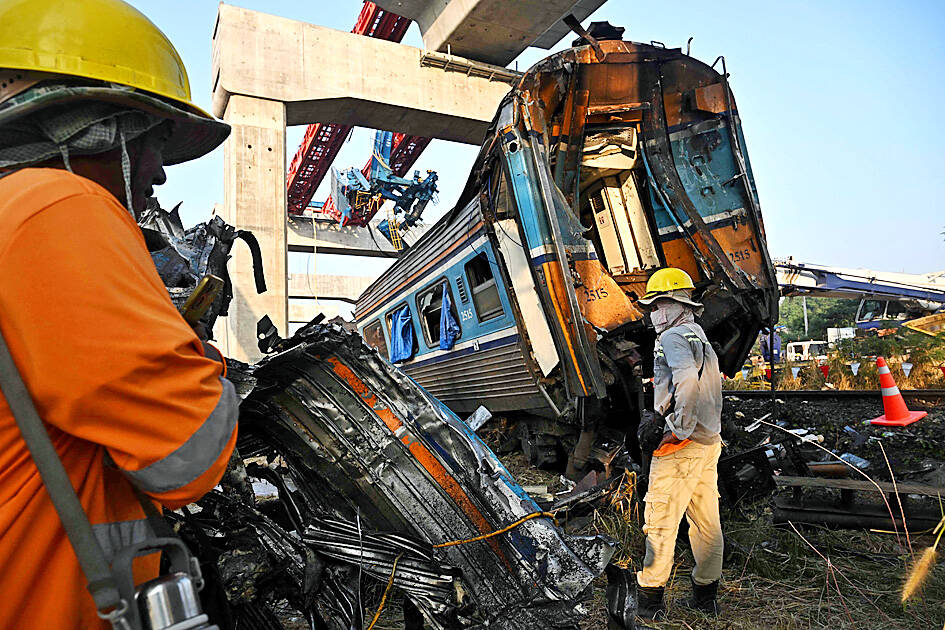
Photo: AFP
“Yes, it is Italian-Thai. I still do not understand what happened,” Phiphat told local media yesterday.
“We have to find out the facts, whether it was an accident or something else,” he said, adding that two people were killed.
The company — one of Thailand’s biggest construction firms — has seen several deadly accidents at its sites in the past few years.
The crane that fell yesterday morning at the under-construction Rama II Expressway in Samut Sakhon Province, outside Bangkok, left two people dead, local police chief Sitthiporn Kasi said from the scene.
In other verified footage from the same vehicle as the dashcam, someone is heard saying: “I almost died... Please pull over first.”
Another person replies: “That’s okay now. It’s not falling further. It’s a crane collapse again in front of me.”
“That was close,” the first person says.
Construction work has been under way for years to expand the road’s capacity and reduce congestion, but the project has been beset by delays and fatalities, earning it the nickname “Death Road.”
Surachai Wongho, a 61-year-old retiree who drives on Rama II every day, said he is haunted by the thought that one day he could be hurt in an accident.
“It’s the same incident happening over and over again in Thailand. It’s time for the government to do something,” he said.

Australians were downloading virtual private networks (VPNs) in droves, while one of the world’s largest porn distributors said it was blocking users from its platforms as the country yesterday rolled out sweeping online age restriction. Australia in December became the first country to impose a nationwide ban on teenagers using social media. A separate law now requires artificial intelligence (AI)-powered chatbot services to keep certain content — including pornography, extreme violence and self-harm and eating disorder material — from minors or face fines of up to A$49.5 million (US$34.6 million). The country also joined Britain, France and dozens of US states requiring

Hungarian authorities temporarily detained seven Ukrainian citizens and seized two armored cars carrying tens of millions of euros in cash across Hungary on suspicion of money laundering, officials said on Friday. The Ukrainians were released on Friday, following their detention on Thursday, but Hungarian officials held onto the cash, prompting Ukraine to accuse Hungary’s Russia-friendly government of illegally seizing the money. “We will not tolerate this state banditism,” Ukrainian Minister of Foreign Affairs Andrii Sybiha said. The seven detained Ukrainians were employees of the Ukrainian state-owned Oschadbank, who were traveling in the two armored cars that were carrying the money between Austria and

Kosovar President Vjosa Osmani on Friday after dissolving the Kosovar parliament said a snap election should be held as soon as possible to avoid another prolonged political crisis in the Balkan country at a time of global turmoil. Osmani said it is important for Kosovo to wrap up the upcoming election process and form functional institutions for political stability as the war rages in the Middle East. “Precisely because the geopolitical situation is that complex, it is important to finish this electoral process which is coming up,” she said. “It is very hard now to imagine what will happen next.” Kosovo, which declared

MORE BANS: Australia last year required sites to remove accounts held by under-16s, with a few countries pushing for similar action at an EU level and India considering its own ban Indonesia on Friday said it would ban social media access for children under 16, citing threats from online pornography, cyberbullying, online fraud and Internet addiction. “Accounts belonging to children under 16 on high-risk platforms will start to be deactivated, beginning with YouTube, TikTok, Facebook, Instagram, Threads, X, Bigo Live and Roblox,” Indonesian Minister of Communications and Digital Meutya Hafid said. “The government is stepping in so that parents no longer have to fight alone against the giants of the algorithm. Implementation will begin on March 28, 2026,” she said. The social media ban would be introduced in stages “until all platforms fulfill their


 RSS
RSS