


More than 20 containers of radioactive zinc stranded in Manila Bay for months have been brought ashore to a “safe place,” the country’s nuclear research director said yesterday.
The 23 containers arrived in Manila aboard the MV Hansa Augsburg in late September after Indonesian authorities “rejected and re-exported” them following the discovery of traces of radioactive Caesium-137.
Jakarta sent the shipment back as it clamped down on scrap iron and steel imports amid a scandal over alleged radioactive contamination of food products.
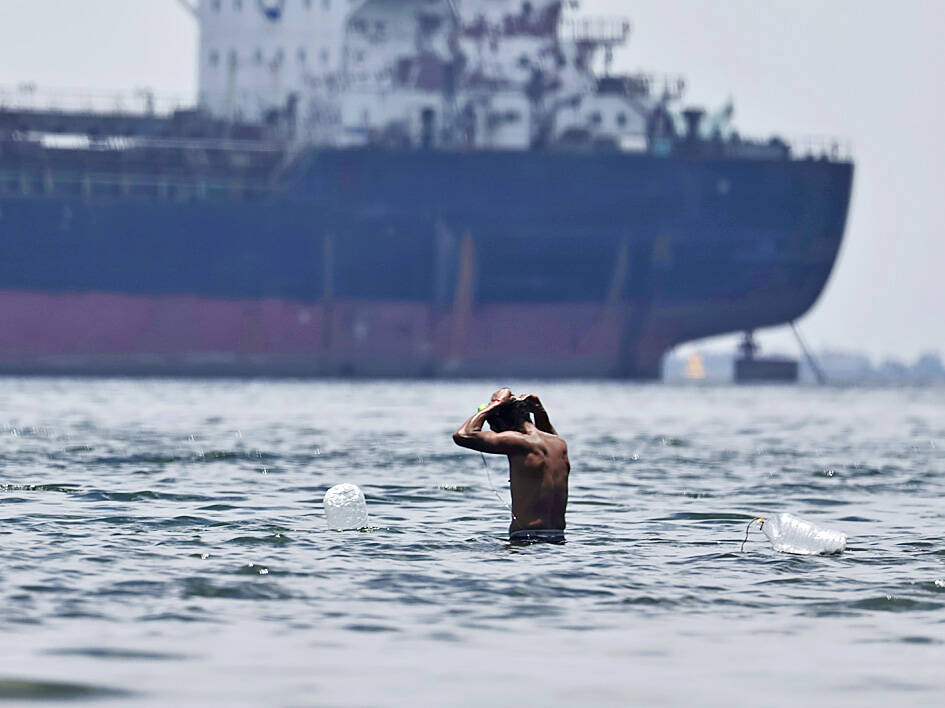
Photo: EPA
A source with knowledge of the situation said the containers were offloaded at Manila’s port on Sunday at 10:27am.
Philippine Nuclear Research Institute (PNRI) Director Carlo Arcilla, who called the issue a “solvable problem” in October, said the zinc was awaiting a medium-term solution, with storage at the Subic Bay military facility a likely option.
He declined to say where the containers were currently located, but another official who spoke on condition of anonymity said they were in a temporary holding area just outside Metro Manila.
The Subic Bay Metropolitan Authority “is open to the idea because they have ammunition bunkers there during World War II. I’ve seen the bunkers; they are in good shape,” Arcilla said, stressing that the contamination levels were low.
“It’s weakly contaminated, because 1m away from the container, the radiation becomes background,” he said, adding that the ship’s crew had tested negative for radiation.
The final solution would see the shipment sealed in a purpose-built underground containment facility, he said.
Arcilla went on to say that China’s Cosco Shipping Lines, the ship’s operator, had been victimized by what he called an “irrational fear of radiation,” as well as Manila’s failure to find a solution.
“The shipping company took it into their own hands to negotiate because they are losing millions,” he said.
Cosco did not immediately respond to questions about the shipment.
Neither the Philippines nor Indonesia has disclosed the radiation levels in the containers.
The zinc dust, a byproduct of steel production, was exported to Indonesia by Zannwann International Trading Corp after being sourced from local recycler Steel Asia, Arcilla said in October.
The recycler temporarily suspended operations at its plant, but slammed the PNRI’s conclusions as “baseless and unscientific,” arguing multiple companies had supplied zinc dust to Zannwann.
Calls to both companies were not immediately returned.
Greenpeace Philippines campaigner Jefferson Chua has warned that even low levels of Caesium-137 exposure carry “long-term cancer risks and can cause lasting environmental contamination.”
The radioactive isotope, which is created through nuclear reactions, is used in industrial, medical and research applications.

‘CROSSING THE LINE’: China’s embassy in Seoul criticized US Forces Korea Commander General Xavier Brunson, asking if his ‘hostile’ remarks were authorized by Washington South Korea and the US are in talks over recent public remarks by the commander of US Forces Korea, Seoul’s presidential office said yesterday, after the comments drew sharp criticism from China. In a recent podcast interview, US Forces Korea Commander General Xavier Brunson described South Korea as “the dagger in the heart of Asia” from China’s east coast, prompting the Chinese embassy in Seoul to say that he had “truly crossed the line.” The interview came amid growing speculation that Washington might seek to expand the role of US Forces Korea in countering the growing regional influence of China, a key

SEEKING ORDER: Rodrigo Paz said that ‘anyone who wants to destroy the nation will have to deal with this president and the full force of the constitution’ Bolivian President Rodrigo Paz on Wednesday said that the nation was at a “breaking point” after nearly a month of protests that have caused shortages of food, fuel and medicine. Paz, who took office six months ago amid the worst economic crisis there in four decades, is battling a groundswell of fury over his policies. The political capital, La Paz, has been besieged by low-income workers and members of the indigenous majority calling for his resignation. “The country needs order and is reaching breaking point,” the 58-year-old said at a public event in La Paz, renewing his appeal for dialogue. On Tuesday, the Bolivian

Through the noise of rushing papers and whirring belts at a print factory in Kyoto, two creators watch their photo essay come to life in broadsheet form — part of an effort to win new audiences in the age of artificial intelligence (AI). Despite the decline of the publishing industry, self-publication and handmade “zine” magazines are growing in popularity in Japan, reflecting the nation’s enduring love of paper in the digital era. While speaking to Agence France-Presse at the plant, his hands black with ink, one of the creators, Kazuma Obara, said: “I think [paper] is a medium that engages all five

Australian researchers have trained lab-grown brain cells on a silicon computer chip to play the 1990s shooter game Doom and said they are just scratching the surface of what the neurons could be capable of doing. It is the science-fiction work of biotech boffins at Cortical Labs, who researched and developed the technology that harnesses the workings of the brain’s networking system. Each so-called “biological computer” contains about 200,000 living human brain cells, grown from stem cells that were harvested from blood donations. Having mastered the simple computer game Pong, where a paddle is moved up and down to send a ball


 RSS
RSS