


Thousands of farmers in Ireland and France on Saturday protested against the EU’s trade deal with the South American bloc Mercosur, a day after EU states approved the treaty despite opposition from some members.
In central Ireland, tractors streamed into the roads of Athlone for a demonstration, displaying signs including “Stop EU-Mercosur” and with the EU flag emblazoned with the words “sell out.”
“We have good quality Irish beef and good standards here, and they don’t have the same standards in South American countries,” said Trisha Chatterton, a 50-year-old farmer. “There is not a lot of traceability on their beef.”

Photo: Reuters
The agreement is widely opposed by farmers for fear it would result in an influx of an extra 99,000 tonnes of cheap beef from South America, disrupting European agriculture.
The Irish Farmers’ Association (IFA), Ireland’s main farmers’ lobby group, called the result “very disappointing.”
It said it would “renew” focus on securing a majority against the deal in the European Parliament.
“We expect Irish MEPs [members of the European Parliament] to stand behind the farming community and reject the Mercosur deal,” IFA president Francie Gorman said in a statement.
In France, police on Saturday ejected farmers occupying a fuel depot near Bordeaux in the southwest.
Later in the day, other farmers tried to block road traffic to the port of Le Havre in the northwest. Two highways remained blocked on Saturday in the southwest of France, farmer unions said.
Farmers on Friday also marched in Poland, and blocked roads in France and Belgium as the EU gave the green light to the trade deal.
While the accord has been welcomed by business groups, European farmers have bitterly criticized it.
The deal, more than 25 years in the making, would create one of the world’s largest free-trade areas, boosting commerce between the 27-nation EU and the Mercosur bloc comprising Brazil, Paraguay, Argentina and Uruguay.
Major Mercosur exports to the EU include agricultural products and minerals, while the EU would export machinery, chemicals and pharmaceuticals with lowered tariffs applied.
Many European farmers fear their livelihoods would be undercut by a flow of cheaper goods from agricultural giant Brazil and its neighbors.
Such concerns prompted Ireland, France, Poland, Hungary and Austria to vote against the accord.
The Mercosur deal still has to be approved by a majority of MEPs in the European Parliament in the coming months, where voting coalitions have become more volatile and unpredictable.
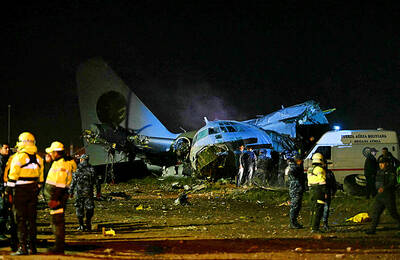
MONEY GRAB: People were rushing to collect bills scattered on the ground after the plane transporting money crashed, which an official said hindered rescue efforts A cargo plane carrying money on Friday crashed near Bolivia’s capital, damaging about a dozen vehicles on highway, scattering bills on the ground and leaving at least 15 people dead and others injured, an official said. Bolivian Minister of Defense Marcelo Salinas said the Hercules C-130 plane was transporting newly printed Bolivian currency when it “landed and veered off the runway” at an airport in El Alto, a city adjacent to La Paz, before ending up in a nearby field. Firefighters managed to put out the flames that engulfed the aircraft. Fire chief Pavel Tovar said at least 15 people died, but

LIKE FATHER, LIKE DAUGHTER: By showing Ju-ae’s ability to handle a weapon, the photos ‘suggest she is indeed receiving training as a successor,’ an academic said North Korea on Saturday released a rare image of leader Kim Jong-un’s teenage daughter firing a rifle at a shooting range, adding to speculation that she is being groomed as his successor. Kim’s daughter, Ju-ae, has long been seen as the next in line to rule the secretive, nuclear-armed state, and took part in a string of recent high-profile outings, including last week’s military parade marking the closing stages of North Korea’s key party congress. Pyongyang’s official Korean Central News Agency (KCNA) released a photo of Ju-ae shooting a rifle at an outdoor shooting range, peering through a rifle scope
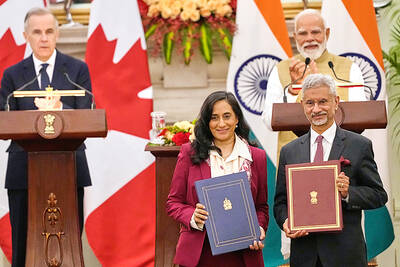
India and Canada yesterday reached a string of agreements, including on critical mineral cooperation and a “landmark” uranium supply deal for nuclear power, the countries’ leaders said in New Delhi. The pacts, which also covered technology and promoting the use of renewable energy, were announced after Indian Prime Minister Narendra Modi and Canadian Prime Minister Mark Carney hailed a fresh start in the relationship between their nations. “Our ties have seen a new energy, mutual trust and positivity,” Modi said. Carney’s visit is a key step forward in ties that effectively collapsed in 2023 after Ottawa accused New Delhi
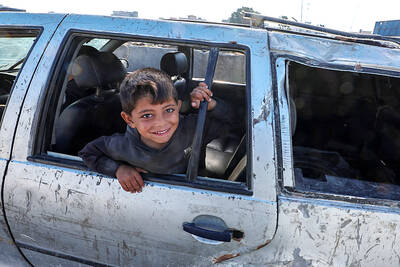
Gaza is rapidly running out of its limited fuel supply and stocks of food staples might become tight, officials said, after Israel blocked the entry of fuel and goods into the war-shattered territory, citing fighting with Iran. The Israeli military closed all Gaza border crossings on Saturday after announcing airstrikes on Iran carried out jointly with the US. Israeli authorities late on Monday night said that they would reopen the Kerem Shalom crossing from Israel to Gaza yesterday, for “gradual entry of humanitarian aid” into the strip, without saying how much. Israeli authorities previously said the crossings could not be operated safely during


 RSS
RSS