


Venezuela on Thursday released a number of imprisoned high-profile opposition figures, activists and journalists in what the government described as a gesture to “seek peace” less than a week after then-Venezuelan president Nicolas Maduro was captured by US forces to face drug-trafficking charges.
US President Donald Trump, who has been pressuring Maduro allies now leading the country to fold to his vision for the future of the oil-rich nation, said the releases came at the request of Washington.
Trump in an interview praised the government of Venezuelan acting president Delcy Rodriguez, saying: “they’ve been great ... Everything we’ve wanted, they’ve given us.”
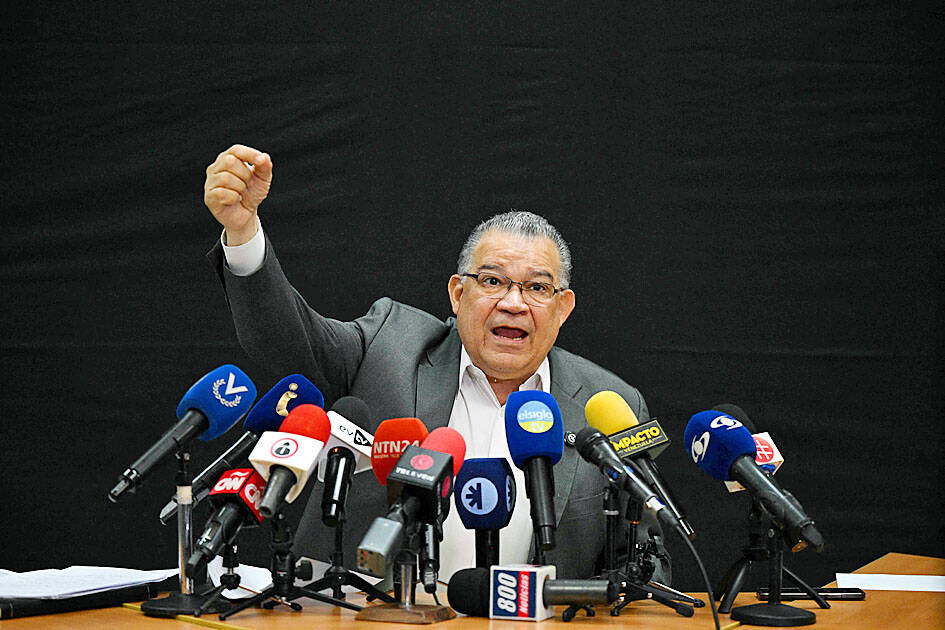
Photo: AFP
The US government and Venezuela’s opposition have long demanded the widespread release of imprisoned politicians, critics and members of civil society.
The Venezuelan government insists it does not hold prisoners for political reasons.
Among those released was Biagio Pilieri, an opposition leader who was part of Nobel Peace Prize winner Maria Corina Machado’s 2024 presidential campaign, according to Foro Penal, an advocacy group for prisoners.
Also released was Enrique Marquez, a former electoral authority and candidate in the 2024 presidential election, the organization said.
Videos posted by journalists on social media show Marquez and Pilieri embracing loved ones on the streets outside the prison.
Five Spanish citizens — including the prominent Venezuelan-Spanish lawyer and human rights activist Rocio San Miguel — were also released in the afternoon and, as the night wore on, reports trickled out of more detainees walking free.
Relatives who waited for hours outside a prison in Guatire briefly chanted, “Libertad! Libertad!” meaning “Freedom! Freedom!”
Human rights groups and members of the opposition were encouraged by the move, although it was not clear yet what it represented — whether the growing pains of a government in transition or a symbolic overture to placate the Trump administration.
The Spanish government said that five of its citizens, including dual national San Miguel, had been released from custody in Venezuela and would soon return to Spain.
Spanish Minister of Foreign Affairs Jose Manuel Albares identified the other Spanish nationals released as Andres Martinez, Jose Maria Basoa, Ernesto Gorbe and Miguel Moreno.
Martinez and Basoa were arrested in Venezuela in September 2024 and accused of plotting to destabilize Maduro’s government as Spanish spies — allegations vehemently denied by Spain.
Gorbe was arrested in 2024 on allegations of overstaying his visa.
Families wait outside prisons
As the news of the release broke, families of detainees rushed to prisons across the country, seeking information on their loved ones.
Pedro Duran, 60, was among those hoping to reunite with his brother, Franklin Duran, as he waited outside the prison in Guatire.
Duran said his brother was detained in 2021 on charges of trying to overthrow Maduro’s government — an accusation his family denies.
Duran, who has been living in Spain, heard rumors on Wednesday that the government could release a number of detainees and immediately bought a plane ticket from Madrid to Caracas to find his brother.
“I don’t have words to express the emotion I’m feeling,” Duran said. “We’re feeling a lot of hope ... We’re just waiting now.”
Despite the anticipation, fear persists.
“Of course everyone here is very scared, but what more could [the government] do to us that they haven’t done already,” he added.
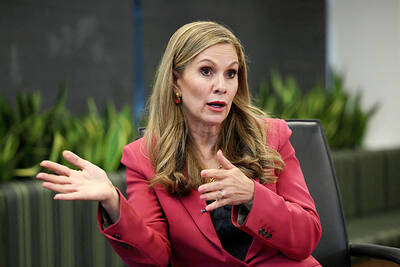
Australians were downloading virtual private networks (VPNs) in droves, while one of the world’s largest porn distributors said it was blocking users from its platforms as the country yesterday rolled out sweeping online age restriction. Australia in December became the first country to impose a nationwide ban on teenagers using social media. A separate law now requires artificial intelligence (AI)-powered chatbot services to keep certain content — including pornography, extreme violence and self-harm and eating disorder material — from minors or face fines of up to A$49.5 million (US$34.6 million). The country also joined Britain, France and dozens of US states requiring
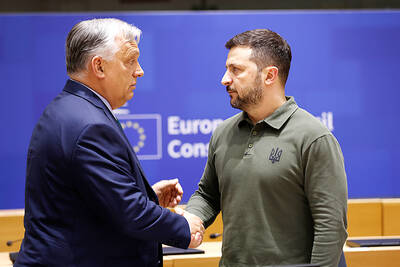
Hungarian authorities temporarily detained seven Ukrainian citizens and seized two armored cars carrying tens of millions of euros in cash across Hungary on suspicion of money laundering, officials said on Friday. The Ukrainians were released on Friday, following their detention on Thursday, but Hungarian officials held onto the cash, prompting Ukraine to accuse Hungary’s Russia-friendly government of illegally seizing the money. “We will not tolerate this state banditism,” Ukrainian Minister of Foreign Affairs Andrii Sybiha said. The seven detained Ukrainians were employees of the Ukrainian state-owned Oschadbank, who were traveling in the two armored cars that were carrying the money between Austria and
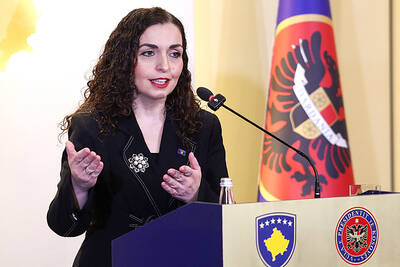
Kosovar President Vjosa Osmani on Friday after dissolving the Kosovar parliament said a snap election should be held as soon as possible to avoid another prolonged political crisis in the Balkan country at a time of global turmoil. Osmani said it is important for Kosovo to wrap up the upcoming election process and form functional institutions for political stability as the war rages in the Middle East. “Precisely because the geopolitical situation is that complex, it is important to finish this electoral process which is coming up,” she said. “It is very hard now to imagine what will happen next.” Kosovo, which declared

MORE BANS: Australia last year required sites to remove accounts held by under-16s, with a few countries pushing for similar action at an EU level and India considering its own ban Indonesia on Friday said it would ban social media access for children under 16, citing threats from online pornography, cyberbullying, online fraud and Internet addiction. “Accounts belonging to children under 16 on high-risk platforms will start to be deactivated, beginning with YouTube, TikTok, Facebook, Instagram, Threads, X, Bigo Live and Roblox,” Indonesian Minister of Communications and Digital Meutya Hafid said. “The government is stepping in so that parents no longer have to fight alone against the giants of the algorithm. Implementation will begin on March 28, 2026,” she said. The social media ban would be introduced in stages “until all platforms fulfill their


 RSS
RSS