


In the dense hill forests along Bangladesh’s border with war-torn Myanmar, villagers are losing limbs to landmines, casualties of a conflict not of their making.
Ali Hossain, 40, was collecting firewood early last year when a blast shattered his life.
“I went into the jungle with fellow villagers. Suddenly, there was an explosion, and my leg was blown off,” he said. “I screamed at the top of my voice.”
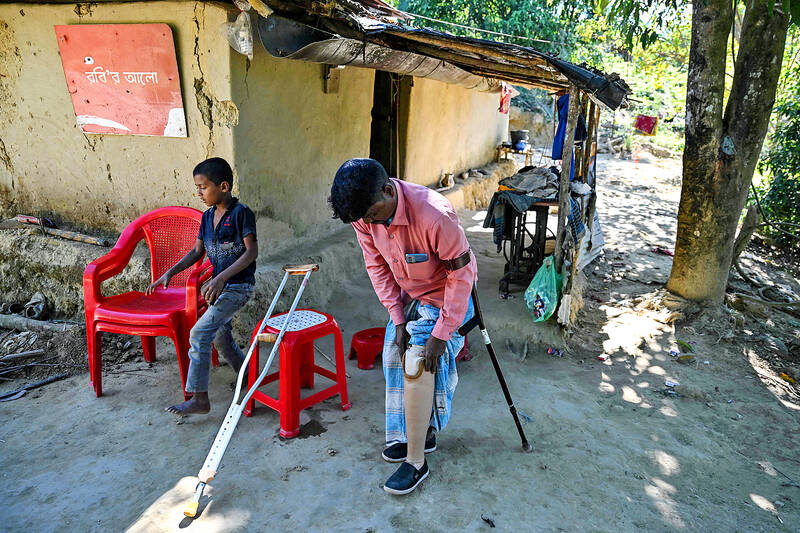
Photo: AFP
Neighbors rushed to stem the spurting blood.
“They picked me up, gathered my severed leg and took me to hospital,” he said.
In Ashartoli, a small settlement in Bandarban District — the village name translates as “haven of hope” — the weapons of a foreign war have turned forests, farms and footpaths deadly.
Bangladesh’s 271km eastern border with Myanmar cuts through forests, much of it unmarked, as well as rivers.
It is crossed daily by villagers, as their families have done for generations, for collecting firewood or trading.
Surgeons chopped Hossain’s leg off above the knee.
“My wife had to carry me on her back,” he said, gesturing toward the steep hillside around his home, as he recalled the months after the blast.
A year later, Hossain walks with an artificial leg and a crutch, but he cannot return to his job on a rubber plantation.
Needing 300 takas (US$2.46) a day for medicine, his two young sons now take on his former dangerous task, collecting firewood after school.
Similar stories echo across the border region.
“My father and forefathers collected wood from the jungle,” said Mohammad Abu Taleb, 47. “I learned no other trade.”
He crossed unwittingly into Myanmar.
“I stepped on a pile of dry leaves and there was an explosion,” he said, leaning on a crutch. “It took away my whole life.”
His 10-year-old son has since dropped out of school to help support the family.
Taleb said trips to repair his artificial leg and attend medical checkups cost about US$80 — an impossible burden for a family struggling to survive.
Nurul Amin, 23, lost his leg while attempting to bring a cow across the border, a memory blurred by pain.
“They carried me on their shoulders to the hospital,” he said, adding that he was more worried that his monthly income had now fallen to about US$25 to US$30.
“That’s not enough for a family,” he said. “I have no other way to survive.”
Myanmar is the world’s most dangerous nation for landmine casualties, according to the International Campaign to Ban Landmines, which has detailed the “massive” and growing use of the weapons, banned by many countries.
It recorded more than 2,000 casualties in Myanmar in 2024, the latest full statistics available — double the total reported the year before.
“The use of mines appeared to significantly increase in 2024-2025,” it said in its Landmine Monitor report, highlighting “an increase in the number of mine victims, particularly near the border” with Bangladesh.
Bangladesh accuses Myanmar’s military and rival armed forces of planting the mines.
Guerrilla Arakan Army fighters — one of the many factions challenging the junta’s rule — control swathes of jungle across the border with Myanmar.
More than 1 million Rohingya refugees who fled Myanmar also live in Bangladesh’s border regions — caught between the warring military and separatist groups.
Bangladesh police say that at least 28 people were injured by landmines last year.
A Bangladesh border guard was killed in November last year when a landmine tore off both his legs.
“This cruelty cannot be legitimized,” said Lieutenant Colonel Kafil Uddin Kayes, a local Border Guard Bangladesh commander.
Bangladesh’s border force has put up warning signs and red flags, and conducts regular mine-sweeping operations, but villagers say warnings offer little protection when survival depends on entering forests seeded with explosives, leaving communities in Bangladesh to pay the price of war.
“The population is increasing and people are moving closer to the border, as we have farmlands there,” 42-year-old farmer Dudu Mia said. “Planting landmines cannot be the solution. It can’t go on like this.”

Kouri Richins, a Utah mother who published a children’s book about grief after the death of her husband is to serve a life sentence for his murder without the possibility of parole, a judge ruled on Wednesday. Richins was convicted in March of aggravated murder for lacing a cocktail given to her husband, Eric Richins, with five times the lethal dose of fentanyl at their home near Park City in 2022. A jury also found her guilty of four other felonies, including insurance fraud, forgery and attempted murder for trying to poison her husband weeks earlier on Feb. 14, 2022, with a

‘PERSONAL MISTAKES’: Eileen Wang has agreed to plead guilty to the felony, which comes with a maximum sentence of 10 years in federal prison A southern California mayor has agreed to plead guilty to acting as an illegal agent for the Chinese government and has resigned from her city position, officials said on Monday. Eileen Wang (王愛琳), mayor of Arcadia, was charged last month with one count of acting in the US as an illegal agent of a foreign government. She was accused of doing the bidding of Chinese officials, such as sharing articles favorable to Beijing, without prior notification to the US government as required by law. The 58-year-old was elected in November 2022 to a five-person city council, from which the mayor is selected

DELA ROSA CASE: The whereabouts of the senator, who is wanted by the ICC, was unclear, while President Marcos faces a political test over the senate situation Philippine authorities yesterday were seeking confirmation of reports that a top politician wanted by the International Criminal Court (ICC) had fled, a day after gunfire rang out at the Philippine Senate where he had taken refuge fearing his arrest. Senator Ronald “Bato” dela Rosa, the former national police chief and top enforcer of former Philippine president Rodrigo Duterte’s “war on drugs,” has been under Senate protection and is wanted for crimes against humanity, the same charges Duterte is accused of. “Several sources confirmed that the senator, Senator Bato, is no longer in the Senate premises, but we are still getting confirmation,” Presidential

HELP DENIED? The US Department of State said that the Cuban leadership refuses to allow the US to provide aid to Cubans, ‘who are in desperate need of assistance’ US Secretary of State Marco Rubio on Wednesday said that Cuba’s leadership must change, as Washington renewed an offer of US$100 million in aid if the communist nation agrees to cooperate. Cuba has been suffering severe economic tumult led by an energy shortage that plunged 65 percent of the country into darkness on Tuesday. Cuba’s leaders have blamed US sanctions, but Rubio, a Cuban American and critic of the government established by Fidel Castro, said the system was to blame, including corruption by the military. “It’s a broken, nonfunctional economy, and it’s impossible to change it. I wish it were different,” he told


 RSS
RSS