


A magnitude 6.5 earthquake on Friday rattled Mexico’s capital and a tourist hotspot on the Pacific coast, killing at least two people and causing moderate damage in a small town near the epicenter.
The US Geological Survey said the quake struck shortly before 8am near Acapulco, a major port and beach resort.
It was felt about 400km away to the north in Mexico City, where alarms sent people rushing into the street for safety, disrupting a holiday weekend.
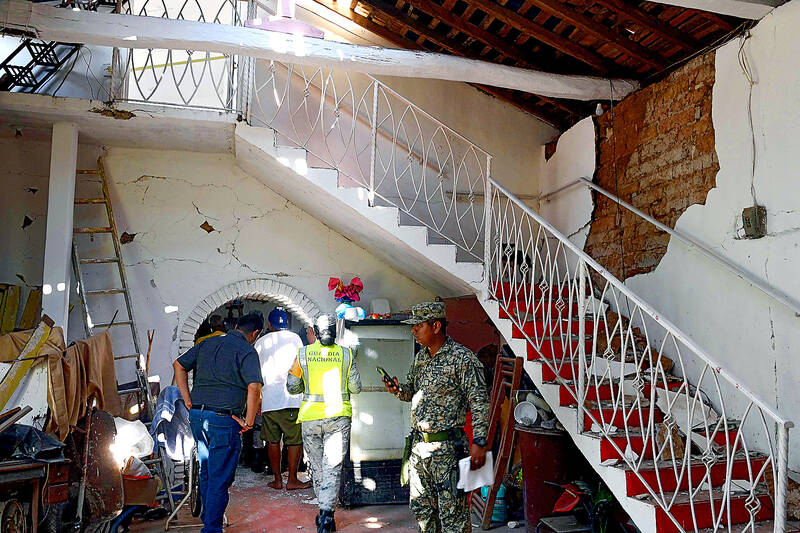
Photo: AFP
A 60-year-old man died after falling while evacuating his second-floor apartment in the capital, local authorities said.
Twelve others were injured, city Mayor Clara Brugada wrote on social media, but there were no reports of major damage in the country’s largest city.
Mexican President Claudia Sheinbaum was forced to evacuate the presidential palace during her regular morning press conference.
Mexico’s National Seismological Service said the earthquake’s epicenter was 14km southwest of the town of San Marcos in the state of Guerrero.
Sheinbaum said there were no immediate reports of major damage, but in San Marcos, the effects were visible.
A woman in her 50s “lost her life when her house collapsed on top of her,” Guerrero Governor Evelyn Salgado said.
San Marcos Mayor Misael Lorenzo Castillo said about 50 houses were destroyed and “all the houses have cracks.”
Mexico is situated between five tectonic plates and as such is one of the world’s most-seismically active countries.
Karen Gomez, a 47-year-old office worker living on the 13th floor of an apartment building in Mexico City, said she was roused from her sleep by a street siren.
“I woke up in terror. My cellphone alert said it was a powerful earthquake.”
Kindergarten director Norma Ortega, 57, who lives in a 10th-floor apartment, said she felt her building shake.
In Acapulco, Ricardo, a tourist from the central Mexican state of Morelos, fled his hotel shirtless after sirens sounded.
The center of Mexico City is built on the muddy subsoil of what was once the bed of a lake, making it particularly vulnerable to earthquakes.
The quakes most strongly felt usually originate off Guerrero state on the Pacific coast.
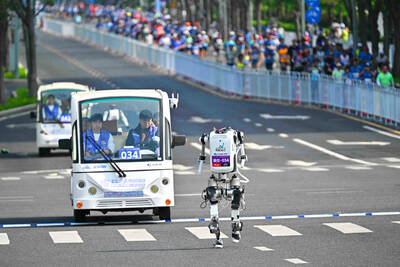
A humanoid robot that won a half-marathon race for robots in Beijing on Sunday ran faster than the human world record in a show of China’s technological leaps. The winner from Honor, a Chinese smartphone maker, completed the 21km race in 50 minutes and 26 seconds, said a WeChat post by the Beijing Economic-Technological Development Area, also known as Beijing E-Town, where the race began. That was faster than the human world record holder, Ugandan Jacob Kiplimo, who finished the same distance in about 57 minutes in March at the Lisbon road race. The performance by the robot marked a significant step forward
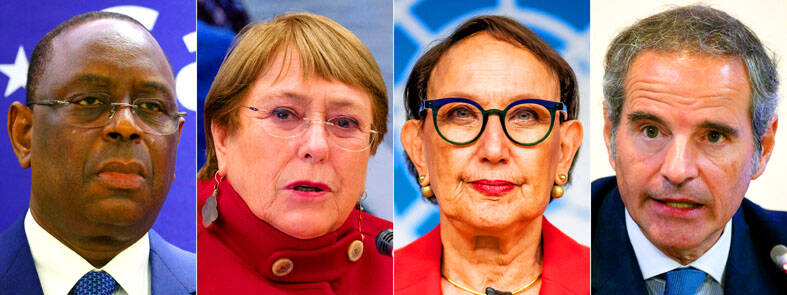
Four contenders are squaring up to succeed Antonio Guterres as secretary-general of the UN, which faces unprecedented global instability, wars and its own crushing budget crisis. Chile’s Michelle Bachelet, Argentina’s Rafael Grossi, Costa Rica’s Rebeca Grynspan and Senegal’s Macky Sall are each to face grillings by 193 member states and non-governmental organizations for three hours today and tomorrow. It is only the second time the UN has held a public question-and-answer, a format created in 2016 to boost transparency. Ultimately the five permanent members of the UN’s top body, the Security Council, hold the power, wielding vetoes over who leads the

South Korea’s air force yesterday apologized for a 2021 midair collision involving two fighter jets, a day after auditors said the pilots were taking selfies and filming during the flight and held them responsible for the accident. “We sincerely apologize to the public for the concern caused by the accident that occurred in 2021,” an air force spokesman told a news conference, adding that one of the pilots involved had been suspended from flying duties, received severe disciplinary action and has since left the military. The apology followed a report released on Wednesday by the South Korean Board of Audit and Inspection,
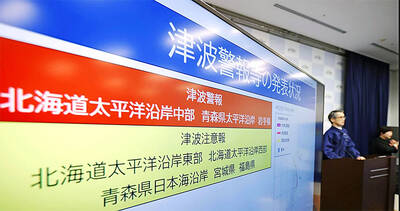
An earthquake registering a preliminary magnitude of 7.7 off northern Japan on Monday prompted a short-lived tsunami alert and the advisory of a higher risk of a possible mega-quake for coastal areas there. The Cabinet Office and the Japan Meteorological Agency said there was a 1% chance for a mega-quake, compared to a 0.1% chance during normal times, in the next week or so following the powerful quake near the Chishima and Japan trenches. Officials said the advisory was not a quake prediction but urged residents in 182 towns along the northeastern coasts to raise their preparedness while continuing their daily lives. Prime


 RSS
RSS