


Families of the victims of Australia’s Bondi Beach mass shootings yesterday called for a national inquiry into anti-Semitism and alleged failures in policing, intelligence and policy they blame for the attack.
Father and son Sajid and Naveed Akram are accused of targeting a Hanukkah event on Sydney’s Bondi Beach on Dec. 14, killing 15 people and wounding dozens in what authorities have described as an anti-Semitic terrorist attack.
Seventeen families urged Australian Prime Minister Anthony Albanese in an open letter to “immediately establish a Commonwealth Royal Commission into the rapid rise of anti-Semitism in Australia” and examine “law enforcement, intelligence, and policy failures that led to the Bondi Beach massacre.”
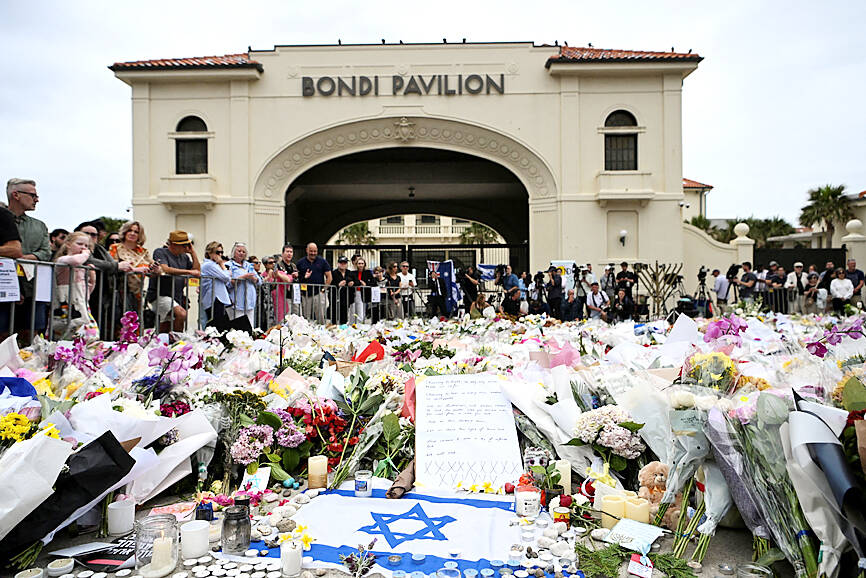
Photo: Reuters
“We demand answers and solutions,” they wrote. “We need to know why clear warning signs were ignored, how anti-Semitic hatred and Islamic extremism were allowed to dangerously grow unchecked, and what changes must be made to protect all Australians going forward.”
Albanese has resisted calls for a federal inquiry, citing a need for urgent action rather than waiting “years for answers.”
“We need to get on with any changes that are required,” he told reporters yesterday.
“I have nothing except sympathy for those families. My job, as prime minister, is to look at how we build unity, how we build social cohesion, how we do what the nation needs at what is a very difficult time,” he said.
Albanese last week said that a New South Wales-led royal commission — where the shooting occurred — would suffice and promised full support.
Canberra has flagged a suite of reforms to gun ownership and hate speech laws, as well as a review of police and intelligence services.
Australian Minister of Home Affairs Tony Burke yesterday said that a national royal commission could give “some of the worst statements and worst voices” a platform to relive “the worst examples of anti-Semitism over the last two years,” which he said was not in the interest of unity or national security.
However, the families of those killed said the federal government’s response is “not nearly enough.”
“We have lost parents, spouses, children and grandparents. Our loved ones were celebrating Chanukah at Bondi Beach, a festival of light and joy, in an iconic public space that should have been safe,” the letter said. “You owe us answers. You owe us accountability. And you owe Australians the truth.”
The families said the rise of anti-Semitism was a “national crisis,” adding that the “threat was not going away.”
“We need strong action now. We need leadership now. You cannot bring back our loved ones. But with a well-led Commonwealth Royal Commission and strong action, you may be able to save many more,” they said.
The call for a royal commission echoes voices in the broader Jewish community, legal experts and other politicians. Executive Council of Australian Jewry co-CEO Alex Ryvchin said the Australian government was not listening.
“We deserve answers. Only a royal commission has the coercive powers to get to the bottom of how this was allowed to happen and what needs to change in this country to prevent the next massacre,” he told national broadcaster ABC.
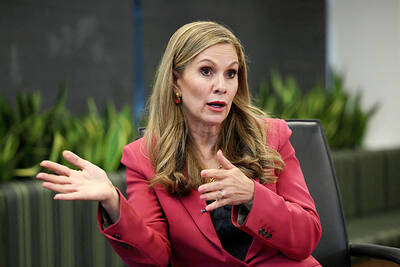
Australians were downloading virtual private networks (VPNs) in droves, while one of the world’s largest porn distributors said it was blocking users from its platforms as the country yesterday rolled out sweeping online age restriction. Australia in December became the first country to impose a nationwide ban on teenagers using social media. A separate law now requires artificial intelligence (AI)-powered chatbot services to keep certain content — including pornography, extreme violence and self-harm and eating disorder material — from minors or face fines of up to A$49.5 million (US$34.6 million). The country also joined Britain, France and dozens of US states requiring
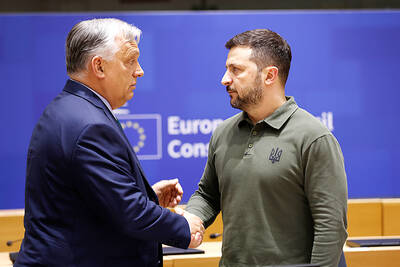
Hungarian authorities temporarily detained seven Ukrainian citizens and seized two armored cars carrying tens of millions of euros in cash across Hungary on suspicion of money laundering, officials said on Friday. The Ukrainians were released on Friday, following their detention on Thursday, but Hungarian officials held onto the cash, prompting Ukraine to accuse Hungary’s Russia-friendly government of illegally seizing the money. “We will not tolerate this state banditism,” Ukrainian Minister of Foreign Affairs Andrii Sybiha said. The seven detained Ukrainians were employees of the Ukrainian state-owned Oschadbank, who were traveling in the two armored cars that were carrying the money between Austria and
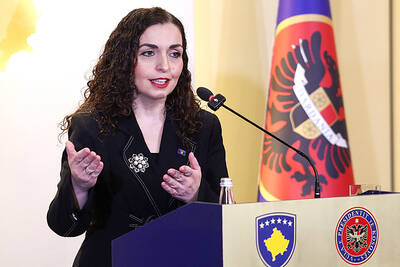
Kosovar President Vjosa Osmani on Friday after dissolving the Kosovar parliament said a snap election should be held as soon as possible to avoid another prolonged political crisis in the Balkan country at a time of global turmoil. Osmani said it is important for Kosovo to wrap up the upcoming election process and form functional institutions for political stability as the war rages in the Middle East. “Precisely because the geopolitical situation is that complex, it is important to finish this electoral process which is coming up,” she said. “It is very hard now to imagine what will happen next.” Kosovo, which declared

MORE BANS: Australia last year required sites to remove accounts held by under-16s, with a few countries pushing for similar action at an EU level and India considering its own ban Indonesia on Friday said it would ban social media access for children under 16, citing threats from online pornography, cyberbullying, online fraud and Internet addiction. “Accounts belonging to children under 16 on high-risk platforms will start to be deactivated, beginning with YouTube, TikTok, Facebook, Instagram, Threads, X, Bigo Live and Roblox,” Indonesian Minister of Communications and Digital Meutya Hafid said. “The government is stepping in so that parents no longer have to fight alone against the giants of the algorithm. Implementation will begin on March 28, 2026,” she said. The social media ban would be introduced in stages “until all platforms fulfill their


 RSS
RSS