


Former Brazilian president Jair Bolsonaro on Saturday underwent a medical procedure to treat recurrent hiccups he has been dealing with for months, his medical team said.
The 70-year-old former Brazilian president, who is serving a 27-year prison sentence for an attempted coup, had been released from prison on Wednesday last week to undergo surgery for a groin hernia at the DF Star Hospital in Brasilia.
That surgery was performed on Thursday without incident, and Bolsonaro remained hospitalized for several days for evaluation.
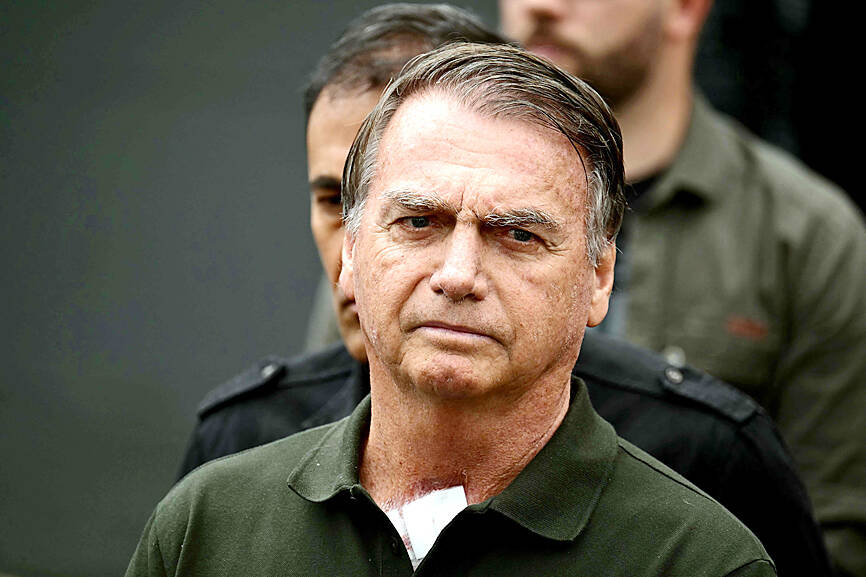
Photo: AFP
During that time, Bolsonaro’s medical team determined it was necessary to perform an anesthetic block of the phrenic nerve — which controls the diaphragm — to treat his recurring hiccups.
Bolsonaro’s doctor, Claudio Birolini, told reporters on Thursday that the procedure involved locating the nerve using an ultrasound machine and then injecting it with a local analgesic.
The procedure on Saturday “went well,” said Mateus Saldanha, another of the doctors.
Birolini said the process took about an hour, adding that “it’s not surgery... It does not involve any incisions.”
The right side of the nerve was treated on Saturday, and a procedure to treat the left side of the nerve is set for today.
“My love just went to the surgical center to have his phrenic nerve blocked,” former Brazilian first lady Michelle Bolsonaro wrote in an Instagram post on Saturday.
“It’s been nine months of struggle and anguish with daily hiccups,” she added.
The far-right former president, who was in power from 2019 to 2022, has for years been dealing with the aftermath of an abdominal stab wound he sustained during a 2018 campaign rally, requiring several major surgeries.
In September, Brazilian Supreme Court found Bolsonaro guilty of conspiring to stay in power after losing the 2022 election to Brazilian President Luiz Inacio Lula da Silva, and handed him a 27-year prison sentence.
The coup failed due to a lack of support from the top military brass. The far-right ex-president has claimed his innocence, claiming he was being persecuted by the Supreme Court.
Bolsonaro was under house arrest from August until his imprisonment on Nov. 22.
Once discharged from the hospital, Bolsonaro would return to serving his sentence at a federal police jail in the capital.
The Supreme Court on Saturday also ordered house arrest for 10 officials from Bolsonaro’s administration who were involved in planning the coup plot, sought legal justification for it, or spread disinformation about it on social media. The 10 officials had been convicted, but were out of prison due to pending appeals. One of the officials, Silvinei Vasques, was detained on Friday in Paraguay after he allegedly tried to board a flight with false papers.

Australians were downloading virtual private networks (VPNs) in droves, while one of the world’s largest porn distributors said it was blocking users from its platforms as the country yesterday rolled out sweeping online age restriction. Australia in December became the first country to impose a nationwide ban on teenagers using social media. A separate law now requires artificial intelligence (AI)-powered chatbot services to keep certain content — including pornography, extreme violence and self-harm and eating disorder material — from minors or face fines of up to A$49.5 million (US$34.6 million). The country also joined Britain, France and dozens of US states requiring
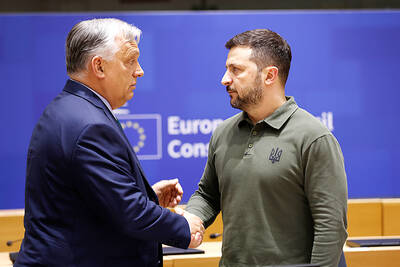
Hungarian authorities temporarily detained seven Ukrainian citizens and seized two armored cars carrying tens of millions of euros in cash across Hungary on suspicion of money laundering, officials said on Friday. The Ukrainians were released on Friday, following their detention on Thursday, but Hungarian officials held onto the cash, prompting Ukraine to accuse Hungary’s Russia-friendly government of illegally seizing the money. “We will not tolerate this state banditism,” Ukrainian Minister of Foreign Affairs Andrii Sybiha said. The seven detained Ukrainians were employees of the Ukrainian state-owned Oschadbank, who were traveling in the two armored cars that were carrying the money between Austria and
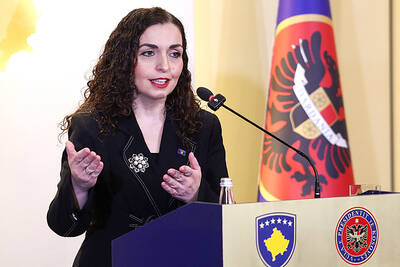
Kosovar President Vjosa Osmani on Friday after dissolving the Kosovar parliament said a snap election should be held as soon as possible to avoid another prolonged political crisis in the Balkan country at a time of global turmoil. Osmani said it is important for Kosovo to wrap up the upcoming election process and form functional institutions for political stability as the war rages in the Middle East. “Precisely because the geopolitical situation is that complex, it is important to finish this electoral process which is coming up,” she said. “It is very hard now to imagine what will happen next.” Kosovo, which declared

MORE BANS: Australia last year required sites to remove accounts held by under-16s, with a few countries pushing for similar action at an EU level and India considering its own ban Indonesia on Friday said it would ban social media access for children under 16, citing threats from online pornography, cyberbullying, online fraud and Internet addiction. “Accounts belonging to children under 16 on high-risk platforms will start to be deactivated, beginning with YouTube, TikTok, Facebook, Instagram, Threads, X, Bigo Live and Roblox,” Indonesian Minister of Communications and Digital Meutya Hafid said. “The government is stepping in so that parents no longer have to fight alone against the giants of the algorithm. Implementation will begin on March 28, 2026,” she said. The social media ban would be introduced in stages “until all platforms fulfill their


 RSS
RSS