


Throngs of feral cats emerged from the shade of parked trucks and bushes as soon as the familiar Subaru Forester pulled into a dump on Hawaii’s Big Island. They ran after the vehicle to a certain meal — a gravy train that might not be around much longer.
A Hawaii County law set to take effect at the start of the new year bans feeding feral animals on county property. It is an effort to protect native species, such as an endangered goose called the nene, from a super predator introduced to the islands by Europeans in the 18th century.
The measure does not sit well with many cat lovers, including the driver of the Subaru, Liz Swan, who has been feeding feral felines on Big Island for 33 years.
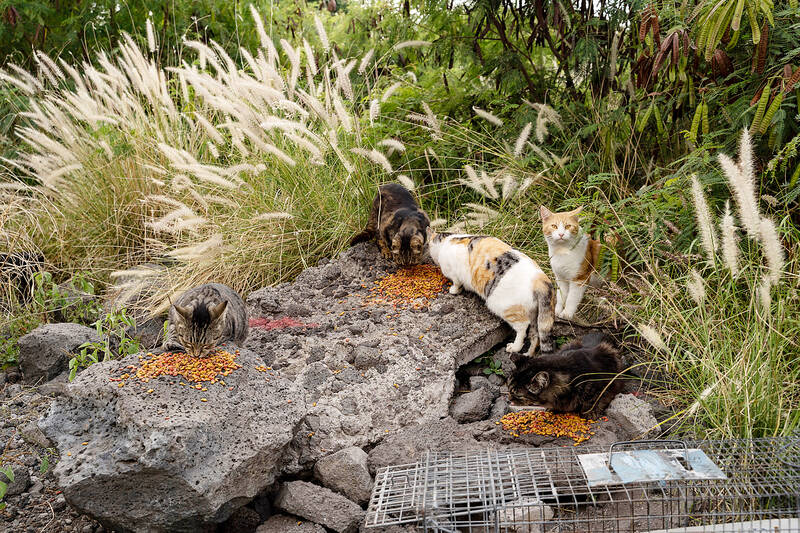
Photo: AP
“I don’t believe the cats should be exterminated at the expense of the nene,” Swan said. “They’re both living creatures.”
It is unclear how many feral cats — abandoned pets and their descendants — live on the Big Island. Estimates range well into the tens of thousands, with pockets of dense colonies supported by people.
Opponents of the ban said it would hamper their efforts to contain the population by trapping and neutering the animals — and that hungry cats would then have to hunt for food.

Photo: AP
About 200 cats live at the Kealakehe Transfer Station and Recycling Center, not far from the bustling tourist district of Kona. Swan shows up every late afternoon with water and kibble, and said she has never seen a nene anywhere near the dump. Despite living amid trash, the cats there generally appear robust, most of them missing the tip of an ear, indicating they have been spayed or neutered.
The cats threaten the native species directly — by killing them — and indirectly, biologists said. Food left out for the cats could attract native animals, bringing them into closer contact with humans. Cat feces could also spread a parasite that causes toxoplasmosis, a disease that has killed endangered Hawaiian monk seals and native birds.
Last year, a male nene was struck and killed by a car as it crossed a road in Hilo, on the eastern side of the island, to reach a cat feeding station. The goose’s surviving mate, which also had a gosling die of toxoplasmosis last year, has recently taken on another partner and is nesting in a Hilo park, the state Department of Land and Natural Resources announced this month.
The feeding ban would help protect them, the department said.
State wildlife biologist Raymond McGuire recently checked for nene nesting sites among the barren black-rock fields near a shopping center at the Waikoloa resort.
It is not their traditional habitat, but he has seen the geese fly in to grab food — risking getting hit by cars — and last year some nested there, he said.
As he approached, a pair of feline eyes peered out of a crack in the lava rock. Cats emerged from their nooks, perhaps mistaking him for someone who might offer food.
McGuire was relieved to see there were no nene nearby, but frustrated with evidence the cats are being fed: empty water bowls and aluminum pans.
He is a cat owner, but as a Hawaiian whose love of nature inspired him to pursue conservation work, he said he believed there is no room for them where native species are struggling to survive.
“There’s so many birds that my kids will never see, that I got to see,” he said, referring to native forest birds. “I think about my ancestors and I do wonder: Are we honoring them well in what we do? Because they did take steps to protect them.”
Feral cats are a problem in many places, but Hawaii’s sensitive ecosystem is full of species that evolved without mammalian predators, making them especially vulnerable, McGuire said.
Hawaiian culture is closely tied to Hawaii’s animals; aumakua, or ancestral spirit guides, could take animal form, Big Island Mayor Kimo Alameda said.
After the county council passed the measure, Alameda decided to let it take effect without his signature. Opponents persuaded him it would harm the cats.
The mayor said he hoped police consider enforcement a low priority.
Cultural practitioner Makaala Kaaumoana said that trapping, neutering and releasing cats makes no difference, because they can still hunt, adding that they have to be removed.
Debbie Cravatta, who feeds cats in her neighborhood, questioned why.
“It’s a native species — why does that reign over a domestic cat that somebody dumped out pregnant and that had six kittens out in the wild?” Cravatta said. “Why is that life more valuable than this life?”

Yemen’s separatist leader has vowed to keep working for an independent state in the country’s south, in his first social media post since he disappeared earlier this month after his group briefly seized swathes of territory. Aidarous al-Zubaidi’s United Arab Emirates (UAE)-backed Southern Transitional Council (STC) forces last month captured two Yemeni provinces in an offensive that was rolled back by Saudi strikes and Riyadh’s allied forces on the ground. Al-Zubaidi then disappeared after he failed to board a flight to Riyadh for talks earlier this month, with Saudi Arabia accusing him of fleeing to Abu Dhabi, while supporters insisted he was

The Chinese Embassy in Manila yesterday said it has filed a diplomatic protest against a Philippine Coast Guard spokesman over a social media post that included cartoonish images of Chinese President Xi Jinping (習近平). Philippine Coast Guard spokesman Jay Tarriela and an embassy official had been trading barbs since last week over issues concerning the disputed South China Sea. The crucial waterway, which Beijing claims historic rights to despite an international ruling that its assertion has no legal basis, has been the site of repeated clashes between Chinese and Philippine vessels. Tarriela’s Facebook post on Wednesday included a photo of him giving a

Syrian President Ahmed al-Sharaa on Sunday announced a deal with the chief of Kurdish-led forces that includes a ceasefire, after government troops advanced across Kurdish-held areas of the country’s north and east. Syrian Kurdish leader Mazloum Abdi said he had agreed to the deal to avoid a broader war. He made the decision after deadly clashes in the Syrian city of Raqa on Sunday between Kurdish-led forces and local fighters loyal to Damascus, and fighting this month between the Kurds and government forces. The agreement would also see the Kurdish administration and forces integrate into the state after months of stalled negotiations on

‘MOBILIZED’: While protesters countered ICE agents, Minnesota Governor Tim Walz activated the state’s National Guard to ‘support the rights of Minnesotans’ to assemble Hundreds of counterprotesters drowned out a far-right activist’s attempt to hold a small rally in support of US President Donald Trump’s latest immigration crackdown in Minneapolis, Minnesota, on Saturday, as the governor’s office announced that National Guard troops were mobilized and ready to assist law enforcement, although not yet deployed to city streets. There have been protests every day since the US Department of Homeland Security (DHS) ramped up immigration enforcement in the Twin Cities of Minneapolis and Saint Paul by bringing in more than 2,000 federal officers. Conservative influencer Jake Lang organized an anti-Islam, anti-Somali and pro-US Immigration and Customs Enforcement


 RSS
RSS