


Waymo on Tuesday said that it would update software used to operate its self-driving vehicles and improve its emergency response protocols after its robotaxis stalled in parts of San Francisco on Saturday due to a widespread power outage that snarled traffic and gridlocked parts of the city.
Waymo paused services on Saturday evening following a fire at a PG&E substation that knocked out power to about one-third of the city, affecting about 130,000 residents and forcing some businesses to close temporarily.
Videos posted on social media showed Waymo robotaxis stuck at intersections with their hazard lights on as traffic lights stopped working due to the outage.
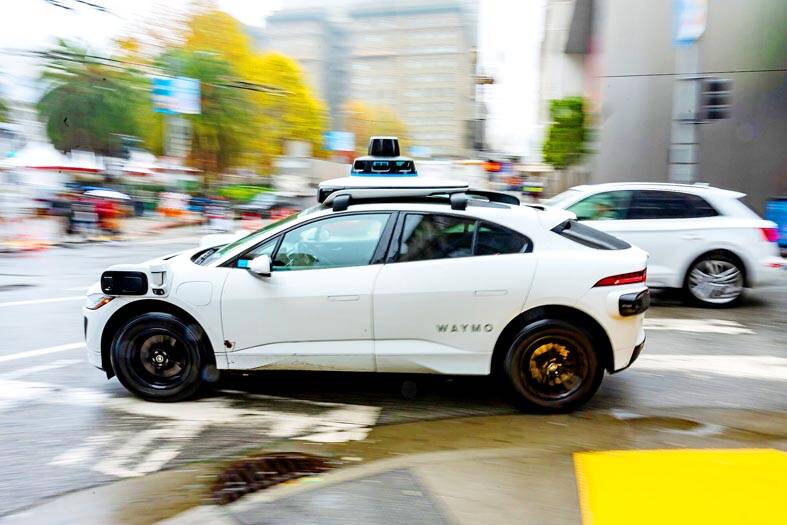
Photo: Bloomberg
Waymo said its self-driving vehicles are designed to handle dark traffic signals at four-way stops, but they might occasionally request a confirmation check.
“While we successfully traversed more than 7,000 dark signals on Saturday, the outage created a concentrated spike in these requests,” Waymo said. “This created a backlog that, in some cases, led to response delays contributing to congestion on already-overwhelmed streets.”
Waymo said the confirmation protocols made sense during early deployment, but it is refining them to match the company’s current scale.
Waymo is implementing fleet-wide updates that provide vehicles with “specific power outage context, allowing it to navigate more decisively.”
Waymo also said it would improve its emergency response protocols by incorporating lessons from this event.
Waymo, which has a fleet of more than 2,500 vehicles operating in the bay area of San Francisco; Los Angeles; Metro Phoenix, Arizona; Austin, Texas; and Atlanta, Georgia, said it resumed its ride-hailing service in the San Francisco bay area on Sunday.
On Monday, the California Public Utilities Commission said that it was reviewing the issue of stalled Waymo vehicles.
The commission, along with the California Department of Motor Vehicles, regulates and issues permits for testing and commercial deployment of robotaxis.

Crowds in Bangladesh are flocking to snap photographs with an unlikely social media star — an albino buffalo with flowing blond hair nicknamed “Donald Trump” that is due to be sacrificed within days. Owner Zia Uddin Mridha, 38, said his brother named the 700kg bull over its flowing helmet of hair resembling the signature look of the US president. “My younger brother picked this name because of the buffalo’s extraordinary hair,” he said at his farm in Narayanganj, just outside the capital, Dhaka. Mridha said that a constant stream of curious visitors — social media fans, onlookers and children — have come throughout

It began as a satirical online project. Now millions of young people in India are flocking to it as an outlet for their frustration. A parody political party called the Cockroach Janta Party, with the insect as its symbol, has exploded across India’s social media by turning absurdist humor into protest. Memes and short videos mocking corruption, joblessness and political dysfunction have flooded social media sites, where millions of users are embracing the cockroach — known for its ability to survive harsh conditions — as a tongue-in-cheek symbol of endurance. The online movement’s rise has been unusually rapid. The Cockroach Janta Party (CJP)

HOTTER: While Indians are accustomed to summer heat, climate change has caused northwestern India to warm faster than other parts of the country, an academic said Roads and markets have emptied during afternoons and some farmers have switched to nighttime work to avoid scorching temperatures as a heat wave grips large parts of India. The India Meteorological Department forecast maximum temperatures for yesterday of about 45°C in the capital, New Delhi, where authorities have opened temporary “cooling zones” to help people cope. The weather department warned that conditions would likely persist across several northern regions in the coming days, with temperatures staying well above seasonal averages. Authorities urged people to stay indoors during the hottest hours and take precautions against heat-related illnesses. India declares a heat wave whenever maximum temperatures

A Hong Kong astronaut is to join a Chinese space mission for the first time as part of a three-person crew launching today, as Beijing edges closer to its goal of landing people on the moon. The Tiangong space station — crewed by teams of three astronauts that are typically rotated every six months — is the crown jewel of China’s space program, boosted by billions in state investment in a bid to catch up with the US and Russia. The Shenzhou-23 mission is to blast off at 11:08pm from the Jiuquan Satellite Launch Center in northwestern China, carrying three astronauts to


 RSS
RSS