


Japanese Prime Minister Sanae Takaichi’s support ratings held steady at historically high levels, polls conducted over the weekend showed, in a sign of her continued popularity despite the fallout from a dispute with China over comments she made on Taiwan last month.
Surveys conducted over the weekend showed that about 70 percent of respondents supported Takaichi’s administration.
The Nikkei put her approval rating at 75 percent, the Yomiuri Shimbun at 73 percent and Kyodo News at 67.5 percent, while the Asahi and Mainichi newspapers put the figure at 68 percent and 67 percent respectively. An FNN poll gave the prime minister a support rating of 75.9 percent.
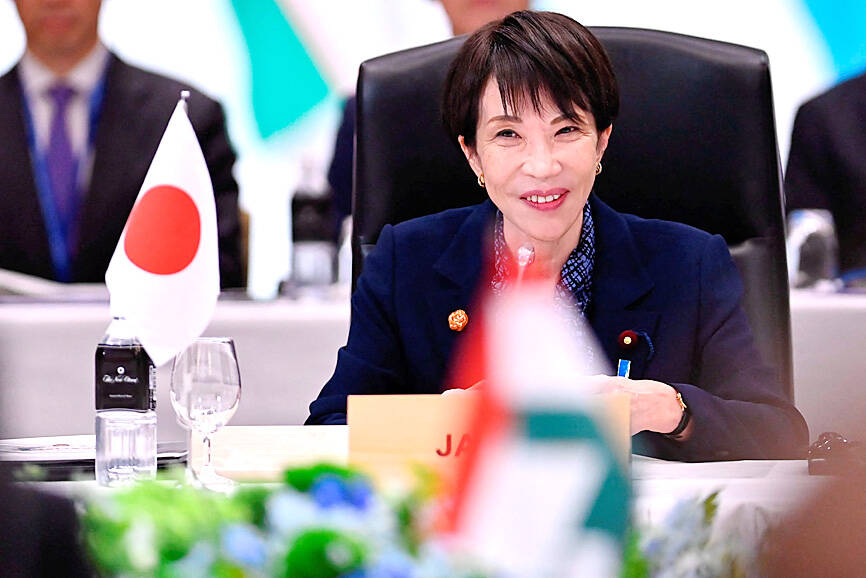
Photo: Reuters
The poll results tracked a continued trend since she became the first woman to take the top job in October. She took over as the ruling bloc’s grip on power was weakened by its loss of majorities in both chambers of parliament.
Since then, she has weathered the collapse of a long-standing coalition between her Liberal Democratic Party (LDP) and Komeito, and ushered in a new partnership with the Japan Innovation Party, as well as the influx of a handful of independent lawmakers, who allowed her to reclaim a razor thin majority in the lower house.
Takaichi has also passed an extra budget, specifically meant to help households cope with inflation, with the help of some opposition parties.
Her ratings are the highest for a Japanese prime minister in about two decades stretching back to the administration of Junichiro Koizumi, Yomiuri reported.
Takaichi has had to navigate the ire of China after she said that a Chinese invasion of Taiwan could possibly be a “survival-threatening situation” — a legal justification for Japan to deploy troops to aid other countries in a contingency.
China has sought a retraction of the comments, but Takaichi has refused to do so, saying that Japan’s policy on Taiwan remains unchanged.
Beijing has since railed against Tokyo, inflicting economic and diplomatic threats by warning its citizens against traveling to Japan and sending letters of complaint to the UN. Tokyo has also alleged that Chinese fighter jets trained fire-control radars on at least one of its jets.
A majority of respondents have supported Takaichi’s stance against China. People who said they agreed with Takaichi’s position on China amounted to 55 percent in the Asahi poll, while 30 percent disagreed. The Kyodo poll showed that 57 percent of respondents did not think Takaichi’s comments were careless.
However, the public appears to be wary of the impact from the dispute. The Nikkei poll showed that 46 percent were concerned about the economic impact of a deterioration in ties between Tokyo and Beijing, while 48 percent said they were not concerned.
Fifty-three percent of respondents were at least partially concerned about the economic impact in a separate Asahi poll, while the Kyodo poll put that rate at 59.9 percent.

Australians were downloading virtual private networks (VPNs) in droves, while one of the world’s largest porn distributors said it was blocking users from its platforms as the country yesterday rolled out sweeping online age restriction. Australia in December became the first country to impose a nationwide ban on teenagers using social media. A separate law now requires artificial intelligence (AI)-powered chatbot services to keep certain content — including pornography, extreme violence and self-harm and eating disorder material — from minors or face fines of up to A$49.5 million (US$34.6 million). The country also joined Britain, France and dozens of US states requiring

Hungarian authorities temporarily detained seven Ukrainian citizens and seized two armored cars carrying tens of millions of euros in cash across Hungary on suspicion of money laundering, officials said on Friday. The Ukrainians were released on Friday, following their detention on Thursday, but Hungarian officials held onto the cash, prompting Ukraine to accuse Hungary’s Russia-friendly government of illegally seizing the money. “We will not tolerate this state banditism,” Ukrainian Minister of Foreign Affairs Andrii Sybiha said. The seven detained Ukrainians were employees of the Ukrainian state-owned Oschadbank, who were traveling in the two armored cars that were carrying the money between Austria and

Kosovar President Vjosa Osmani on Friday after dissolving the Kosovar parliament said a snap election should be held as soon as possible to avoid another prolonged political crisis in the Balkan country at a time of global turmoil. Osmani said it is important for Kosovo to wrap up the upcoming election process and form functional institutions for political stability as the war rages in the Middle East. “Precisely because the geopolitical situation is that complex, it is important to finish this electoral process which is coming up,” she said. “It is very hard now to imagine what will happen next.” Kosovo, which declared

MORE BANS: Australia last year required sites to remove accounts held by under-16s, with a few countries pushing for similar action at an EU level and India considering its own ban Indonesia on Friday said it would ban social media access for children under 16, citing threats from online pornography, cyberbullying, online fraud and Internet addiction. “Accounts belonging to children under 16 on high-risk platforms will start to be deactivated, beginning with YouTube, TikTok, Facebook, Instagram, Threads, X, Bigo Live and Roblox,” Indonesian Minister of Communications and Digital Meutya Hafid said. “The government is stepping in so that parents no longer have to fight alone against the giants of the algorithm. Implementation will begin on March 28, 2026,” she said. The social media ban would be introduced in stages “until all platforms fulfill their


 RSS
RSS