


What lies ahead after Myanmar’s forthcoming elections?
The answer is hidden in the alignment of the stars, the occult flame of black magic candles and sacred geometry visible only to the third eye — if you believe the country’s spiritual soothsayers.
“The question most people ask is clear: When will Myanmar prosper?” astrologer Linn Nhyo Taryar said.
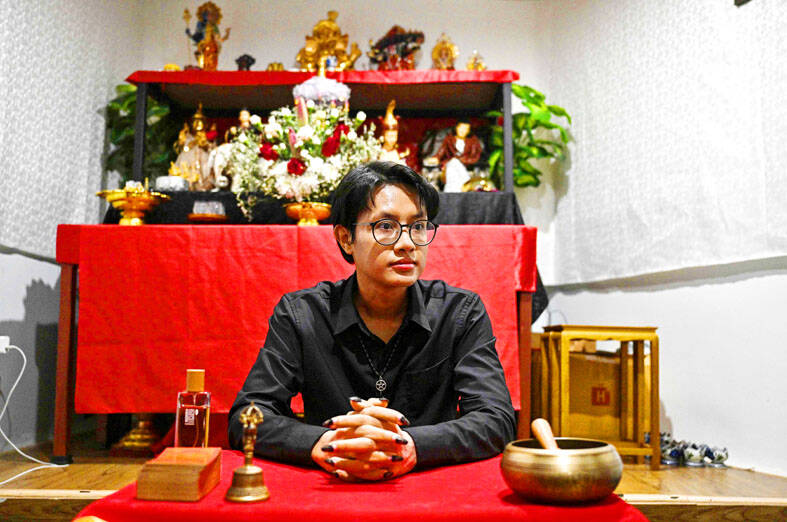
Photo: AFP
Five years ago, Myanmar’s future seemed more certain. The country had enjoyed a decade-long democratic experiment after a history of hermetic military rule.
However, a 2021 military coup toppled the government, triggering civil war and precarity — from regular internet outages to life-or-death combat zone crises.
Sunday presents fresh uncertainty, as voting is set to start in a phased election being rejected by rebels and criticized abroad as a ploy to rebrand military rule.
Myanmar has a rich culture of fortune-telling, and many believe the future can be discerned by mystics.
The poll’s outcome, some reckon, could even be swayed with “Yadaya” — magic rituals thought to steer fate.
“People struggling with trouble turn to fortune-telling and Yadaya, seeking the power and belief derived from it,” Linn Nhyo Taryar said.
“What people really want is a safe and secure life and future,” the 30-year-old said.
Linn Nhyo Taryar’s past has been anything but safe and secure, thanks to his prophesying.
As protests erupted after the coup — which he claims to have seen coming — he put a “Nine Swords, Nine Needles” hex on military chief Min Aung Hlaing, calling on social media for other mystics to do the same.
The ritual of candles arranged atop knives set out in a star pattern earned him two years in Yangon’s Insein Prison — notorious for alleged brutal rights abuses — for “causing fear or alarm” and inducing others to attack the state.
Post-release he lives in self-exile in Bangkok, communing online with clients back in Myanmar.
Myanmar’s culture is profoundly influenced by Buddhism-inflected supernaturalism.
Astrologers consult a national zodiac, palm readers ring pagodas, would-be alchemists attempt to transmute mercury into gold and SIM card companies advertise dial-a-diviners.
Mysticism also holds sway behind the closed door of politics.
Previous military ruler Ne Win changed the rules of the road, requiring vehicles to swap driving lanes — supposedly the result of misconstrued astrological advice to shift his left-wing regime to the political right.
An avid numerologist, in 1987, he issued new currency in denominations of nine — a digit considered auspicious, but bewildering shoppers with mental arithmetic.
Demonstrations forced Ne Win’s resignation, but Myanmar’s military chain of command continued to Min Aung Hlaing, also rumored to be motivated by superstition.
With ousted leader Aung San Suu Kyi jailed incommunicado and her party dissolved, analysts suggest the month-long poll would prolong Min Aung Hlaing’s rule under a civilian banner.
However, the country’s most popular horoscope forecasting the Buddhist new year starting in early next year, touted by street vendors nationwide in recent days, contains clashing portents.
Myanmar Calendar Advisory Board members predict that those born on a Tuesday under a lion zodiac — like Min Aung Hlaing and Suu Kyi — “will find that the more opposition they face, the more successful they become.”
“They are likely to be well and gain special privileges wherever they are,” it says, advising Yadaya practitioners to leave buttered rice at a home Buddha shrine.
In Yangon, Min Thein Kyaw has read the cards.
“Myanmar holds good potential for the coming year,” the 73-year-old said. “However, for any prediction to fully succeed, three factors must align: time, place and the individual.”
In tumultuous Myanmar, even clairvoyants urge caution.
“There are also many things that need to be watched out for. Vigilance is key,” Min Thein Kyaw said. “Just as every individual needs to possess mindfulness, morality and wisdom — people in power must also possess these.”
Australians were downloading virtual private networks (VPNs) in droves, while one of the world’s largest porn distributors said it was blocking users from its platforms as the country yesterday rolled out sweeping online age restriction. Australia in December became the first country to impose a nationwide ban on teenagers using social media. A separate law now requires artificial intelligence (AI)-powered chatbot services to keep certain content — including pornography, extreme violence and self-harm and eating disorder material — from minors or face fines of up to A$49.5 million (US$34.6 million). The country also joined Britain, France and dozens of US states requiring

Hungarian authorities temporarily detained seven Ukrainian citizens and seized two armored cars carrying tens of millions of euros in cash across Hungary on suspicion of money laundering, officials said on Friday. The Ukrainians were released on Friday, following their detention on Thursday, but Hungarian officials held onto the cash, prompting Ukraine to accuse Hungary’s Russia-friendly government of illegally seizing the money. “We will not tolerate this state banditism,” Ukrainian Minister of Foreign Affairs Andrii Sybiha said. The seven detained Ukrainians were employees of the Ukrainian state-owned Oschadbank, who were traveling in the two armored cars that were carrying the money between Austria and
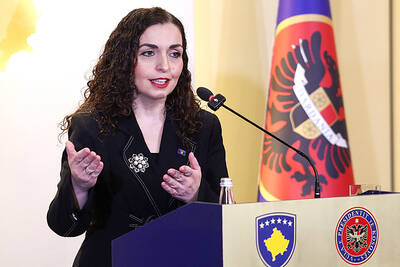
Kosovar President Vjosa Osmani on Friday after dissolving the Kosovar parliament said a snap election should be held as soon as possible to avoid another prolonged political crisis in the Balkan country at a time of global turmoil. Osmani said it is important for Kosovo to wrap up the upcoming election process and form functional institutions for political stability as the war rages in the Middle East. “Precisely because the geopolitical situation is that complex, it is important to finish this electoral process which is coming up,” she said. “It is very hard now to imagine what will happen next.” Kosovo, which declared

MORE BANS: Australia last year required sites to remove accounts held by under-16s, with a few countries pushing for similar action at an EU level and India considering its own ban Indonesia on Friday said it would ban social media access for children under 16, citing threats from online pornography, cyberbullying, online fraud and Internet addiction. “Accounts belonging to children under 16 on high-risk platforms will start to be deactivated, beginning with YouTube, TikTok, Facebook, Instagram, Threads, X, Bigo Live and Roblox,” Indonesian Minister of Communications and Digital Meutya Hafid said. “The government is stepping in so that parents no longer have to fight alone against the giants of the algorithm. Implementation will begin on March 28, 2026,” she said. The social media ban would be introduced in stages “until all platforms fulfill their


 RSS
RSS