


At least 16 files disappeared from the US Department of Justice’s (DOJ) public Web site for documents related to Jeffrey Epstein — including a photograph showing US President Donald Trump — less than a day after they were posted, with no explanation from the government and no notice to the public.
The missing files, which were available on Friday and no longer accessible by Saturday, included images of paintings depicting nude women, and one showing a series of photographs along a credenza and in drawers. In that image, inside a drawer among other photos, was a photograph of Trump, alongside Epstein, Melania Trump and Epstein’s longtime associate Ghislaine Maxwell.
The DOJ did not answer questions on Saturday about why the files disappeared, but wrote on social media that “photos and other materials will continue being reviewed and redacted consistent with the law in an abundance of caution as we receive additional information.”
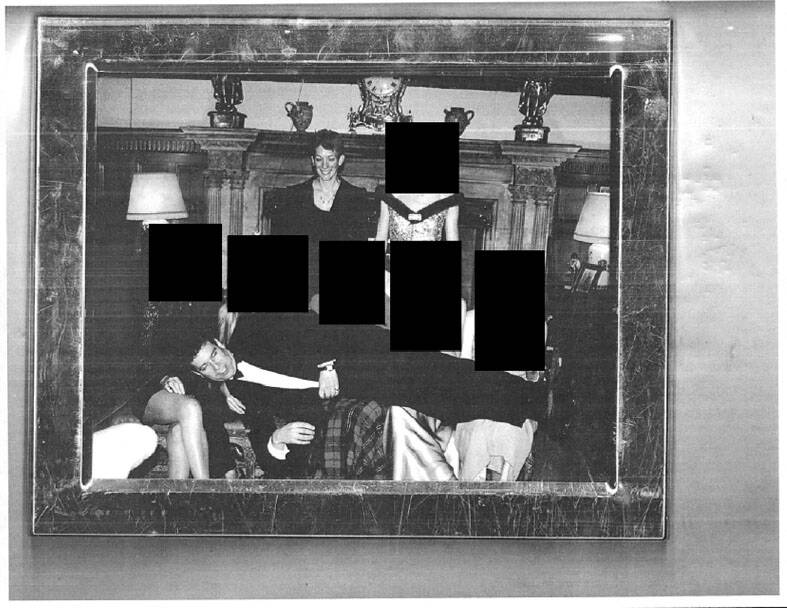
Photo: US Department of Justice Handout via REUTERS
The episode deepened concerns that had already emerged from the much-anticipated document release. The tens of thousands of pages made public offered little new insight into Epstein’s crimes or the prosecutorial decisions that allowed him to avoid serious federal charges for years, while omitting some of the most closely watched materials.
Some of the most consequential records about Epstein are nowhere to be found in the initial disclosures
Missing are FBI interviews with survivors and internal memos examining charging decisions — records that could have helped explain how investigators viewed the case and why Epstein was allowed in 2008 to plead guilty to a relatively minor state-level prostitution charge.
The records, required to be released under a recent law passed by the US Congress, hardly reference several powerful figures long associated with Epstein, including former British prince Andrew, renewing questions about who was scrutinized, who was not, and how much the disclosures truly advance public accountability.
Despite a Friday deadline set by the Congress to make everything public, the DOJ said it plans to release records on a rolling basis.
It blamed the delay on the time-consuming process of obscuring survivors’ names and other identifying information. The department has not given any notice when more records might arrive.
That approach angered some Epstein accusers and members of the Congress. Instead of marking the end of a years-long battle for transparency, the document release Friday was merely the beginning of an indefinite wait for a complete picture of Epstein’s crimes and the steps taken to investigate them.
“I feel like again the DOJ, the justice system is failing us,” said Marina Lacerda, who alleges Epstein started sexually abusing her at his New York City mansion when she was 14.
The documents just made public were a sliver of potentially millions of pages records in the DOJ’s possession. In one example, US Deputy Attorney General Todd Blanche said Manhattan federal prosecutors had more than 3.6 million records from sex trafficking investigations into Epstein and Maxwell, although many duplicated material already turned over by the FBI.
Ones that were new were often lacking necessary context or heavily blacked out. A 119-page document marked “Grand Jury-NY,” likely from one of the federal sex trafficking investigations that led to the charges against Epstein in 2019 or Maxwell in 2021, was entirely blacked out.
Trump’s Republican allies seized on the Clinton images, including photos of the Democrat with singers Michael Jackson and Diana Ross. There were also photos of Epstein with actors Chris Tucker and Kevin Spacey, and even Epstein with TV newscaster Walter Cronkite. However, none of the photos had captions and was no explanation given for why any of them were together.

VAGUE: The criteria of the amnesty remain unclear, but it would cover political violence from 1999 to today, and those convicted of murder or drug trafficking would not qualify Venezuelan Acting President Delcy Rodriguez on Friday announced an amnesty bill that could lead to the release of hundreds of prisoners, including opposition leaders, journalists and human rights activists detained for political reasons. The measure had long been sought by the US-backed opposition. It is the latest concession Rodriguez has made since taking the reins of the country on Jan. 3 after the brazen seizure of then-Venezuelan president Nicolas Maduro. Rodriguez told a gathering of justices, magistrates, ministers, military brass and other government leaders that the ruling party-controlled Venezuelan National Assembly would take up the bill with urgency. Rodriguez also announced the shutdown

Chinese President Xi Jinping’s (習近平) purge of his most senior general is driven by his effort to both secure “total control” of his military and root out corruption, US Ambassador to China David Perdue said told Bloomberg Television yesterday. The probe into Zhang Youxia (張又俠), Xi’s second-in-command, announced over the weekend, is a “major development,” Perdue said, citing the family connections the vice chair of China’s apex military commission has with Xi. Chinese authorities said Zhang was being investigated for suspected serious discipline and law violations, without disclosing further details. “I take him at his word that there’s a corruption effort under
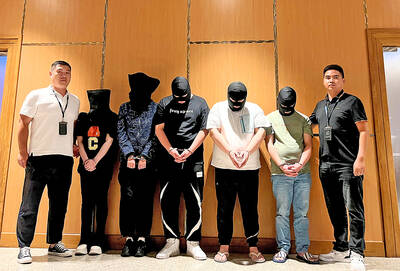
China executed 11 people linked to Myanmar criminal gangs, including “key members” of telecom scam operations, state media reported yesterday, as Beijing toughens its response to the sprawling, transnational industry. Fraud compounds where scammers lure Internet users into fake romantic relationships and cryptocurrency investments have flourished across Southeast Asia, including in Myanmar. Initially largely targeting Chinese speakers, the criminal groups behind the compounds have expanded operations into multiple languages to steal from victims around the world. Those conducting the scams are sometimes willing con artists, and other times trafficked foreign nationals forced to work. In the past few years, Beijing has stepped up cooperation

The dramatic US operation that deposed Venezuelan president Nicolas Maduro this month might have left North Korean leader Kim Jong-un feeling he was also vulnerable to “decapitation,” a former Pyongyang envoy to Havana said. Lee Il-kyu — who served as Pyongyang’s political counselor in Cuba from 2019 until 2023 — said that Washington’s lightning extraction in Caracas was a worst-case scenario for his former boss. “Kim must have felt that a so-called decapitation operation is actually possible,” said Lee, who now works for a state-backed think tank in Seoul. North Korea’s leadership has long accused Washington of seeking to remove it from power


 RSS
RSS