


The administration of US President Donald Trump restricted visas for two Honduran election officials, citing interference in the Central American country’s special vote count.
The US Department of State in a statement on Friday said it revoked the visa of Mario Morazan, a magistrate of the Honduran Electoral Justice Tribunal, and denied a visa application from Marlon Ochoa, a member of the Honduran National Electoral Council. Both belong to the ruling Liberty and Refoundation (Libre) party.
“The United States will not tolerate actions that undermine our national security and our region’s stability,” the statement said. “We will consider all appropriate measures to deter those impeding the vote count in Honduras.”
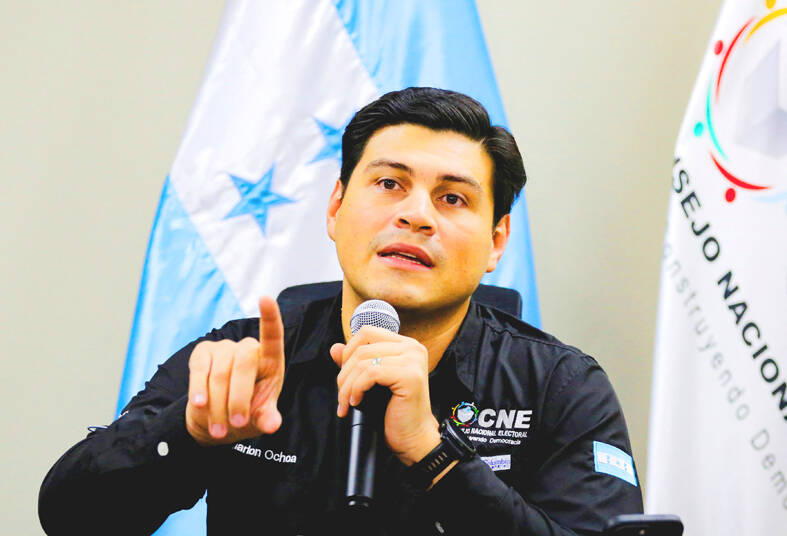
Photo: REUTERS
Nearly 20 days after the elections were held, Hondurans still do not know the results of the presidential race. Due to the narrow margin between the two leading candidates, electoral officials have carried out a special revision of 2,792 ballot boxes that show alleged inconsistencies and errors.
Officials began the special vote count on Thursday after more than a week of the count being paralyzed.
With 99.85 percent of the vote counted so far, conservative candidate Nasry Asfura of the National Party — whom Trump had backed in the lead-up to the election, fueling accusations of election intervention by his opponents — is narrowly leading with 40.24 percent of the vote.
Fellow conservative Salvador Nasralla of the Liberal Party followed with 39.64 percent.
In a distant third place is the ruling party’s candidate, Rixi Moncada of Libre, with 19.12 percent of the vote. Moncada has not recognized the results.
This is the latest example of the Trump administration weighing in on Honduran affairs throughout the election.
Over the past year in office, it has wielded its power in Latin America more aggressively than most US governments in recent history. Trump has openly offered support and funds to right-wing allies, while applying punishing pressure to adversaries, often on the left.
Trump had also pardoned former Honduran president Juan Orlando Hernandez, sentenced by a US court last year to 45 years in prison for his role in a drug trafficking operation.
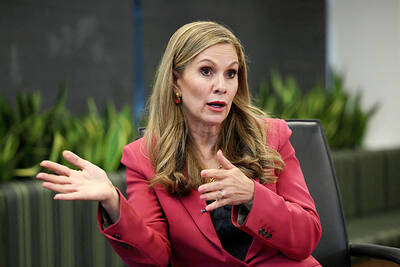
Australians were downloading virtual private networks (VPNs) in droves, while one of the world’s largest porn distributors said it was blocking users from its platforms as the country yesterday rolled out sweeping online age restriction. Australia in December became the first country to impose a nationwide ban on teenagers using social media. A separate law now requires artificial intelligence (AI)-powered chatbot services to keep certain content — including pornography, extreme violence and self-harm and eating disorder material — from minors or face fines of up to A$49.5 million (US$34.6 million). The country also joined Britain, France and dozens of US states requiring
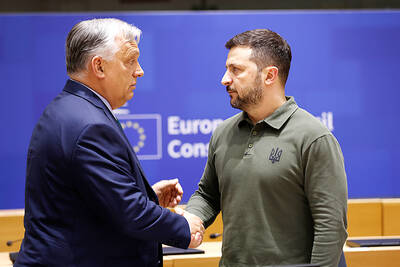
Hungarian authorities temporarily detained seven Ukrainian citizens and seized two armored cars carrying tens of millions of euros in cash across Hungary on suspicion of money laundering, officials said on Friday. The Ukrainians were released on Friday, following their detention on Thursday, but Hungarian officials held onto the cash, prompting Ukraine to accuse Hungary’s Russia-friendly government of illegally seizing the money. “We will not tolerate this state banditism,” Ukrainian Minister of Foreign Affairs Andrii Sybiha said. The seven detained Ukrainians were employees of the Ukrainian state-owned Oschadbank, who were traveling in the two armored cars that were carrying the money between Austria and
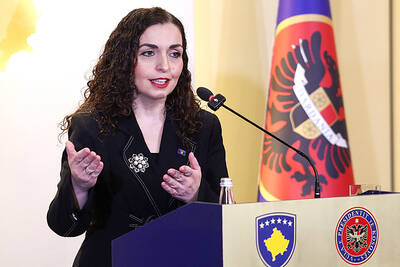
Kosovar President Vjosa Osmani on Friday after dissolving the Kosovar parliament said a snap election should be held as soon as possible to avoid another prolonged political crisis in the Balkan country at a time of global turmoil. Osmani said it is important for Kosovo to wrap up the upcoming election process and form functional institutions for political stability as the war rages in the Middle East. “Precisely because the geopolitical situation is that complex, it is important to finish this electoral process which is coming up,” she said. “It is very hard now to imagine what will happen next.” Kosovo, which declared

MORE BANS: Australia last year required sites to remove accounts held by under-16s, with a few countries pushing for similar action at an EU level and India considering its own ban Indonesia on Friday said it would ban social media access for children under 16, citing threats from online pornography, cyberbullying, online fraud and Internet addiction. “Accounts belonging to children under 16 on high-risk platforms will start to be deactivated, beginning with YouTube, TikTok, Facebook, Instagram, Threads, X, Bigo Live and Roblox,” Indonesian Minister of Communications and Digital Meutya Hafid said. “The government is stepping in so that parents no longer have to fight alone against the giants of the algorithm. Implementation will begin on March 28, 2026,” she said. The social media ban would be introduced in stages “until all platforms fulfill their


 RSS
RSS