


Israeli troops fired over the ceasefire line in the northern Gaza Strip on Friday, killing at least five Palestinians, including a baby, according to a local hospital that received the casualties. The killings came as the tenuous Israel-Hamas truce has stalled in recent weeks.
The five died in Tuffah, an eastern neighborhood in Gaza City, said Rami Mhanna, managing director of Shifa Hospital.
Israel’s military said troops identified “a number of suspicious individuals ... in command structures west of the Yellow Line,” and fired at them.
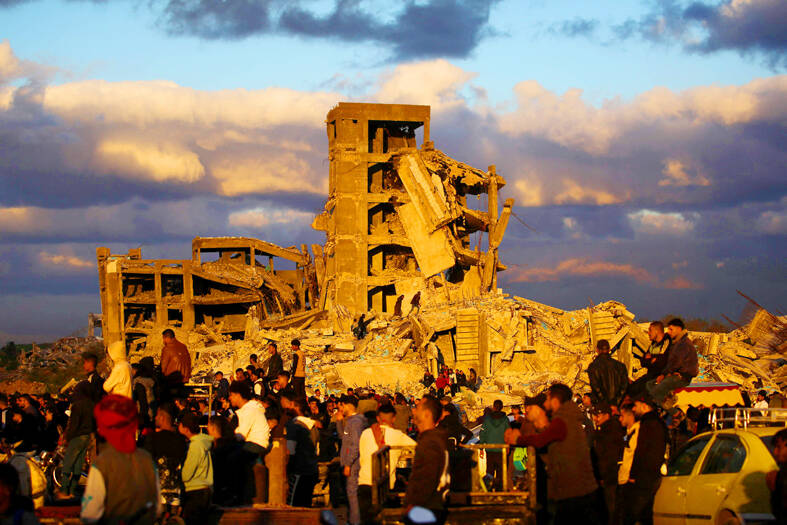
Photo: AFP
The incident is under review and the military “regrets any harm to uninvolved individuals,” it added.
The Yellow Line divides the Israeli-held part of Gaza from the rest of the territory, and was drawn under the US-brokered ceasefire agreement that went into effect in October.
Also on Friday, US President Donald Trump’s Mideast envoy Steve Witkoff was planning to host in Florida top officials from Middle Eastern countries mediating the Gaza ceasefire, according to a US official.
The talks are an effort to push the ceasefire into its second, much more complex phase.
The first phase began in October, days after the two-year anniversary of the initial Hamas-led attack on Israel that killed around 1,200 people. All but one of the 251 hostages taken that day have been released, alive or dead, in exchange for Palestinian prisoners and detainees.
The war in Gaza has killed more than 70,660 Palestinians, roughly half of them women and children, according to the territory’s Health Ministry. The ministry, which operates under the Hamas-run government, is staffed by medical professionals and maintains detailed records viewed as generally reliable by the international community.
Although the ceasefire, now in its third month, has mostly held, its progress has slowed amid accusations of violations by both sides.
The second phase of the deal is supposed to involve even bigger challenges — the deployment of an international stabilization force, a technocratic governing body for Gaza, the disarmament of Hamas and further Israeli troop withdrawals from the territory.
Meanwhile, the spread of famine has been averted in the Gaza Strip, but the situation remains critical with the entire Palestinian territory still facing starvation, the world’s leading authority on food crises said on Friday.
The new report by the Integrated Food Security Phase Classification (IPC) comes months after the group said famine was occurring in Gaza City and likely to spread across the territory without a ceasefire and an end to humanitarian aid restrictions.
There were “notable improvements” in food security and nutrition following the ceasefire and no famine has been detected, the report said.
Still, the IPC warned that the situation remains “highly fragile” and the entire Gaza Strip is in danger of starvation, with nearly 2,000 people facing catastrophic levels of hunger through April.
In the worst-case scenario, including renewed conflict and a halt of aid, the whole Gaza Strip is at risk of famine. Needs remain immense, and sustained, expanded and unhindered aid is required, the IPC said.
The Israeli military agency in charge of coordinating aid to Gaza, known as COGAT, on Friday said that it strongly rejected the findings.
The agency adheres to the ceasefire and allows the agreed amount of aid to reach the strip, COGAT said, noting the aid quantities “significantly exceed the nutritional requirements of the population” in Gaza according to accepted international methodologies, including the United Nations.
The Israeli Ministry of Foreign Affairs said that it also rejects the findings, saying the IPC’s report does not reflect reality in Gaza and more than the required amount of aid was reaching the territory.
The ministry said the IPC ignores the vast volume of aid entering Gaza, because the group relies primarily on data related to UN trucks, which account for only 20 percent of all aid trucks.
The IPC said that the report totals include commercial and UN trucks, and its information is based on UN and COGAT data.
Israel’s government has rejected the IPC’s past findings, with Israeli Prime Minister Benjamin Netanyahu calling the previous report an “outright lie.”
Friday’s report said that the spread of famine had been offset by a significant reduction in conflict, a proposed peace plan and improved access for humanitarian and commercial food deliveries.
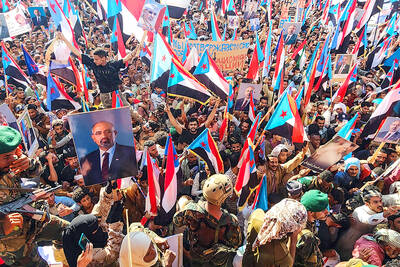
Yemen’s separatist leader has vowed to keep working for an independent state in the country’s south, in his first social media post since he disappeared earlier this month after his group briefly seized swathes of territory. Aidarous al-Zubaidi’s United Arab Emirates (UAE)-backed Southern Transitional Council (STC) forces last month captured two Yemeni provinces in an offensive that was rolled back by Saudi strikes and Riyadh’s allied forces on the ground. Al-Zubaidi then disappeared after he failed to board a flight to Riyadh for talks earlier this month, with Saudi Arabia accusing him of fleeing to Abu Dhabi, while supporters insisted he was

The Chinese Embassy in Manila yesterday said it has filed a diplomatic protest against a Philippine Coast Guard spokesman over a social media post that included cartoonish images of Chinese President Xi Jinping (習近平). Philippine Coast Guard spokesman Jay Tarriela and an embassy official had been trading barbs since last week over issues concerning the disputed South China Sea. The crucial waterway, which Beijing claims historic rights to despite an international ruling that its assertion has no legal basis, has been the site of repeated clashes between Chinese and Philippine vessels. Tarriela’s Facebook post on Wednesday included a photo of him giving a
Syrian President Ahmed al-Sharaa on Sunday announced a deal with the chief of Kurdish-led forces that includes a ceasefire, after government troops advanced across Kurdish-held areas of the country’s north and east. Syrian Kurdish leader Mazloum Abdi said he had agreed to the deal to avoid a broader war. He made the decision after deadly clashes in the Syrian city of Raqa on Sunday between Kurdish-led forces and local fighters loyal to Damascus, and fighting this month between the Kurds and government forces. The agreement would also see the Kurdish administration and forces integrate into the state after months of stalled negotiations on

‘MOBILIZED’: While protesters countered ICE agents, Minnesota Governor Tim Walz activated the state’s National Guard to ‘support the rights of Minnesotans’ to assemble Hundreds of counterprotesters drowned out a far-right activist’s attempt to hold a small rally in support of US President Donald Trump’s latest immigration crackdown in Minneapolis, Minnesota, on Saturday, as the governor’s office announced that National Guard troops were mobilized and ready to assist law enforcement, although not yet deployed to city streets. There have been protests every day since the US Department of Homeland Security (DHS) ramped up immigration enforcement in the Twin Cities of Minneapolis and Saint Paul by bringing in more than 2,000 federal officers. Conservative influencer Jake Lang organized an anti-Islam, anti-Somali and pro-US Immigration and Customs Enforcement


 RSS
RSS