


China is exploiting partnerships with US researchers funded by the US Department of Energy (DOE) to provide the Chinese military with access to sensitive nuclear technology and other innovations with economic and national security applications, a US congressional report published on Wednesday said.
The report says the US must do more to protect high-tech research and ensure that the results of taxpayer-funded work do not end up benefiting Beijing.
The investigation is part of a congressional push to raise a firewall blocking US research from boosting China’s military buildup when the two countries are locked in a tech and arms rivalry.
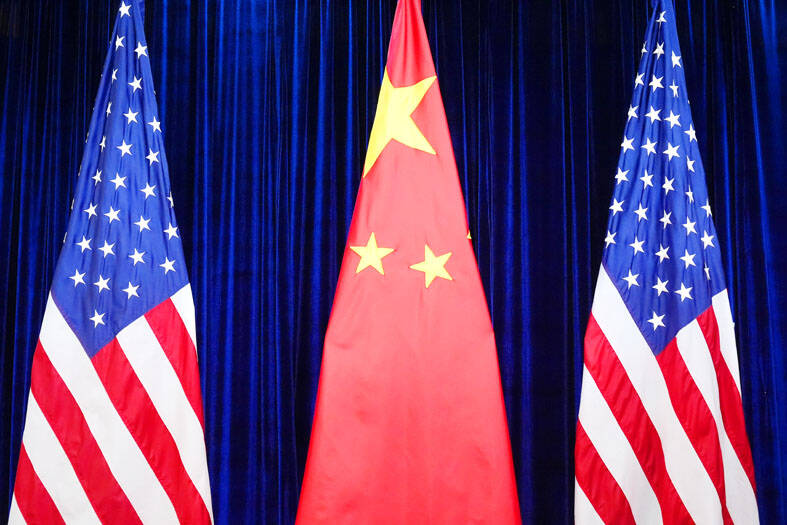
Photo: AP
Investigators from the US House of Representatives Select Committee on Strategic Competition between the United States and the Chinese Communist Party and the House Committee on Education and the Workforce identified more than 4,300 academic papers published between June 2023 and June of this year that involved collaborations between DOE-funded scientists and Chinese researchers. About half of the papers involved Chinese researchers affiliated with China’s military or industrial base.
Particularly concerning, investigators found that federal funds went to research collaborations with Chinese state-owned laboratories and universities that work directly for China’s military, including some listed in a Pentagon database of Chinese military companies with operations in the US.
The report also detailed collaborations between US researchers and groups blamed for cyberattacks as well as human rights abuses in China.
The Chinese embassy in Washington said the select committee “has long smeared and attacked China for political purposes and has no credibility to speak of.”
“A handful of US politicians are overstretching the concept of national security to obstruct normal scientific research exchanges, a move that wins no public support and is bound to fail,” embassy spokesman Liu Pengyu (劉鵬宇) said.
The DOE routinely funds advanced research into nuclear energy and the development and disposal of nuclear weaponry, along with a long list of other high-tech fields such as quantum computing, materials science and physics. It doles out hundreds of millions of dollars each year for research. It oversees 17 national laboratories that have led the development in many technologies.
The report followed a number of congressional investigations into federally funded research involving Chinese scientists and researchers.
Last year, a report released by Republicans found that partnerships between US and Chinese universities over the past decade had allowed hundreds of millions of dollars in federal funding to help Beijing develop critical technology that could help strengthen its military.
Another investigation this year revealed that the Pentagon in a two-year period funded hundreds of projects in collaboration with Chinese entities linked to China’s defense industry.
House committee researchers made recommended a new standardized approach to assessing the national security risks of research, as well as requirements that the department share information about research ties with China with other US government agencies to make it easier to spot problems.
US Representative John Moolenaar, who chairs the select committee on China, said in a statement that the “investigation reveals a deeply alarming problem: The Department of Energy failed to ensure the security of its research and it put American taxpayers on the hook for funding the military rise of our nation’s foremost adversary.”
Moolenaar this year introduced legislation aimed at preventing research funding in science and technology and defense from going to collaborations or partnerships with “foreign adversary-controlled” entities that pose a national security risk.
The legislation cleared the House, but failed to advance to become part of the annual sweeping defense policy bill.
It was met with strong opposition from scientists and researchers, who said the measures were too broad and could chill collaboration and undermine the US’ competitive edge in science and technology.

ROCKY RELATIONS: The figures on residents come as Chinese tourist numbers drop following Beijing’s warnings to avoid traveling to Japan The number of Chinese residents in Japan has continued to rise, even as ties between the two countries have become increasingly fractious, data released on Friday showed. As of the end of December last year, the number of Chinese residents had increased by 6.5 percent from the previous year to 930,428. Chinese people accounted for 22.6 percent of all foreign residents in Japan, making them by far the largest group, Japanese Ministry of Justice data showed. Beijing has criticized Tokyo in increasingly strident terms since Japanese Prime Minister Sanae Takaichi last year suggested that a military conflict around Taiwan could

A retired US colonel behind a privately financed rocket launch site in the Dominican Republic sees the project as a response to China’s dominance of the space race in Latin America. Florida-based Launch on Demand is slated to begin building a US$600 million facility in a remote region near the border with Haiti late this year. The project is designed to meet surging demand for the heavy-lift rockets needed to put clusters of satellites into orbit. It is also an answer to China’s growing presence in the region, said CEO Burton Catledge, a former commander of the US Air Force’s 45th Operations

Germany is considering Australia’s Ghost Bat robot fighter as it looks to select a combat drone to modernize its air force, German Minister of Defense Boris Pistorius said yesterday. Germany has said it wants to field hundreds of uncrewed fighter jets by 2029, and would make a decision soon as it considers a range of German, European and US projects developing so-called “collaborative combat aircraft.” Australia has said it will integrate the Ghost Bat, jointly developed by Boeing Australia and the Royal Australian Air Force, into its military after a successful weapons test last year. After inspecting the Ghost Bat in Queensland yesterday,
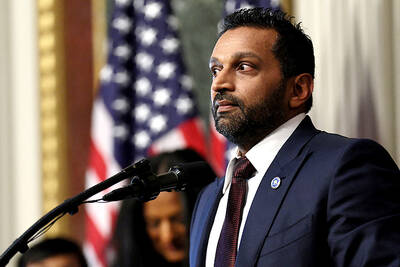
A pro-Iran hacking group claimed to breach FBI Director Kash Patel’s personal e-mail inbox and posted some of the contents online. The e-mails provided by the hacking group include travel details, correspondence with leasing agents in Washington and global entry, and loyalty account numbers. The e-mail address the hackers claim to have compromised has been previously tied to Patel’s personal details, and the leaked e-mails contain photos of Patel and others, in addition to correspondence with family members and colleagues. “The FBI is aware of malicious actors targeting Director Patel’s personal email information,” the agency said in a statement on


 RSS
RSS