


Belarusian street protest leader Maria Kolesnikova and Nobel Prize winner Ales Bialiatski on Saturday walked free with 121 other political prisoners released in an unprecedented US-brokered deal.
Belarusian President Alexander Lukashenko has locked up thousands of his opponents, critics and protesters since the 2020 election, which rights groups said was rigged and which triggered weeks of protests that almost toppled him.
The charismatic Kolesnikova was the star of the 2020 movement that presented the most serious challenge to Lukashenko in his 30-year rule.

Photo: Reuter
She famously ripped up her passport as the KGB tried to deport her from the country.
Bialiatski — a 63-year-old veteran rights defender and 2022 Nobel Peace Prize winner — is considered by Lukashenko to be a personal enemy. He has documented rights abuses in the country, a close ally of Moscow, for decades.
Bialiatski stressed he would carry on fighting for civil rights and freedom for political prisoners after his surprise release, which he called a “huge emotional shock.”
“Our fight continues, and the Nobel Prize was, I think, a certain acknowledgement of our activity, our aspirations that have not yet come to fruition,” he told media in an interview from Vilnius.
“Therefore, the fight continues,” he added.
He was awarded the prize in 2022 while in jail.
After being taken out of prison, he said he was put on a bus and blindfolded until they reached the border with Lithuania.
His wife, Natalia Pinchuk, said that her first words to him on his release were: “I love you.”
Most of those freed, including Kolesnikova, were unexpectedly taken to Ukraine, surprising their allies who had been waiting for all of them in Lithuania.
Kolesnikova called for all political prisoners to be released.
“I’m thinking of those who are not yet free, and I’m very much looking forward to the moment when we can all embrace, when we can all see one another, and when we will all be free,” she said in a video interview with a Ukrainian government agency.
Hailing Bialiatski’s release, the Nobel Committee said there were still more than 1,200 political prisoners inside the country.
“Their continued detention starkly illustrates the ongoing, systemic repression in the country,” Norwegian Nobel Committee chairman Jorgen Watne Frydnes said.
European Commission President Ursula von der Leyen said their release should “strengthen our resolve ... to keep fighting for all remaining prisoners behind bars in Belarus, because they had the courage to speak truth to power.”
Jailed opponents of Lukashenko are often held incommunicado in a prison system notorious for its secrecy and harsh treatment.
There had been fears for the health of Bialiatski and Kolesnikova while they were behind bars, although in interviews on Saturday they both said they felt okay.
The deal was brokered by the US, which has pushed for prisoners to be freed and offered some sanctions relief in return.
An envoy of US President Donald Trump, John Coale, was in Minsk this week for talks with Lukashenko.
He told reporters from state media that Washington would remove sanctions on the country’s potash industry, without providing specific details.
A US official separately said that one US citizen was among the 123 released.
Minsk also freed Viktor Babariko, an ex-banker who tried to run against Lukashenko in the 2020 presidential election, but was jailed instead.
Kolesnikova was part of a trio of women, including Svetlana Tikhanovskaya who stood against Lukashenko and now leads the opposition in exile, who headed the 2020 street protests.
She was serving an 11-year sentence in a prison colony.
In 2020, security services had put a sack over Kolesnikova’s head and drove her to the Ukrainian border, but she ripped up her passport, foiling the deportation plan, and was placed under arrest. Former prisoners from the Gomel prison where she was held have said she was barred from talking to other political prisoners and regularly thrown into harsh punishment cells.
An image of Kolesnikova making a heart shape with her hands became a symbol of anti-Lukashenko protests.
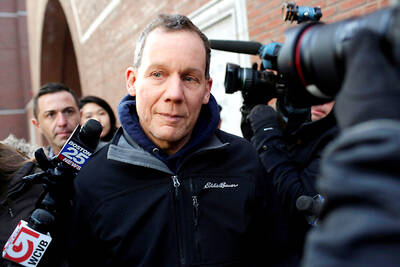
An American scientist convicted of lying to US authorities about payments from China while he was at Harvard University has rebuilt his research lab in Shenzhen, China, to pursue technology the Chinese government has identified as a national priority: embedding electronics into the human brain. Charles Lieber, 67, is among the world’s leading researchers in brain-computer interfaces. The technology has shown promise in treating conditions such as amyotrophic lateral sclerosis and restoring movement in paralyzed people. It also has potential military applications: Scientists at the Chinese People’s Liberation Army have investigated brain interfaces as a way to engineer super soldiers by boosting
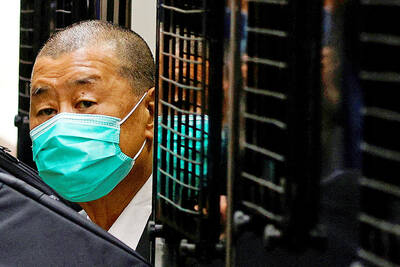
Jailed media entrepreneur Jimmy Lai (黎智英) has been awarded Deutsche Welle’s (DW) freedom of speech award for his contribution to Hong Kong’s pro-democracy movement. The German public broadcaster on Thursday said Lai would be presented in absentia with the 12th iteration of the award on June 23 at the DW Global Media Forum in Bonn. Deutsche Welle director-general Barbara Massing praised the 78-year-old founder of the now-shuttered news outlet Apple Daily for standing “unwaveringly for press freedom in Hong Kong at great personal risk.” “With Apple Daily, he gave journalists a platform for free reporting and a voice to the democracy movement in
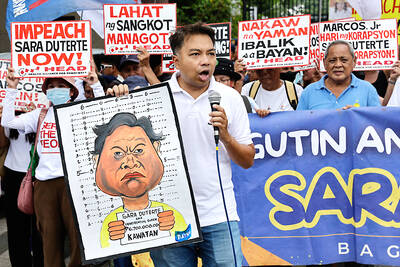
PHILIPPINE COMMITTEE: The head of the committee that made the decision said: ‘If there is nothing to hide, there is no reason to hide, there is no reason to obstruct’ A Philippine congressional committee on Wednesday ruled that there was “probable cause” to impeach Philippine Vice President Sara Duterte after hearing allegations of unexplained wealth, misuse of state funds and threats to have the president assassinated. The unanimous decision of the 53-member committee in the Philippine House of Representatives sends the two impeachment complaints to deliberations and voting by the entire lower chamber, which has more than 300 lawmakers. The complaints centered on Duterte’s alleged illegal use and mishandling of intelligence funds from the vice president’s office, and from her time as education secretary under Philippine President Ferdinand Marcos Jr. Duterte and the
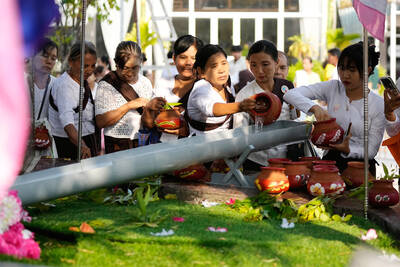
Burmese President Min Aung Hlaing yesterday cut all prisoners’ sentences by one-sixth, a blanket measure that a source close to deposed leader Aung San Suu Kyi said would further shorten her detention. Aung San Suu Kyi has been sequestered since a 2021 military coup, but the senior member of her dissolved National League for Democracy (NLD) party said that while her term had been reduced, her remaining sentence is still unclear. “We also don’t know exactly how many years she has left,” the source told reporters, speaking on condition of anonymity for security reasons. The military toppled Aung San Suu Kyi’s elected government


 RSS
RSS