


At long last, vindication is at hand for an Oscar-winning composer who sought to prove he was just as capable of breathing life into Italy’s grand theaters as gritty Hollywood films.
Naples’ Teatro San Carlo yesterday evening staged composer Ennio Morricone’s only opera, Partenope, three full decades after its composition. It is inspired by the mythical siren who drowned herself after failing to enchant Ulysses, her body washing ashore and becoming a settlement that grew over millennia into the seaside city of Naples.
When Morricone wrote Partenope in 1995, he was already the world-famous creator of the theme to the spaghetti Western The Good, the Bad and the Ugly, and haunting soundtracks for epic films such as The Untouchables and Once Upon a Time in America.
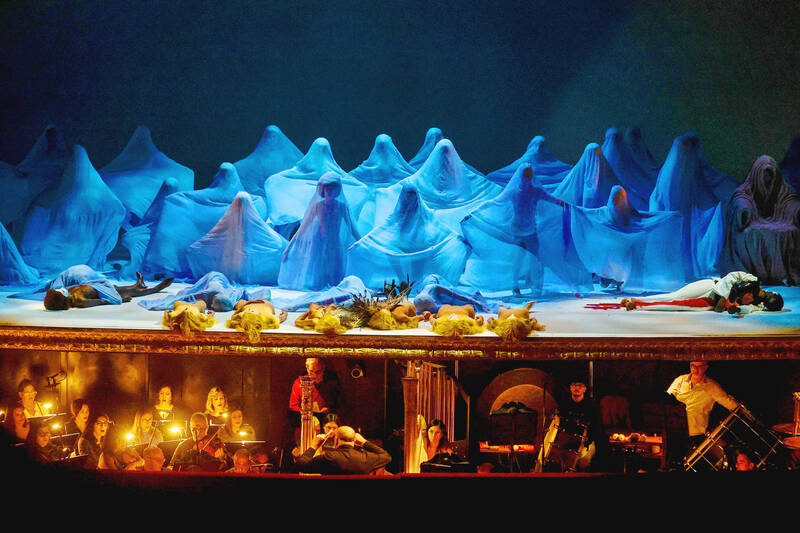
Photo: AP
He earned an Oscar for lifetime achievement in 2007, but his compositions never resounded in the hallowed halls of opera houses — viewed in his home country as the elite musical echelon. To his great chagrin, Partenope gathered dust for decades; Morricone died without seeing it performed.
“In the end, he read as a sign of destiny the fact he would not make his debut in the opera world,” said Alessandro De Rosa, a close collaborator who coauthored Morricone’s autobiography. “I’m sure that if he were alive now, he would have taken the challenge, and would have dialogued with the orchestra and the director, tirelessly, like a young kid.”
Director Vanessa Beecroft and conductor Riccardo Frizza had to find their way through the visionary work without the benefit of those notes.
“It would have been wonderful to be able to talk to Morricone about his musical choices... but we had to understand them from what he left us and tried to interpret them in the best way,” Frizza said.
For instance, Frizza said he chose not to use violins in this orchestra, instead favoring flutes, harps and horns, which appear in Greek mythology.
“Then you have the modern instruments, lots of percussion, with the Neapolitan sounds provided by tambourines and putipu,” he added, referencing a friction drum used in local folk music.
Teatro San Carlo on Thursday evening was filled with anticipation, as Neapolitans attended an open rehearsal. Free tickets were snapped up in just a few hours.
The mythical Partenope is part of Naples’ culture, with tradition suggesting her voice represents the city’s enduring spirit. The original Greek settlement was named for her. She is depicted at monuments such as the Fontana della Sirena, a fountain that has become one of the city’s symbols. Young children all along the Gulf of Naples, living under Mount Vesuvius’ shadow, learn the legend of Partenope from their parents.
Like Morricone’s opera, Naples itself spent decades downtrodden and overlooked, but is enjoying resurgence: The UN recognized its pizza makers as an intangible cultural heritage of humanity; it was featured on foreign media lists of must-visit destinations; writer Elena Ferrante’s Neapolitan novels were acclaimed bestsellers that became an HBO series; and its soccer team in 2023 took home the nation’s top league trophy for the first time since Maradona played in the 1980s, then won again in May.
Naples has also been celebrating its 2,500th anniversary this year, and Morricone’s opera marks the culmination of festivities. The protagonist in his adaptation is a woman who, after her husband dies and she is separated from her best friend, refuses the consolation of being transformed into a distant constellation. Instead, she asks the gods to let her stretch her wings along the gulf on which an immortal city will arise.
The production explores the link between the ancient legend and the modern city’s identity, as two sopranos embody Partenope simultaneously, reflecting her dual nature as body and myth.

An American scientist convicted of lying to US authorities about payments from China while he was at Harvard University has rebuilt his research lab in Shenzhen, China, to pursue technology the Chinese government has identified as a national priority: embedding electronics into the human brain. Charles Lieber, 67, is among the world’s leading researchers in brain-computer interfaces. The technology has shown promise in treating conditions such as amyotrophic lateral sclerosis and restoring movement in paralyzed people. It also has potential military applications: Scientists at the Chinese People’s Liberation Army have investigated brain interfaces as a way to engineer super soldiers by boosting

Indonesian police have arrested 13 people after shocking images of alleged abuse against small children at a daycare center went viral, sparking outrage across the nation, officials said on Monday. Police on Friday last week raided Little Aresha, a daycare center in Yogyakarta on Java island, following a report from a former employee. CCTV footage circulating on social media showed children, most younger than two, lying on the floor wearing only diapers, their hands and feet bound with rags. The police have confirmed that the footage is authentic. Police said they also found 20 children crammed into a room just 3m by 3m. “So

Jailed media entrepreneur Jimmy Lai (黎智英) has been awarded Deutsche Welle’s (DW) freedom of speech award for his contribution to Hong Kong’s pro-democracy movement. The German public broadcaster on Thursday said Lai would be presented in absentia with the 12th iteration of the award on June 23 at the DW Global Media Forum in Bonn. Deutsche Welle director-general Barbara Massing praised the 78-year-old founder of the now-shuttered news outlet Apple Daily for standing “unwaveringly for press freedom in Hong Kong at great personal risk.” “With Apple Daily, he gave journalists a platform for free reporting and a voice to the democracy movement in

PHILIPPINE COMMITTEE: The head of the committee that made the decision said: ‘If there is nothing to hide, there is no reason to hide, there is no reason to obstruct’ A Philippine congressional committee on Wednesday ruled that there was “probable cause” to impeach Philippine Vice President Sara Duterte after hearing allegations of unexplained wealth, misuse of state funds and threats to have the president assassinated. The unanimous decision of the 53-member committee in the Philippine House of Representatives sends the two impeachment complaints to deliberations and voting by the entire lower chamber, which has more than 300 lawmakers. The complaints centered on Duterte’s alleged illegal use and mishandling of intelligence funds from the vice president’s office, and from her time as education secretary under Philippine President Ferdinand Marcos Jr. Duterte and the


 RSS
RSS