


South Korean police yesterday raided the Seoul headquarters of e-commerce giant Coupang over a recent data leak believed to have affected almost two-thirds of the nation’s population.
Coupang is South Korea’s most popular online shopping platform, serving millions of customers with lightning-fast deliveries of products from groceries to gadgets.
However, the company suffered a massive data leak this year and was forced to alert customers that their names, e-mail addresses, phone numbers, shipping addresses and some order histories had been exposed.
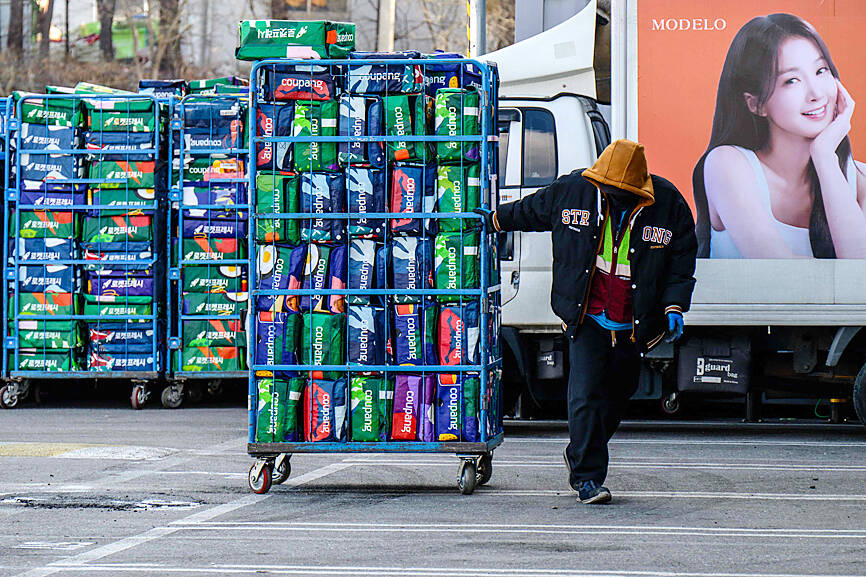
Photo: AFP
Payment details and login credentials were not affected, it said.
Coupang had told authorities the personal information of 33.7 million customers had been leaked — almost two-thirds of the population of the country.
Police in Seoul yesterday conducted a “search and seizure” operation at Coupang’s South Korean headquarters, describing it as a “necessary measure” in its investigation into the leak.
Seventeen officers from the force’s cyberinvestigation unit were deployed, with law enforcement vowing to “comprehensively investigate” based on the evidence obtained.
South Korean President Lee Jae Myung last week called for swift action to penalize those responsible for the debacle.
Seoul has said the leak took place through Coupang’s overseas servers from June 24 to Nov. 8.
The company only became aware of it last month, according to police and local media, when it issued a complaint against the alleged culprit — a former employee who is a Chinese national.
The suspect is yet to be apprehended.
Coupang is now facing a class action lawsuit in the US, where its global headquarters is based, over the leak.
South Korea’s presidential office on Monday said that the firm needed to provide answers over how it would compensate users who have had data stolen.
“Coupang must present clear measures outlining how it will take responsibility if damages occur,” presidential chief of staff Kang Hoon-sik said, according to Yonhap.
The case follows a major breach at South Korea’s largest mobile carrier SK Telecom, which was fined 134 billion won (US$91 million) in August after a cyberattack exposed data on nearly 27 million users.
South Korea, among the world’s most wired countries, has also been a target of hacking by arch-rival North Korea.
Police last year announced that North Korean hackers were behind the theft of sensitive data from a South Korean court computer network — including individuals’ financial records— over a two-year period.
Yonhap last month reported that South Korean authorities suspected a North Korean hacking group might be behind the recent cyberattack on cryptocurrency exchange Upbit, which led to the unauthorized withdrawal of 44.5 billion won in digital assets.

Gaza is rapidly running out of its limited fuel supply and stocks of food staples might become tight, officials said, after Israel blocked the entry of fuel and goods into the war-shattered territory, citing fighting with Iran. The Israeli military closed all Gaza border crossings on Saturday after announcing airstrikes on Iran carried out jointly with the US. Israeli authorities late on Monday night said that they would reopen the Kerem Shalom crossing from Israel to Gaza yesterday, for “gradual entry of humanitarian aid” into the strip, without saying how much. Israeli authorities previously said the crossings could not be operated safely during

Hungarian authorities temporarily detained seven Ukrainian citizens and seized two armored cars carrying tens of millions of euros in cash across Hungary on suspicion of money laundering, officials said on Friday. The Ukrainians were released on Friday, following their detention on Thursday, but Hungarian officials held onto the cash, prompting Ukraine to accuse Hungary’s Russia-friendly government of illegally seizing the money. “We will not tolerate this state banditism,” Ukrainian Minister of Foreign Affairs Andrii Sybiha said. The seven detained Ukrainians were employees of the Ukrainian state-owned Oschadbank, who were traveling in the two armored cars that were carrying the money between Austria and

Kosovar President Vjosa Osmani on Friday after dissolving the Kosovar parliament said a snap election should be held as soon as possible to avoid another prolonged political crisis in the Balkan country at a time of global turmoil. Osmani said it is important for Kosovo to wrap up the upcoming election process and form functional institutions for political stability as the war rages in the Middle East. “Precisely because the geopolitical situation is that complex, it is important to finish this electoral process which is coming up,” she said. “It is very hard now to imagine what will happen next.” Kosovo, which declared

MORE BANS: Australia last year required sites to remove accounts held by under-16s, with a few countries pushing for similar action at an EU level and India considering its own ban Indonesia on Friday said it would ban social media access for children under 16, citing threats from online pornography, cyberbullying, online fraud and Internet addiction. “Accounts belonging to children under 16 on high-risk platforms will start to be deactivated, beginning with YouTube, TikTok, Facebook, Instagram, Threads, X, Bigo Live and Roblox,” Indonesian Minister of Communications and Digital Meutya Hafid said. “The government is stepping in so that parents no longer have to fight alone against the giants of the algorithm. Implementation will begin on March 28, 2026,” she said. The social media ban would be introduced in stages “until all platforms fulfill their


 RSS
RSS