


The Mediterranean’s first sanctuary for dolphins that have lived in captivity would open off Italy next year, as demand for rehoming rises with the closure of marine parks across Europe.
“We must develop a new model for managing dolphins in a natural, but supervised environment,” San Paolo Dolphin Refuge head Carmelo Fanizza said.
The sanctuary still needs a final green light from the government, but the site would be ready by the end of this month and the first dolphins are expected to arrive “no later than May or June 2026,” Fanizza said.
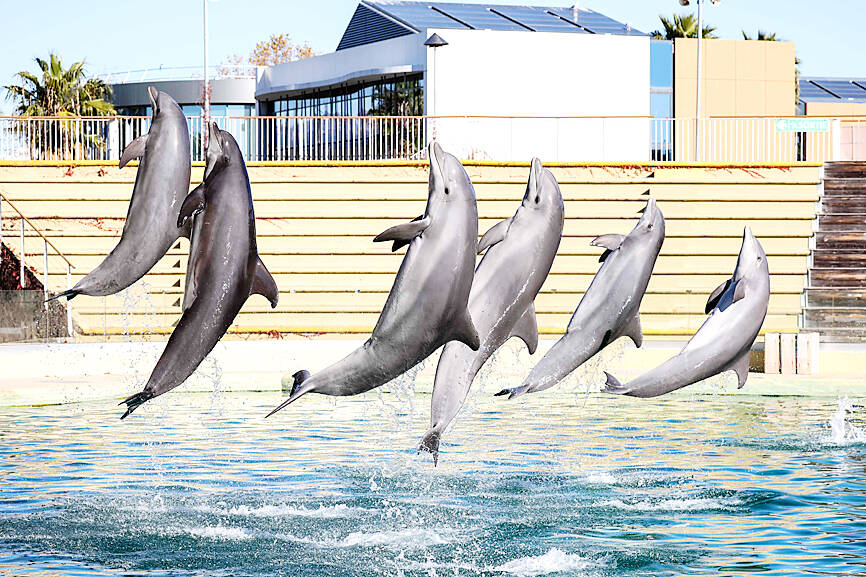
Photo: AFP
Animal rights concerns have driven countries such as Canada and France to ban the capture of dolphins, porpoises and whales, while a growing number of marine parks are shutting.
That has created a burning question: What to do with the cetaceans, which could live for decades and have mostly only known life in captivity, so they cannot be released into the wild?
The sanctuary got permission from the Italian government in 2023 to use a seven hectare area in the Gulf of Taranto.
The spot is “sheltered and protected from the sea, winds and prevailing ocean currents,” Fanizza said.
“Improvements have been made to the facilities, so that the quality of the breathable air, the water column and the sediments in the area currently pose no risk to animal health,” he added.
The facility has a main 1,600m2 enclosure, a smaller one for potential transfers and a veterinary one for quarantine cases. It has a floating laboratory, accommodation so staff can be on site overnight and a food preparation area. It is also equipped with a video surveillance system and sensors at sea, which transmit data to a control room in Taranto.
The sanctuary’s construction has been largely paid for by Jonian Dolphin Conservation — the research organization behind the initiative — with support from private donors and European public funds.
The site’s operating costs are estimated at between 350,000 and 500,000 euros (US$407,960 and US$582,800) per year.
It could legally accommodate up to 17 dolphins, but “the number will absolutely not be that,” Fanizza said.
“Our goal at this stage is not to take in a large number of animals, but to identify a group that, given its medical condition, behavior and social structure, could be ideal for initiating such a project,” he said.

PHISHING: The con might appear convincing, as the scam e-mails can coincide with genuine messages from Apple saying you have run out of storage For a while you have been getting messages from Apple saying “your iCloud storage is full.” They say you have exceeded your storage plan, so documents are no longer being backed up, and photos you take are not being uploaded. You have been resisting Apple’s efforts to get you to pay a minimum of £0.99 (US$1.33) a month for more storage, but it seems that you cannot keep putting off the inevitable: You have received an e-mail which says your iCloud account has been blocked, and your photos and videos would be deleted very soon. To keep them you need

For two decades, researchers observed members of the Ngogo chimpanzee group of Kibale National Park in Uganda spend their days eating fruits and leaves, resting, traveling and grooming in their tropical rainforest abode, but this stable community then fractured and descended into years of deadly violence. The researchers are now describing the first clearly documented example of a group of wild chimpanzees splitting into two separate factions, with one launching a series of coordinated attacks against the other. Adult males and infants were targeted, with 28 deaths. “Biting, pounding the victim with their hands, dragging them, kicking them — mostly adult males,

The Israeli military has demolished entire villages as part of its invasion of south Lebanon, rigging homes with explosives and razing them to the ground in massive remote detonations. The Guardian reviewed three videos posted by the Israeli military and on social media, which showed Israel carrying out mass detonations in the villages of Taybeh, Naqoura and Deir Seryan along the Israel-Lebanon border. Lebanese media has reported more mass detonations in other border villages, but satellite imagery was not readily available to verify these claims. The demolitions came after Israeli Minister of Defense Israel Katz called for the destruction of

SUPERFAN: The Japanese PM played keyboard in a Deep Purple tribute band in middle school and then switched to drums at university, she told the British rock band Legendary British rock band Deep Purple yesterday made Japanese Prime Minister Sanae Takaichi’s day with a brief visit to their high-profile superfan as they returned to the nation they first toured more than half a century ago. Takaichi’s reputation as an amateur drummer, and a fan of hard rock and heavy metal has been well documented, and she has referred to Deep Purple as one of her favorite bands along with the likes of Black Sabbath and Iron Maiden. “You are my god,” a giddy Takaichi said in English to Deep Purple drummer Ian Paice, presenting him with a set of made-in-Japan


 RSS
RSS