


Two oil tankers said to be part of Russia’s “shadow fleet” that were set ablaze off Turkey’s Black Sea coast might have been hit by mines, drones or missiles, a senior Turkish official said yesterday.
Tankers Kairos and Virat were struck in quick succession late on Friday afternoon, prompting rescue operations. Crew members on board both vessels were reported to be safe.
Turkish Minister of Transport and Infrastructure Abdulkadir Uraloglu said rescue services first received reports that the Kairos might have hit a mine before being told of an explosion on the Virat.
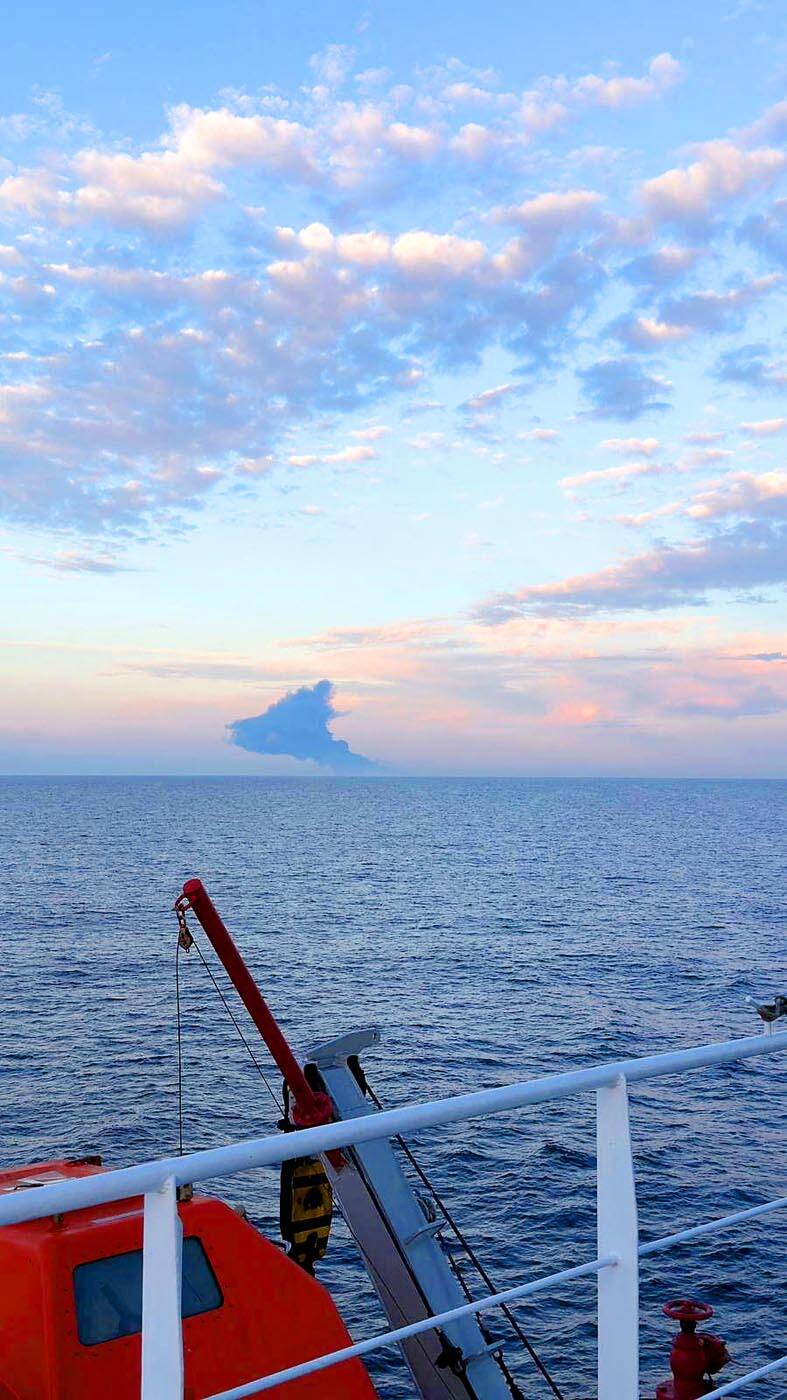
Photo: Turkish Directorate General for Maritime Affairs/Handout via REUTERS
“Our crews indicate that there were explosions on the other ship and that these were also caused by external interference,” Uraloglu told broadcaster NTV early yesterday.
“The first things that come to mind for external interference could be a mine, a missile, a marine vessel or a drone. We don’t have definitive information on this,” he added.
The OpenSanctions database, which tracks people or organizations involved in sanctions evasion, describes the vessels as part of a shadow fleet of ships used to evade sanctions imposed on Russia following its 2022 invasion of Ukraine.
Ukraine has carried out successful naval strikes against Russian shipping during the war, particularly using explosives-packed marine drones. However, Ukrainian missions have largely been limited to the waters of the northern Black Sea.
The Gambian-flagged Kairos caught fire in the Black Sea approximately 28 nautical miles (52km) off the coast of Turkey’s Kocaeli province, the Turkish Directorate General of Maritime Affairs said.
It was sailing empty toward Russia’s Novorossiysk port.
Within an hour, the maritime authority reported that a second tanker, Virat, was “struck” while sailing in the Black Sea about 35 nautical miles off the Turkish coast. It did not provide further details.
Rescue teams were dispatched to the scene to provide assistance. All 20 crew members aboard the Virat were safe, although heavy smoke was reported in the engine room, the maritime authority said.
All 25 crew aboard the Kairos were safely evacuated, Kocaeli Governor Ilhami Aktas said.
The VesselFinder Web site showed the Virat was anchored north of the Bosphorus, not far from its current position, on Nov. 4. The Kairos’ last position was on Wednesday south of the Dardanelles Strait connecting the Aegean Sea and the Sea of Marmara.
The US sanctioned the Virat in January this year, followed by the EU, Switzerland, the UK and Canada, according to the OpenSanctions Web site. Similarly, the EU sanctioned the Kairos in July this year, followed by the UK and Switzerland.
“The shadow tanker fleet continues to provide multibillion-dollar revenues for the Kremlin bypassing sanctions, disguising its activities under the flags of third countries, using complex schemes to conceal owners and poses significant environmental threats,” OpenSanctions said in its Web site entry on the Kairos.
The Virat, built in 2018, uses “irregular and high-risk shipping practices” and has previously sailed under the flags of Barbados, Comoros, Liberia and Panama, OpenSanctions said.
The Kairos, formerly flagged as Panamanian, Greek and Liberian, was built in 2002.
Ukraine’s military intelligence service on its Web site said that both ships visit Russian ports and have a history of shutting off their automatic identification systems, which transmit a ship’s position.
They have also docked at ports in China, Turkey and India, among other locations.

ON THE LAM: The Brazilian Supreme Court said that the former president tried to burn his ankle monitor off as part of an attempt to orchestrate his escape from Brazil Former Brazilian president Jair Bolsonaro — under house arrest while he appeals a conviction for a foiled coup attempt — was taken into custody on Saturday after the Brazilian Supreme Court deemed him a high flight risk. The court said the far-right firebrand — who was sentenced to 27 years in prison over a scheme to stop Brazilian President Luiz Inacio Lula da Silva from taking office after the 2022 elections — had attempted to disable his ankle monitor to flee. Supreme Court judge Alexandre de Moraes said Bolsonaro’s detention was a preventive measure as final appeals play out. In a video made

Tunisian President Kais Saied yesterday condemned a European Parliament resolution on human rights calling for the release of his critics as “blatant interference.” The EU Parliament resolution, voted by an overwhelming majority the day before, called for the release of lawyer Sonia Dahmani, a popular critic of Saied, who was freed from prison on Thursday, but remained under judicial supervision. “The European Parliament [resolution] is a blatant interference in our affairs,” Saied said. “They can learn lessons from us on rights and freedoms.” Saied’s condemnation also came two days after he summoned the EU’s ambassador for “failing to respect diplomatic rules.” He also
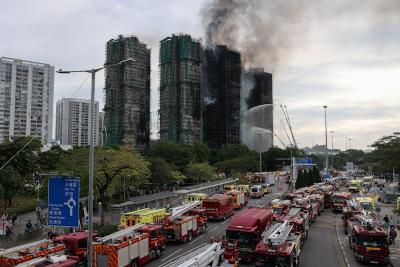
Firefighters battled one of Hong Kong’s deadliest modern blazes for a second day today, fighting to control a fire that blackened several high-rise towers and killed at least 44 people, with hundreds still missing. Three men from a construction company this morning were arrested on suspicion of manslaughter, and rescue efforts are ongoing. Thick smoke still poured out of the Wang Fuk Court (宏福苑) complex, which houses thousands, in Tai Po (大埔) district, a northern suburb near the border with the Chinese mainland, this morning. The fire that started midafternoon yesterday had spread across seven of the complex’s eight buildings, and

Under glaring laboratory lights, a research assistant extends his forearm and carefully inverts a mesh-topped container onto his skin to allow a wriggling mass of bed bugs to feed on his blood, all in the name of science. Loathed as itchy household pests, the blood-sucking insects have revealed a darker, more intriguing potential as Malaysian scientists have discovered they can be turned into unlikely crime-busting allies. A team from the Science University of Malaysia (USM) in northern Penang has found that tropical bed bugs can retain DNA from human prey for up to 45 days after snacking on an unwary victim. This makes


 RSS
RSS