


US President Donald Trump on Friday made a major intervention into Honduran politics days before the country’s presidential election, pardoning a convicted ex-leader and threatening to cut US support if his preferred candidate loses.
Trump said he would pardon former Honduran president Juan Orlando Hernandez, who was convicted last year in a US court of drug trafficking charges and sentenced to 45 years in prison.
Hernandez, who led the Central American nation from 2014 to 2022, was accused by US prosecutors of facilitating the import of some 400 tonnes of cocaine into the US.
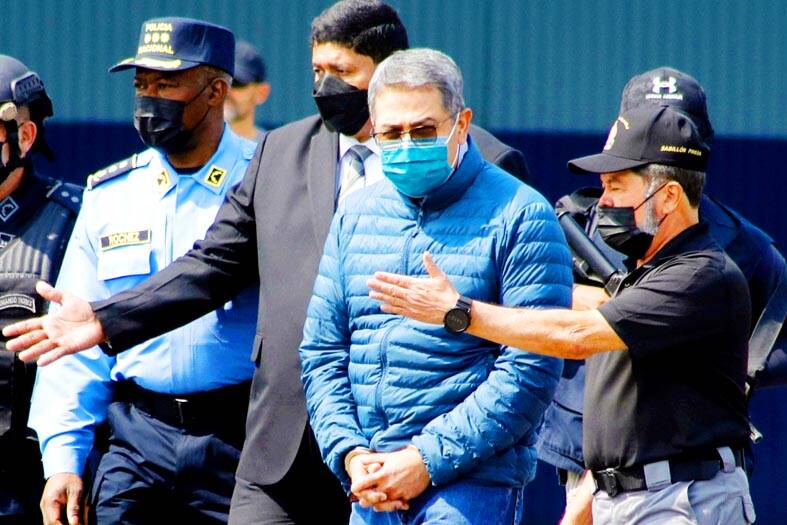
Photo: AP
He was extradited to the US just weeks after leaving office, when Honduran President Xiomara Castro came to power.
Trump’s stunning announcement came in a social media post proclaiming support for Nasry Asfura, the candidate of Hernandez’s right-wing party in Honduras’s presidential election today.
The US president had earlier endorsed Asfura, but his latest comments went further, apparently conditioning future aid to Honduras on his victory.
“If he doesn’t win, the United States will not be throwing good money after bad, because a wrong Leader can only bring catastrophic results to a country, no matter which country it is,” Trump wrote on social media.
Trump had made a similar threat before Argentina’s election last month.
Asfura denied any links to Hernandez when asked for comment, but celebrated Trump’s re-upped endorsement.
Hernandez “was president of the Republic, the party is not responsible for his personal actions,” Asfura said.
Asfura, a 67-year-old construction magnate and former mayor of the Honduran capital, is running in a tight three-way race against leftist lawyer Rixi Moncada and fellow right-wing TV host Salvador Nasralla.
Trump on Friday accused Nasralla, 72, of running as a spoiler candidate to draw votes away from Asfura.
Noting that Nasralla served as Castro’s vice president before resigning, Trump said he “is now pretending to be an anti-Communist only for the purposes of splitting Asfura’s vote.”
Trump also bashed Moncada, the political heir to Castro, as a “communist,” and said her victory would be a win for Venezuelan President Nicolas Maduro “and his Narcoterrorists.”
The pardoning of Hernandez comes despite a major US operation in Latin America, which Washington says aims to halt drug trafficking, in which more than 80 people have been killed in strikes in international waters.
A jury in New York convicted Hernandez in March last year of having facilitated the smuggling of hundreds of tons of cocaine — mainly from Colombia and Venezuela — to the US via Honduras since 2004, starting long before he became president.
Then-US attorney general Merrick Garland said after Hernandez’s sentencing last year that he had “abused his power to support one of the largest and most violent drug trafficking conspiracies in the world.”
Trump said in his social media post on Friday that Hernandez “has been, according to many people that I greatly respect, treated very harshly and unfairly,” without elaborating.
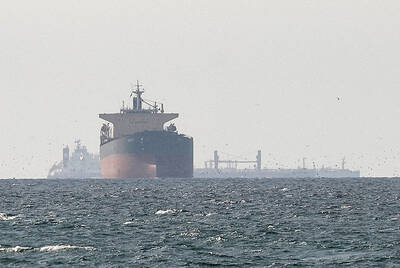
A ship that appears to be taking on the identity of a scrapped gas carrier exited the Strait of Hormuz on Friday, showing how strategies to get through the waterway are evolving as the Middle East war progresses. The vessel identifying as liquefied natural gas (LNG) carrier Jamal left the Strait on Friday morning, ship-tracking data show. However, the same tanker was also recorded as having beached at an Indian demolition yard in October last year, where it is being broken up, according to market participants and port agent’s reports. The ship claiming to be Jamal is likely a zombie vessel that
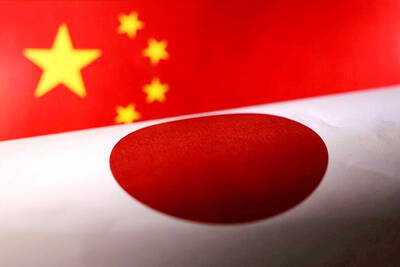
Japan is to downgrade its description of ties with China from “one of its most important” in an annual diplomatic report, according to a draft reviewed by Reuters, as relations with Beijing worsen. This year’s Diplomatic Bluebook, which Japanese Prime Minister Sanae Takaichi’s government is expected to approve next month, would instead describe China as an important neighbor and the relationship as “strategic” and “mutually beneficial.” The draft cites a series of confrontations with Beijing over the past year, including export controls on rare earths, radar lock-ons targeting Japanese military aircraft and increased pressure around Taiwan. The shift in tone underscores a deterioration
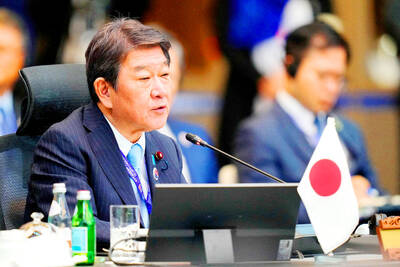
LAW CONSTRAINTS: The US has been pressing allies to send warships to open the Strait, but Tokyo’s military actions are limited under its postwar pacifist constitution Japan could consider deploying its military for minesweeping in the Strait of Hormuz if a ceasefire is reached in the war on Iran, Japanese Minister of Foreign Affairs Toshimitsu Motegi said yesterday. “If there were to be a complete ceasefire, hypothetically speaking, then things like minesweeping could come up,” Motegi said. “This is purely hypothetical, but if a ceasefire were established and naval mines were creating an obstacle, then I think that would be something to consider.” Japan’s military actions are limited under its postwar pacifist constitution, but 2015 security legislation allows Tokyo to use its Self-Defense Forces overseas if an attack,

German Chancellor Friedrich Merz’s conservative Christian Democratic Union (CDU) yesterday faced a regional election battle in Rhineland-Palatinate, now held by the center-left Social Democratic Party (SPD). Merz’s CDU has enjoyed a narrow poll lead over the SPD — their coalition partners at the national level — who have ruled the mid-sized state for 35 years. Polling third is the far-right Alternative for Germany (AfD), which spells a greater threat to the two centrist parties in several state elections in September in the country’s ex-communist east. The picturesque state of Rhineland-Palatinate, bordering France, Belgium and Luxembourg and with a population of about 4 million,


 RSS
RSS