


US Representative Marjorie Taylor Greene, a Georgia Republican who was among US President Donald Trump’s strongest allies in the US Congress before their relationship fell apart, would resign from the US House of Representatives in January.
Her last day in the US House would be Jan. 5, she wrote on social media on Friday.
Greene was among the Republicans who led the legislative effort to compel the US Department of Justice to release the files of sex trafficker Jeffrey Epstein.
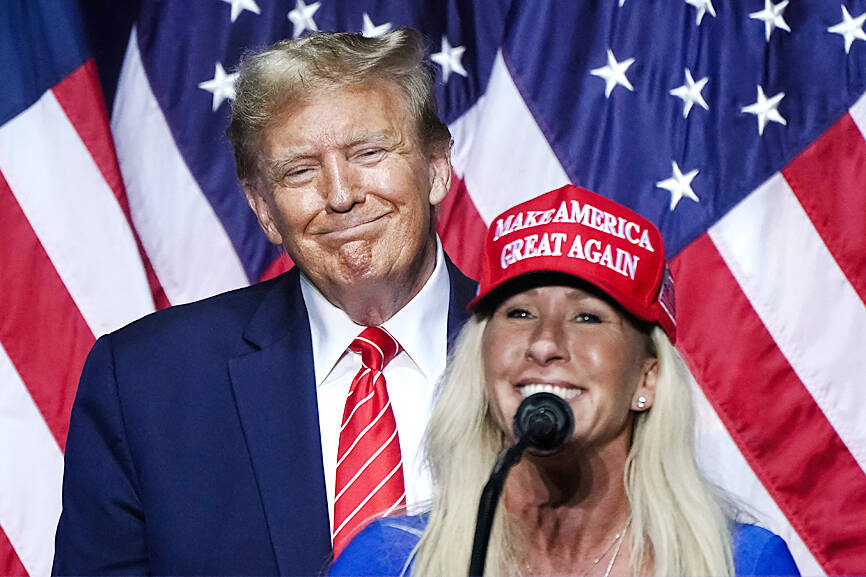
Photo: AFP
Her efforts led to a public fallout with Trump, who called her a traitor and said that he would support the “right person” to run against her in next year’s midterm elections.
“I have too much self respect and dignity, love my family way too much, and do not want my sweet district to have to endure a hurtful and hateful primary against me by the President we all fought for, only to fight and win my election while Republicans will likely lose the midterms,” Greene wrote.
Trump described Greene’s resignation as “great news for the country,” ABC reported, citing a phone call with the president.
He said he did not know about Greene’s decision in advance of the announcement, according to an ABC reporter.
Democrats who previously called Greene racist and antisemitic found common cause with her on the Epstein matter. Aside from that, Greene has criticized Trump for focusing his attentions abroad, a departure from his “America first” base. She is one of the staunchest opponents of aiding Ukraine in its war against Russia.
Greene’s district in northwest Georgia is a Republican stronghold. However, her departure from the House would thin the party’s already narrow majority, with just weeks before US House Speaker Mike Johnson would need to pass another bill to fund government operations. The House is split 219 to 213, with three vacancies.
In her post, Greene said she refused to be a “battered wife” hoping the situation would improve and that she would “look forward to a new path ahead.”
Greene is resigning just after she qualifies for a congressional pension at five years of service.

REVENGE: Trump said he had the support of the Syrian government for the strikes, which took place in response to an Islamic State attack on US soldiers last week The US launched large-scale airstrikes on more than 70 targets across Syria, the Pentagon said on Friday, fulfilling US President Donald Trump’s vow to strike back after the killing of two US soldiers. “This is not the beginning of a war — it is a declaration of vengeance,” US Secretary of Defense Pete Hegseth wrote on social media. “Today, we hunted and we killed our enemies. Lots of them. And we will continue.” The US Central Command said that fighter jets, attack helicopters and artillery targeted ISIS infrastructure and weapon sites. “All terrorists who are evil enough to attack Americans are hereby warned

Seven wild Asiatic elephants were killed and a calf was injured when a high-speed passenger train collided with a herd crossing the tracks in India’s northeastern state of Assam early yesterday, local authorities said. The train driver spotted the herd of about 100 elephants and used the emergency brakes, but the train still hit some of the animals, Indian Railways spokesman Kapinjal Kishore Sharma told reporters. Five train coaches and the engine derailed following the impact, but there were no human casualties, Sharma said. Veterinarians carried out autopsies on the dead elephants, which were to be buried later in the day. The accident site

‘POLITICAL LOYALTY’: The move breaks with decades of precedent among US administrations, which have tended to leave career ambassadors in their posts US President Donald Trump’s administration has ordered dozens of US ambassadors to step down, people familiar with the matter said, a precedent-breaking recall that would leave embassies abroad without US Senate-confirmed leadership. The envoys, career diplomats who were almost all named to their jobs under former US president Joe Biden, were told over the phone in the past few days they needed to depart in the next few weeks, the people said. They would not be fired, but finding new roles would be a challenge given that many are far along in their careers and opportunities for senior diplomats can

RUSHED: The US pushed for the October deal to be ready for a ceremony with Trump, but sometimes it takes time to create an agreement that can hold, a Thai official said Defense officials from Thailand and Cambodia are to meet tomorrow to discuss the possibility of resuming a ceasefire between the two countries, Thailand’s top diplomat said yesterday, as border fighting entered a third week. A ceasefire agreement in October was rushed to ensure it could be witnessed by US President Donald Trump and lacked sufficient details to ensure the deal to end the armed conflict would hold, Thai Minister of Foreign Affairs Sihasak Phuangketkeow said after an ASEAN foreign ministers’ meeting in Kuala Lumpur. The two countries agreed to hold talks using their General Border Committee, an established bilateral mechanism, with Thailand


 RSS
RSS