


Tanzanian politicians are in shock over the massacre of hundreds of young protesters during its recent election, insiders told Agence France-Presse, but are too afraid to speak out as a tiny cabal around the president takes control.
Gruesome images of dead Tanzanians have flooded the Internet in the wake of the Oct. 29 elections that triggered widespread protests over government repression.
Tanzanian President Samia Suluhu Hassan officially won with 98 percent of the vote, but key opposition leaders were jailed or disqualified.
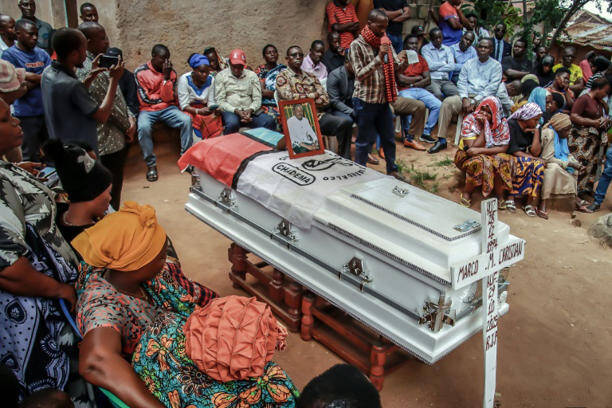
Photo :AFP
The opposition said that more than 1,000 people were killed as security forces crushed the protests under cover of a five-day Internet blackout.
Two weeks on, the government has yet to give any casualty numbers.
“There are ... disturbing reports that security forces have been seen removing bodies from streets and hospitals, and taking them to undisclosed locations in an apparent attempt to conceal evidence,” UN High Commissioner for Human Rights Volker Turk said on Tuesday.
A senior official in the Tanzanian government who said they were horrified by the events of the past two weeks agreed to talk to AFP.
The official said they would end up dead if their name was published, but provided AFP with coordinates for two suspected sites of mass graves near Dar es Salaam — at Kondo and Mabwepande.
The nature of the sites could not be independently verified.
AFP was not in a position to independently verify the sites.
A tiny cabal around Hassan now has total control over the levers of power and repression in the east African country, said the official and a former presidential adviser, who also spoke on condition of anonymity.
“People in the government are in shock ... there’s disbelief,” the official said. “Nobody has the guts to talk ... that’s the sad part of it, but people do whisper.”
AFP has spoken to multiple eyewitnesses who describe seeing people shot at point-blank range by police and unidentified armed men.
One described a bystander shot in the head by a soldier in Dar es Salaam on election day.
The next day he saw three people lined up and shot “five or six times” in the legs by police.
The opposition has called fresh protests for independence day on Dec. 9.
“We really don’t know what to do,” the government official said. “Do we want more demos? No, because the youth are going to be executed again.”
The group around the president includes her son Abdul Halim Hafidh Ameir; her private secretary, Waziri Salum; head of the intelligence service Suleiman Abubakar Mombo; and a little-known member of the East African parliament, Angela Kizigha, the two government sources said.
“There’s a very, very tiny cabal who is informing and influencing the president and running the country,” the former presidential adviser said.
“It’s unprecedented and very un-Tanzanian,” they said. Everyone else “has been completely frozen out.”
The violence began more than a year before the elections, with critics attacked, kidnapped and murdered.
Ameir has “a private militia and most of the people believe that’s the one involved in the abductions from the beginning,” the official said.
The government has denied responsibility for abductions.
Spokespeople did not respond to AFP requests for comment for this article.
Prior to the election, the Tanganyika Law Society had confirmed 83 abductions under Hassan’s rule, but said reported disappearances increased significantly in the final days of the campaign. Some were high-profile, like former government spokesman and ambassador Humphrey Polepole, reported missing from his blood-stained home on Oct. 6 after resigning in a letter that criticized Hassan’s government.
Others were unknown individuals in small villages, seemingly targeted for minor online posts.
“Why are you abducting a 20-year-old kid just because they criticized you? You’re the president, for crying out loud,” the government official said.
Hassan inherited the presidency on the sudden death of former Tanzanian president John Magufuli in 2021. She faced strong opposition from within the party, but was feted for easing restrictions on the opposition and media.
That opening proved short-lived, as repression returned worse than ever last year.
“The only explanation is deep-seated paranoia ... and now it’s out of control,” the former adviser said.
Those with power “know one tool ... a very brutal, crude, authoritarian tool,” they said.
Members of parliament talk constantly about the killings, but are paralyzed by fear of the security services and also terrified of facing their constituents in the future,” the official said. “What’s clear is that Tanzania will never be the same again.”

An American scientist convicted of lying to US authorities about payments from China while he was at Harvard University has rebuilt his research lab in Shenzhen, China, to pursue technology the Chinese government has identified as a national priority: embedding electronics into the human brain. Charles Lieber, 67, is among the world’s leading researchers in brain-computer interfaces. The technology has shown promise in treating conditions such as amyotrophic lateral sclerosis and restoring movement in paralyzed people. It also has potential military applications: Scientists at the Chinese People’s Liberation Army have investigated brain interfaces as a way to engineer super soldiers by boosting
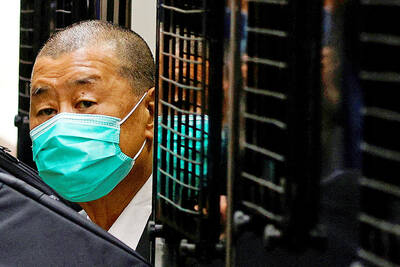
Jailed media entrepreneur Jimmy Lai (黎智英) has been awarded Deutsche Welle’s (DW) freedom of speech award for his contribution to Hong Kong’s pro-democracy movement. The German public broadcaster on Thursday said Lai would be presented in absentia with the 12th iteration of the award on June 23 at the DW Global Media Forum in Bonn. Deutsche Welle director-general Barbara Massing praised the 78-year-old founder of the now-shuttered news outlet Apple Daily for standing “unwaveringly for press freedom in Hong Kong at great personal risk.” “With Apple Daily, he gave journalists a platform for free reporting and a voice to the democracy movement in
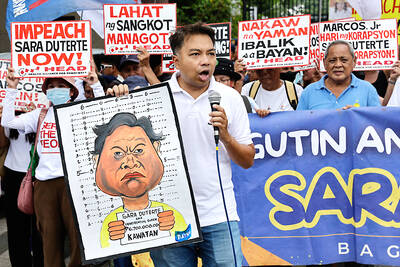
PHILIPPINE COMMITTEE: The head of the committee that made the decision said: ‘If there is nothing to hide, there is no reason to hide, there is no reason to obstruct’ A Philippine congressional committee on Wednesday ruled that there was “probable cause” to impeach Philippine Vice President Sara Duterte after hearing allegations of unexplained wealth, misuse of state funds and threats to have the president assassinated. The unanimous decision of the 53-member committee in the Philippine House of Representatives sends the two impeachment complaints to deliberations and voting by the entire lower chamber, which has more than 300 lawmakers. The complaints centered on Duterte’s alleged illegal use and mishandling of intelligence funds from the vice president’s office, and from her time as education secretary under Philippine President Ferdinand Marcos Jr. Duterte and the

Burmese President Min Aung Hlaing yesterday cut all prisoners’ sentences by one-sixth, a blanket measure that a source close to deposed leader Aung San Suu Kyi said would further shorten her detention. Aung San Suu Kyi has been sequestered since a 2021 military coup, but the senior member of her dissolved National League for Democracy (NLD) party said that while her term had been reduced, her remaining sentence is still unclear. “We also don’t know exactly how many years she has left,” the source told reporters, speaking on condition of anonymity for security reasons. The military toppled Aung San Suu Kyi’s elected government


 RSS
RSS