


A small group of countries led by China and Russia has repeatedly tried to block funding for human rights-related work at the UN over a five-year period, a report by the nonprofit International Service for Human Rights (ISHR) said.
The report cited proposals for major cuts to the Office of the High Commissioner for Human Rights (OHCHR) and for the elimination of funding for some UN investigations, in what it called a weaponization of the budget process.
While those attempts, made in closed-door UN meetings, did not succeed, the authors voiced concern about as the UN is facing a financial crisis and as US President Donald Trump’s administration steps back from multilateralism.
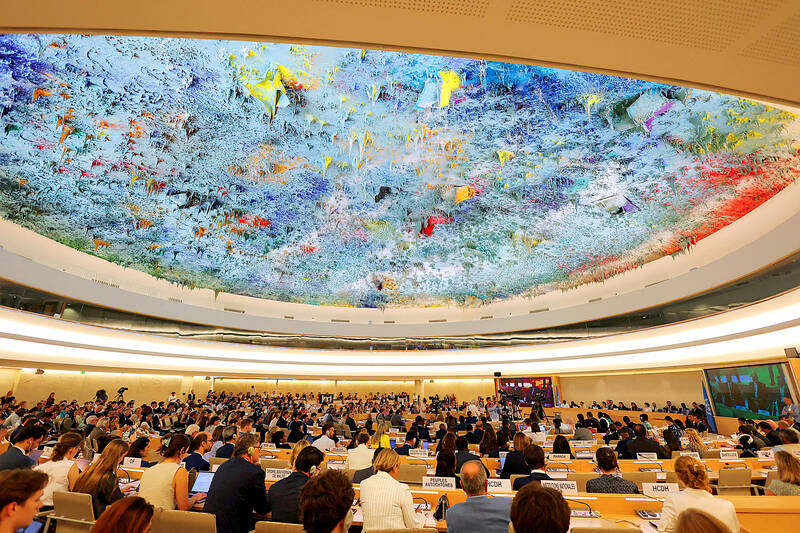
Photo: Reuters
“The proposals that China and Russia have put forth are clearly about crippling OHCHR,” said Angeli Datt, one of the authors of the 97-page report titled “Budget Battles at the UN.”
China’s mission to the UN in New York said the report was “groundless.”
“In recent years, thanks to the concerted efforts of all parties, budgetary resources for human rights have continued to grow,” the mission said in a statement.
There was no immediate comment from the Russian mission.
ISHR program manager for China and Latin America Raphael Viana David said the proposals set a dangerous precedent and highlighted a trend for “putting noninterference in national affairs over human rights.”
The US, formerly one of the most active members of the UN Human Rights Council, has disengaged under Trump, alleging an anti-Israel bias.
That would “create space for China and Russia to expand their influence within budgetary processes at a time of critical structural UN reform,” the report said.
One of the proposals brought jointly by China and Russia in 2021 sought to block all resources to 17 projects set up by the rights council, a summary of the motion included in the report showed.
Another, from last year, backed by China, Russia and others sought to block all resources for investigations on Iran, North Korea, Ukraine, Belarus, Eritrea, Sudan and Venezuela.
The report was based on interviews with dozens of diplomats, experts and UN officials, as well as a review of public and private UN documents from 2019 to last year.

‘CROSSING THE LINE’: China’s embassy in Seoul criticized US Forces Korea Commander General Xavier Brunson, asking if his ‘hostile’ remarks were authorized by Washington South Korea and the US are in talks over recent public remarks by the commander of US Forces Korea, Seoul’s presidential office said yesterday, after the comments drew sharp criticism from China. In a recent podcast interview, US Forces Korea Commander General Xavier Brunson described South Korea as “the dagger in the heart of Asia” from China’s east coast, prompting the Chinese embassy in Seoul to say that he had “truly crossed the line.” The interview came amid growing speculation that Washington might seek to expand the role of US Forces Korea in countering the growing regional influence of China, a key

SEEKING ORDER: Rodrigo Paz said that ‘anyone who wants to destroy the nation will have to deal with this president and the full force of the constitution’ Bolivian President Rodrigo Paz on Wednesday said that the nation was at a “breaking point” after nearly a month of protests that have caused shortages of food, fuel and medicine. Paz, who took office six months ago amid the worst economic crisis there in four decades, is battling a groundswell of fury over his policies. The political capital, La Paz, has been besieged by low-income workers and members of the indigenous majority calling for his resignation. “The country needs order and is reaching breaking point,” the 58-year-old said at a public event in La Paz, renewing his appeal for dialogue. On Tuesday, the Bolivian

Through the noise of rushing papers and whirring belts at a print factory in Kyoto, two creators watch their photo essay come to life in broadsheet form — part of an effort to win new audiences in the age of artificial intelligence (AI). Despite the decline of the publishing industry, self-publication and handmade “zine” magazines are growing in popularity in Japan, reflecting the nation’s enduring love of paper in the digital era. While speaking to Agence France-Presse at the plant, his hands black with ink, one of the creators, Kazuma Obara, said: “I think [paper] is a medium that engages all five

Australian researchers have trained lab-grown brain cells on a silicon computer chip to play the 1990s shooter game Doom and said they are just scratching the surface of what the neurons could be capable of doing. It is the science-fiction work of biotech boffins at Cortical Labs, who researched and developed the technology that harnesses the workings of the brain’s networking system. Each so-called “biological computer” contains about 200,000 living human brain cells, grown from stem cells that were harvested from blood donations. Having mastered the simple computer game Pong, where a paddle is moved up and down to send a ball


 RSS
RSS