


An army unit siding with anti-government protesters on Sunday installed a new military chief as Madagascan President Andry Rajoelina denounced an “attempt to seize power illegally.”
The soldiers from the CAPSAT contingent joined protesters for a second consecutive day, attending a rally in the capital to remember the people killed in more than two weeks of anti-government demonstrations that erupted on Sept. 25.
The unit, which played a major role in a 2009 coup that first brought Rajoelina to power, on Saturday declared it would “refuse orders to shoot” on demonstrators.
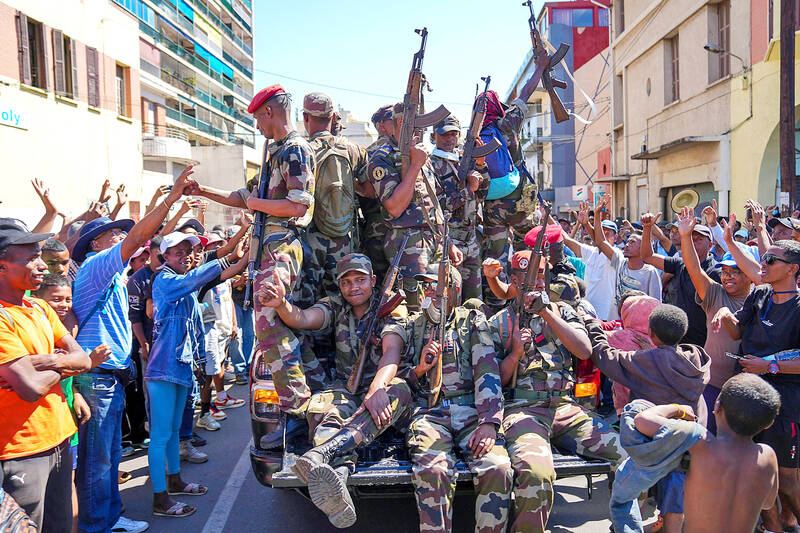
Photo: AP
Soldiers then entered the city center to meet several thousand protesters, who welcomed them with jubilation and praise.
Early on Sunday the contingent claimed in a video statement that “from now on, all orders of the Malagasy army — whether land, air or the navy — will originate from CAPSAT headquarters.”
Hours later, its pick for new chief of the army staff, General Demosthene Pikulas, was installed during a ceremony at the army headquarters attended by Madagascan Minister of Armed Forces Manantsoa Deramasinjaka Rakotoarivelo.
“I give him my blessing,” said the minister, who was appointed by Rajoelina last week.
Pikulas told journalists that events in Madagascar over the past few days had been “unpredictable.”
“So the army has a responsibility to restore calm and peace throughout Madagascar,” he said.
Asked about calls for Rajoelina to resign, he said he refused to “discuss politics within a military facility.”
Rajoelina earlier on Sunday said that “an attempt to seize power illegally and by force, contrary to the constitution and to democratic principles, is currently under way.”
“Dialogue is the only way forward and the only solution to the crisis currently facing the country,” he said in a statement.
CAPSAT Colonel Michael Randrianirina said his unit’s decision to join the protesters did not amount to a coup.
“We answered the people’s calls, but it wasn’t a coup d’etat,” he told reporters.
The protests were initially focused on chronic power and water cuts in the impoverished Indian Ocean nation, but developed into a broader anti-government movement that called for 51-year-old Rajoelina to resign.
The UN has said that at least 22 people were killed in the first days, some by security forces, and others in violence sparked by criminal gangs and looters in the wake of the demonstrations.
Rajoelina has disputed the toll, saying last week there were “12 confirmed deaths, and all of these individuals were looters and vandals.”
Large crowds of people on Sunday joined prayers outside Antananarivo City Hall for the victims, who included a CAPSAT soldier killed in a clash with gendarmes on Saturday.
“We will prevail, because evil will not prevail in Madagascar,” Randrianirina told the gathering where officers were joined on stage by opposition political figures, including former Madagascan president Marc Ravalomanana, who was ousted in the 2009 uprising.
Officers of the gendarmerie, accused of heavy-handed tactics against the demonstrators, said in a video statement that they recognized “faults and excesses during our interventions.”
“We are here to protect, not to terrorize,” they said.
To try to defuse the protests, the president last month sacked his entire government.
Meeting one of the demands of the protesters, the Madagascan Senate on Sunday announced the dismissal of its president, Richard Ravalomanana, a former general of the gendarmerie paramilitary police.
Amid rumors that Rajoelina had fled, his government on Saturday said that he remained in Madagascar and was managing national affairs.
Madagascar has had a turbulent political history since it gained independence from France in 1960.
Although rich in natural resources for farming, forestry, fishing and minerals, nearly three-quarters of the population of 32 million lived below the poverty line in 2022, according to the World Bank.

SPEAKING OUT: After Siranudh Scott’s allegations surfaced, celebrities and public figures took to social media to share their own experiences of sexual misconduct and abuse A high-profile alleged sexual abuse case within a wealthy Thai beer brewing family has prompted a wave of painful accounts from survivors of unconnected abuse in the conservative nation. Siranudh Scott, a member of the billionaire Thai family that founded the ubiquitous Singha beer brand, posted an emotional video this month accusing his elder brother Sunit of repeatedly abusing him when he was a teenager. Sunit, who is in his 30s, later denied the allegations in a video posted online, but Singha parent Boonrawd dismissed him from his executive role with the company on Tuesday last week. “I felt I needed to speak

A Hong Kong astronaut is to join a Chinese space mission for the first time as part of a three-person crew launching today, as Beijing edges closer to its goal of landing people on the moon. The Tiangong space station — crewed by teams of three astronauts that are typically rotated every six months — is the crown jewel of China’s space program, boosted by billions in state investment in a bid to catch up with the US and Russia. The Shenzhou-23 mission is to blast off at 11:08pm from the Jiuquan Satellite Launch Center in northwestern China, carrying three astronauts to

SEEKING ORDER: Rodrigo Paz said that ‘anyone who wants to destroy the nation will have to deal with this president and the full force of the constitution’ Bolivian President Rodrigo Paz on Wednesday said that the nation was at a “breaking point” after nearly a month of protests that have caused shortages of food, fuel and medicine. Paz, who took office six months ago amid the worst economic crisis there in four decades, is battling a groundswell of fury over his policies. The political capital, La Paz, has been besieged by low-income workers and members of the indigenous majority calling for his resignation. “The country needs order and is reaching breaking point,” the 58-year-old said at a public event in La Paz, renewing his appeal for dialogue. On Tuesday, the Bolivian
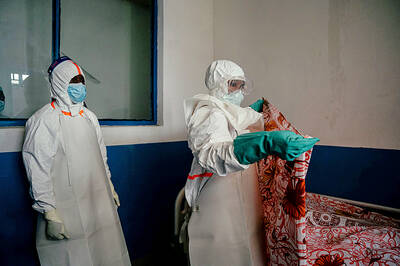
UPGRADED ALERT: The risk inside DR Congo is now considered ‘very high,’ while neighboring countries face a ‘high’ threat as the outbreak continues, the WHO said Ebola is spreading faster than responders can track it in eastern Congo, where health workers managed to follow up with barely one in five identified contacts in a single day. Authorities in the Democratic Republic of the Congo (DR Congo) reported 83 confirmed infections, 746 suspected cases and 1,603 identified contacts as of Thursday, but health workers were able to follow up on only 342 contacts that day — about 21 percent of the total under monitoring — data released by the DR Congo Ministry of Public Health on Friday showed. The figures suggest the response is falling behind the outbreak itself,


 RSS
RSS