


Leo Garcia Venegas was working at a construction site in Alabama when two immigration agents ran up to him and wrestled him to the ground.
“I’m a citizen. I’m a citizen,” he told them.
They did not believe it. He was handcuffed and detained for an hour before being released — with no apology, his lawyers said.
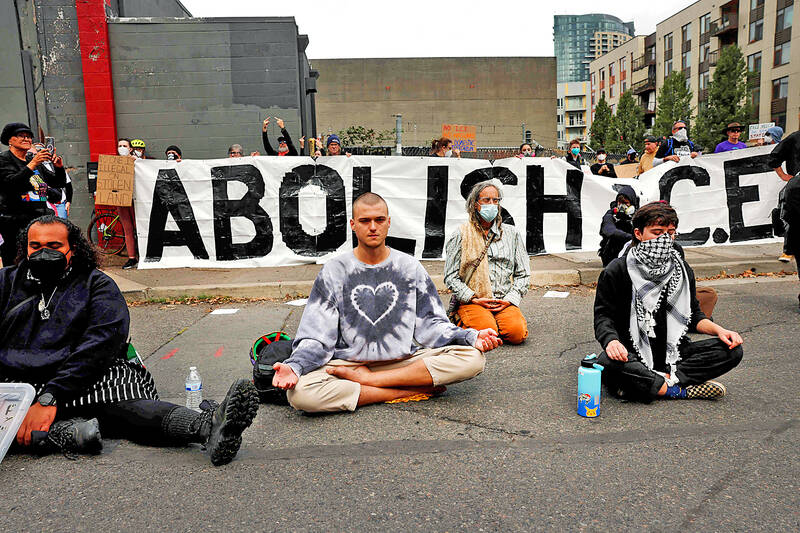
Photo: Getty Images via AFP
“The officers have no warrant, they didn’t know who Leo was and haven’t seen him breaking any laws,” said Janae Wilkerson of the public-interest Institute for Justice (IJ), which partnered with Garcia Venegas in filing a class-action lawsuit in Alabama last week.
“When the officers checked Leo’s Alabama-issued real ID, they called it fake,” Wilkerson said.
The incident occurred in May, in an area of Alabama where there is hot demand for new homes.
In June, it happened again.
“I was in one of the houses with headphones on. I felt someone behind me. It was an immigration agent who came through the garage,” Garcia Venegas said in a video produced by IJ.
“I told him that I was a citizen. They told me I had to follow them to the car to verify whether I was a citizen or no,” he said.
Garcia Venega’s lawyers say the US Department of Homeland Security’s policies allow agents to arrest anyone they believe might be undocumented, until they prove otherwise. That violates the Fourth Amendment of the US Constitution, which protects citizens against “unreasonable searches and seizures,” and warrantless arrests.
“They arrested me twice for being Latino, for working in construction,” said Garcia Venegas, a 25-year-old man born in Florida to Mexican parents.
“I live in fear every day that when I get to work it will happen again,” he said.
US President Donald Trump has launched a crackdown on illegal immigration, saying the US has been invaded by foreign criminals. US Immigration and Customs Enforcement (ICE) agents are carrying out his mass deportation operation, often armed and wearing masks.
Their activities and aggressive tactics have sparked criticism and protests. Even Pope Leo XIV has denounced the “inhumane” treatment of migrants in the US.
In a statement on Wednesday last week, the US Department of Homeland Security said Garcia Venegas was earlier detained, because he had tried to prevent “the lawful arrest of an illegal alien.”
“He physically got in between agents and the subject they were attempting to arrest, and refused to comply with numerous verbal commands,” the statement said.
Federal agents began raiding construction sites in Alabama early this year, IJ said.
“We’ll be filing a preliminary injunction next week that will ask the judge to quickly halt warrantless raids on private construction sites” in south Alabama, IJ spokesman Andrew Wimer said.
In California, Rafie Ollah Shouhed, a 79-year-old naturalized American born in Iran, is suing the US government for US$50 million after he was body-slammed during an immigration raid at his car wash early last month, fracturing his ribs, ABC news reported.
Also in California, border patrol agents attempted to handcuff Jason Brian Gavidia, a 29-year-old Latino American, with one agent demanding to know the name of the hospital where he was born, video of the interaction shows. He was released, and the government claimed he had been interfering with their work at his auto body shop.
“This is not right at all,” Gavidia told the New York Times. “Latinos in general are getting attacked. We’re all getting attacked.”
“ICE does NOT arrest or deport US citizens,” US Department of Homeland Security Assistant Secretary Tricia McLaughlin said in a statement. “Any US citizens arrested are because of obstructing or assaulting law enforcement.”

‘CROSSING THE LINE’: China’s embassy in Seoul criticized US Forces Korea Commander General Xavier Brunson, asking if his ‘hostile’ remarks were authorized by Washington South Korea and the US are in talks over recent public remarks by the commander of US Forces Korea, Seoul’s presidential office said yesterday, after the comments drew sharp criticism from China. In a recent podcast interview, US Forces Korea Commander General Xavier Brunson described South Korea as “the dagger in the heart of Asia” from China’s east coast, prompting the Chinese embassy in Seoul to say that he had “truly crossed the line.” The interview came amid growing speculation that Washington might seek to expand the role of US Forces Korea in countering the growing regional influence of China, a key

SEEKING ORDER: Rodrigo Paz said that ‘anyone who wants to destroy the nation will have to deal with this president and the full force of the constitution’ Bolivian President Rodrigo Paz on Wednesday said that the nation was at a “breaking point” after nearly a month of protests that have caused shortages of food, fuel and medicine. Paz, who took office six months ago amid the worst economic crisis there in four decades, is battling a groundswell of fury over his policies. The political capital, La Paz, has been besieged by low-income workers and members of the indigenous majority calling for his resignation. “The country needs order and is reaching breaking point,” the 58-year-old said at a public event in La Paz, renewing his appeal for dialogue. On Tuesday, the Bolivian

Through the noise of rushing papers and whirring belts at a print factory in Kyoto, two creators watch their photo essay come to life in broadsheet form — part of an effort to win new audiences in the age of artificial intelligence (AI). Despite the decline of the publishing industry, self-publication and handmade “zine” magazines are growing in popularity in Japan, reflecting the nation’s enduring love of paper in the digital era. While speaking to Agence France-Presse at the plant, his hands black with ink, one of the creators, Kazuma Obara, said: “I think [paper] is a medium that engages all five

Australian researchers have trained lab-grown brain cells on a silicon computer chip to play the 1990s shooter game Doom and said they are just scratching the surface of what the neurons could be capable of doing. It is the science-fiction work of biotech boffins at Cortical Labs, who researched and developed the technology that harnesses the workings of the brain’s networking system. Each so-called “biological computer” contains about 200,000 living human brain cells, grown from stem cells that were harvested from blood donations. Having mastered the simple computer game Pong, where a paddle is moved up and down to send a ball


 RSS
RSS