


The Church of England has named Sarah Mullally the next archbishop of Canterbury, the first woman to be nominated to lead the institution in its almost 500-year history. The role serves as the spiritual head of 85 million Anglicans worldwide.
Mullally, 63, was previously the bishop of London, a role she has performed since 2018. Before being ordained, she was chief nursing officer for England having specialized as a cancer nurse, a British government statement said on Friday.
She was educated at London South Bank University and trained for ministry at the South East Institute of Theological Education.
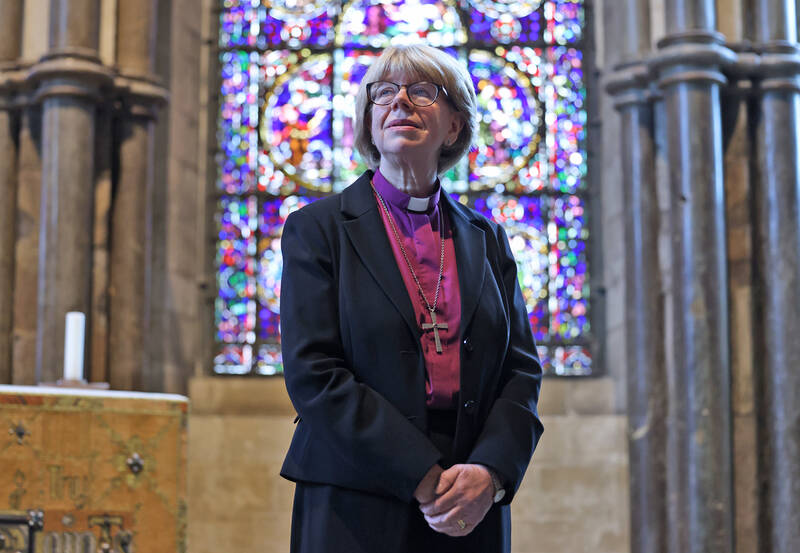
Photo: EPA
The Church of England traces its origins to when King Henry VIII broke from Rome and declared himself supreme head of the Church of England. There have been 105 previous archbishops of Canterbury — but none of them women.
The position had been empty for almost a year after Justin Welby resigned following a report that found he had not taken enough action against one of the church’s most prolific abusers, John Smyth.
Mullally would not formally take on the role until a confirmation takes place in January, and she would be installed in a service at Canterbury Cathedral two months later. Her previous actions send a signal as to how she might seek to use her position; in 2023, she referred to the Church of England’s decision to give permission for priests to bless same-sex couples as “a moment of hope for the church.”
In a statement, Mullally said: “I look forward to sharing this journey of faith with the millions of people serving God and their communities in parishes all over the country and across the global Anglican Communion.”
Speaking in Canterbury in her first address to the nation, she referenced the deadly terrorist attack outside a synagogue in Manchester on Thursday.
“Hatred and racism of any kind cannot be allowed to tear us apart,” she said.

An American scientist convicted of lying to US authorities about payments from China while he was at Harvard University has rebuilt his research lab in Shenzhen, China, to pursue technology the Chinese government has identified as a national priority: embedding electronics into the human brain. Charles Lieber, 67, is among the world’s leading researchers in brain-computer interfaces. The technology has shown promise in treating conditions such as amyotrophic lateral sclerosis and restoring movement in paralyzed people. It also has potential military applications: Scientists at the Chinese People’s Liberation Army have investigated brain interfaces as a way to engineer super soldiers by boosting
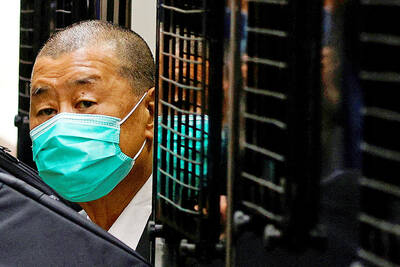
Jailed media entrepreneur Jimmy Lai (黎智英) has been awarded Deutsche Welle’s (DW) freedom of speech award for his contribution to Hong Kong’s pro-democracy movement. The German public broadcaster on Thursday said Lai would be presented in absentia with the 12th iteration of the award on June 23 at the DW Global Media Forum in Bonn. Deutsche Welle director-general Barbara Massing praised the 78-year-old founder of the now-shuttered news outlet Apple Daily for standing “unwaveringly for press freedom in Hong Kong at great personal risk.” “With Apple Daily, he gave journalists a platform for free reporting and a voice to the democracy movement in

PHILIPPINE COMMITTEE: The head of the committee that made the decision said: ‘If there is nothing to hide, there is no reason to hide, there is no reason to obstruct’ A Philippine congressional committee on Wednesday ruled that there was “probable cause” to impeach Philippine Vice President Sara Duterte after hearing allegations of unexplained wealth, misuse of state funds and threats to have the president assassinated. The unanimous decision of the 53-member committee in the Philippine House of Representatives sends the two impeachment complaints to deliberations and voting by the entire lower chamber, which has more than 300 lawmakers. The complaints centered on Duterte’s alleged illegal use and mishandling of intelligence funds from the vice president’s office, and from her time as education secretary under Philippine President Ferdinand Marcos Jr. Duterte and the

As evening falls in Fiji’s capital, a steady stream of people approaches a makeshift clinic that is a first line of defense against one of the world’s fastest-growing HIV epidemics. In the South Pacific nation — a popular tourist destination of just under a million people — more than 2,000 new HIV cases were recorded last year, a 26 percent increase from 2024. The government has declared an HIV outbreak and described it as a national crisis. “It’s spreading like wildfire,” said Siteri Dinawai, 46, who came to be tested. The Moonlight Clinic, a converted minibus parked in a suburban cul-de-sac in Suva, is


 RSS
RSS