


Afghanistan yesterday faced a second day without Internet and mobile phone service, after Taliban authorities cut the fiber-optic network.
Taliban authorities began shutting down high-speed Internet connections to some provinces last month to prevent “vice.”
On Monday night, the mobile phone signal and Internet service gradually weakened until connectivity was less than 1 percent of ordinary levels, according to Internet watchdog NetBlocks.
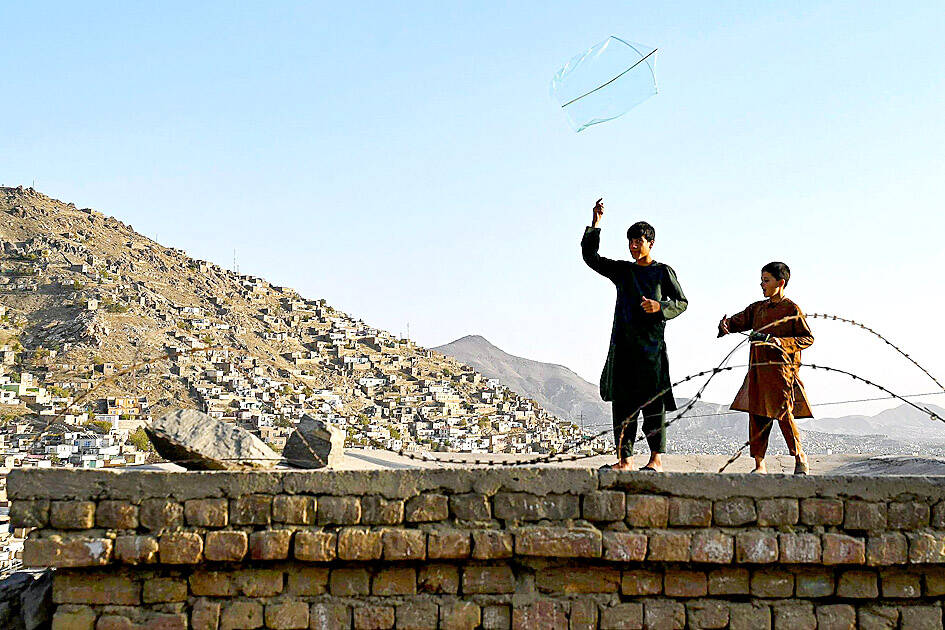
Photo: AFP
It is the first time since the Taliban government won the insurgency in 2021 and imposed a strict version of Islamic law that communications have been shut down in the nation.
“We are blind without phones and Internet,” 42-year-old shopkeeper Najibullah said in Kabul. “All our business relies on mobiles. The deliveries are with mobiles. It’s like a holiday, everyone is at home. The market is totally frozen.”
In the minutes before it happened, a government official said that the fiber-optic network would be cut, affecting mobile phone services, too.
“Eight to nine thousand telecommunications pillars” would be shut down, he said, adding that the blackout would last “until further notice.”
“There isn’t any other way or system to communicate ... the banking sector, customs, everything across the country will be affected,” said the official who asked not to be named.
Netblocks, a watchdog that monitors cybersecurity and Internet governance, said that the blackout in Afghanistan “appears consistent with the intentional disconnection of service.”
“Because of the shutdown, I’m totally disconnected with my family in Kabul,” a 40-year-old Afghan living in Oman said via text message, asking not to be named. “I don’t know whats happening, I’m really worried.”
Telephone services are often routed over the Internet, sharing the same fiber-optic network, especially in nations with limited telecoms infrastructure. Over the past weeks, Internet connections have been extremely slow or intermittent.
On Sept. 16, Balkh provincial spokesman Attaullah Zaid said the Internet was completely banned in the northern province on the Taliban leader’s orders.
“This measure was taken to prevent vice, and alternative options will be put in place across the country to meet connectivity needs,” Zaid wrote on social media.
Kabul last year had touted the 9,350km fiber-optic network — largely built by former US-backed governments — as a “priority” to bring the country closer to the rest of the world and lift it out of poverty.

An American scientist convicted of lying to US authorities about payments from China while he was at Harvard University has rebuilt his research lab in Shenzhen, China, to pursue technology the Chinese government has identified as a national priority: embedding electronics into the human brain. Charles Lieber, 67, is among the world’s leading researchers in brain-computer interfaces. The technology has shown promise in treating conditions such as amyotrophic lateral sclerosis and restoring movement in paralyzed people. It also has potential military applications: Scientists at the Chinese People’s Liberation Army have investigated brain interfaces as a way to engineer super soldiers by boosting

Jailed media entrepreneur Jimmy Lai (黎智英) has been awarded Deutsche Welle’s (DW) freedom of speech award for his contribution to Hong Kong’s pro-democracy movement. The German public broadcaster on Thursday said Lai would be presented in absentia with the 12th iteration of the award on June 23 at the DW Global Media Forum in Bonn. Deutsche Welle director-general Barbara Massing praised the 78-year-old founder of the now-shuttered news outlet Apple Daily for standing “unwaveringly for press freedom in Hong Kong at great personal risk.” “With Apple Daily, he gave journalists a platform for free reporting and a voice to the democracy movement in
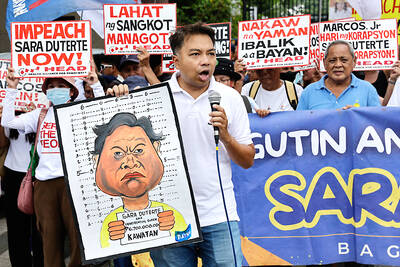
PHILIPPINE COMMITTEE: The head of the committee that made the decision said: ‘If there is nothing to hide, there is no reason to hide, there is no reason to obstruct’ A Philippine congressional committee on Wednesday ruled that there was “probable cause” to impeach Philippine Vice President Sara Duterte after hearing allegations of unexplained wealth, misuse of state funds and threats to have the president assassinated. The unanimous decision of the 53-member committee in the Philippine House of Representatives sends the two impeachment complaints to deliberations and voting by the entire lower chamber, which has more than 300 lawmakers. The complaints centered on Duterte’s alleged illegal use and mishandling of intelligence funds from the vice president’s office, and from her time as education secretary under Philippine President Ferdinand Marcos Jr. Duterte and the

Burmese President Min Aung Hlaing yesterday cut all prisoners’ sentences by one-sixth, a blanket measure that a source close to deposed leader Aung San Suu Kyi said would further shorten her detention. Aung San Suu Kyi has been sequestered since a 2021 military coup, but the senior member of her dissolved National League for Democracy (NLD) party said that while her term had been reduced, her remaining sentence is still unclear. “We also don’t know exactly how many years she has left,” the source told reporters, speaking on condition of anonymity for security reasons. The military toppled Aung San Suu Kyi’s elected government


 RSS
RSS