


US lawmakers and activists across the political spectrum called on US tech firms to stop selling surveillance equipment to Chinese police and for the US Congress to examine the issue after The Associated Press reported that US technology had played a far greater role than previously known in enabling human rights abuses by Beijing.
US Senator Josh Hawley said he wanted to summon tech companies before Congress to address how their technology exports were used.
Hawley, a longtime critic of US technology companies, bemoaned Silicon Valley’s general lack of cooperation with Congress on that and similar inquiries.
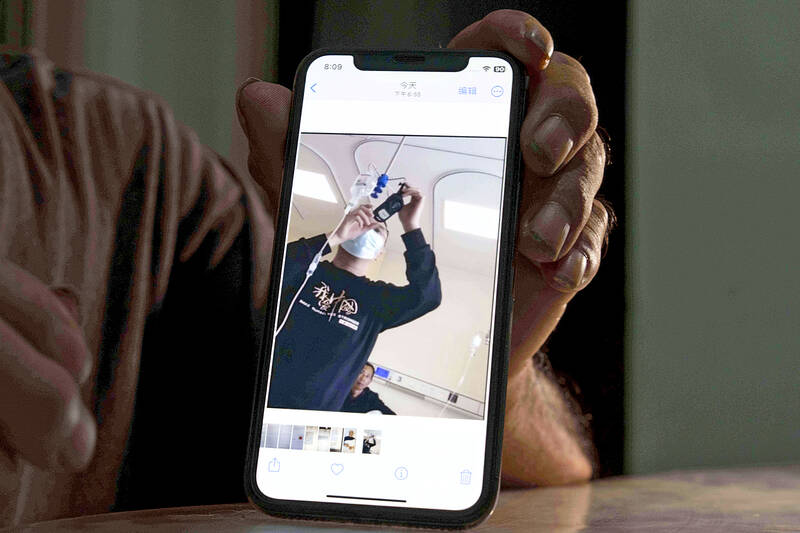
Photo: AP
“I think eventually we’re going to have to subpoena these people,” Hawley said.
Hawley wrote on social media that “Big Tech must cut ties with the CCP [Chinese Communist Party] — or face my committee.”
Hawley sits on several Senate panels that might have jurisdiction to examine technology issues.
An AP investigation published earlier this month revealed that US technology companies to a large degree designed and built China’s surveillance state. Firms including IBM, Dell and Cisco sold billions in technology to Chinese police and government agencies, despite repeated warnings that such tools were being used to quash dissent, persecute religious sects and target minorities.
Companies named in the reporting said they complied with all export control laws.
Yang Caiying (楊彩瑛), who said in the report that her family was targeted by Chinese surveillance using US technology because of their activism in rural Jiangsu Province, said she was “shocked by the pivotal role that major US tech companies have played” in her family’s ordeal.
Yang is collecting signatures for petitions urging Washington to bar US firms from selling to Chinese police, online and on the street.
Yang added that her mother and sister were each sentenced to more than a year in prison earlier this month, but that she had no regrets about telling their story.
Such reporting was necessary to expose “how miserable people’s lives can be when digital surveillance is combined with systematic human rights violations,” she said.
“Without attention, China will sink into an endless abyss,” she said.
Other lawmakers from both parties urged Congress to beef up export laws to prevent more US technology from being used to fuel human rights abuses abroad.
“China has been utilizing partnerships with US tech companies to build malignant ‘smart cities’ that are used for mass surveillance and human rights abuses against millions of innocent Chinese people,” said US Representative John Moolenaar, who chairs the US House of Representatives’ Select Committee on Strategic Competition Between the United States and the Chinese Communist Party.
“As executives at Nvidia and other American tech companies chase business in China, they cannot deny that their technology will be used to commit atrocities, strengthen China and weaken America,” Moolenaar said.
He called for US companies to work with Congress to write new laws that restrict the export of technologies that enable oppression, and work harder to keep their products from being smuggled into China.
US Senator Elizabeth Warren, a ranking member of the Senate Banking Committee that oversees export control processes, also called for strengthening restrictions.
“It’s deeply disturbing to see the extent to which some of the largest American tech companies will do the bidding of whoever pays the most — even if it means helping to build a high-tech surveillance state,” she said. “It underscores the urgency of implementing robust export controls that ensure American technology is not used to enable human rights abuses and harm US interests.”
International Campaign for Tibet president Tencho Gyatso said she was “shocked and dismayed” by the revelations in the investigation.
“I am appalled that US technology companies have made millions in profits selling to China’s security services,” Gyatso said, calling on US tech firms to “sever immediately any remaining ties or business relationships with China’s police state or entities affiliated with it.”
World Uyghur Congress vice president Zumretay Arkin said that US tech companies and scientific researchers bear responsibility for ethnic repression.
“US companies have to stop providing these technologies for the Chinese government,” Arkin said.

Kouri Richins, a Utah mother who published a children’s book about grief after the death of her husband is to serve a life sentence for his murder without the possibility of parole, a judge ruled on Wednesday. Richins was convicted in March of aggravated murder for lacing a cocktail given to her husband, Eric Richins, with five times the lethal dose of fentanyl at their home near Park City in 2022. A jury also found her guilty of four other felonies, including insurance fraud, forgery and attempted murder for trying to poison her husband weeks earlier on Feb. 14, 2022, with a

‘PERSONAL MISTAKES’: Eileen Wang has agreed to plead guilty to the felony, which comes with a maximum sentence of 10 years in federal prison A southern California mayor has agreed to plead guilty to acting as an illegal agent for the Chinese government and has resigned from her city position, officials said on Monday. Eileen Wang (王愛琳), mayor of Arcadia, was charged last month with one count of acting in the US as an illegal agent of a foreign government. She was accused of doing the bidding of Chinese officials, such as sharing articles favorable to Beijing, without prior notification to the US government as required by law. The 58-year-old was elected in November 2022 to a five-person city council, from which the mayor is selected

DELA ROSA CASE: The whereabouts of the senator, who is wanted by the ICC, was unclear, while President Marcos faces a political test over the senate situation Philippine authorities yesterday were seeking confirmation of reports that a top politician wanted by the International Criminal Court (ICC) had fled, a day after gunfire rang out at the Philippine Senate where he had taken refuge fearing his arrest. Senator Ronald “Bato” dela Rosa, the former national police chief and top enforcer of former Philippine president Rodrigo Duterte’s “war on drugs,” has been under Senate protection and is wanted for crimes against humanity, the same charges Duterte is accused of. “Several sources confirmed that the senator, Senator Bato, is no longer in the Senate premises, but we are still getting confirmation,” Presidential

HELP DENIED? The US Department of State said that the Cuban leadership refuses to allow the US to provide aid to Cubans, ‘who are in desperate need of assistance’ US Secretary of State Marco Rubio on Wednesday said that Cuba’s leadership must change, as Washington renewed an offer of US$100 million in aid if the communist nation agrees to cooperate. Cuba has been suffering severe economic tumult led by an energy shortage that plunged 65 percent of the country into darkness on Tuesday. Cuba’s leaders have blamed US sanctions, but Rubio, a Cuban American and critic of the government established by Fidel Castro, said the system was to blame, including corruption by the military. “It’s a broken, nonfunctional economy, and it’s impossible to change it. I wish it were different,” he told


 RSS
RSS