


An Italian teenager dubbed “God’s Influencer” for his efforts to spread the Catholic faith online is to become the first millennial saint tomorrow at a canonization attended by thousands of pilgrims.
Computer whiz Carlo Acutis, who died of leukemia in 2006 at the age of 15, is to be raised to sainthood by Pope Leo XIV in a solemn ceremony in St Peter’s Square at the Vatican.
The teenager’s body, dressed in jeans and a pair of Nike trainers, lies in a glass-walled tomb in Assisi, Italy, visited by hundreds of thousands of people a year.
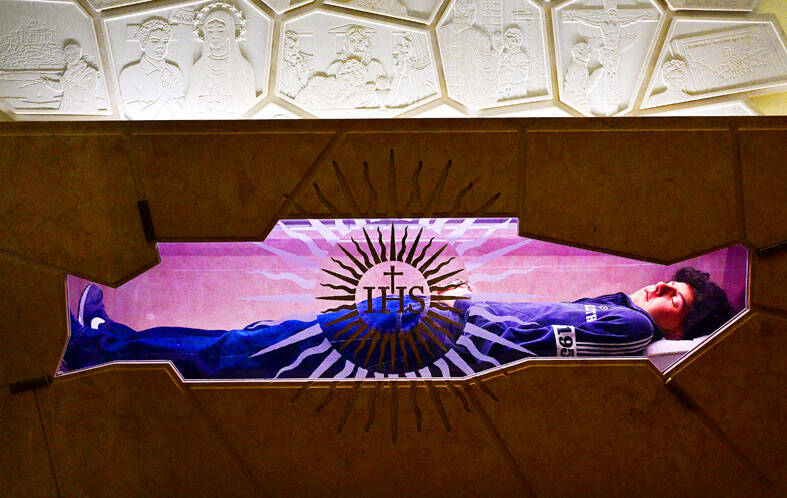
Photo: AFP
His canonization, initially set for April, but postponed when Pope Francis died, would be watched by faithful on giant screens in Assisi.
Acutis, born in London in 1991, had an ardent faith, although his parents were not particularly devout.
He grew up in the northern city of Milan, where he attended Mass daily and had a reputation for kindness to bullied children and homeless people, bringing the latter food and sleeping bags.
A fan of computer games, Acutis taught himself basic coding and used it to document miracles and other elements of the Catholic faith online.
The Vatican has recognized Acutis as performing two miracles himself since his death — a necessary step on the path to sainthood.
The first was the healing of a Brazilian child who had a rare pancreatic malformation, the second the recovery of a Costa Rican student seriously injured in an accident.
In both cases, relatives had prayed for help from the teenager, who was beatified in 2020 by Pope Francis.
More than 800 people would be traveling to Rome on a special train from Assisi for the canonization of the so-called “cyber-apostle,” which begins at 10am.
Canonization is the result of a long and meticulous process, involving an investigation by the Vatican and specialists who assess whether the obligatory miracles have taken place. Final approval rests with the pope.
Pier Giorgio Frassati, a mountaineering enthusiast who died in 1925 and was known for his social and spiritual commitment, is also to be made a saint tomorrow.
His casket is inscribed with the words “Verso l’alto” (“To the heights”), a phrase he wrote on a photograph taken of him looking up to the summit while mountaineering.
An engineering student who made it his mission to serve the poor and sick of his city, he was held up by the church as a model of charity after his death of polio at the age of 24.
He was beatified by Pope John Paul II in 1990.
The Vatican recognized the necessary second miracle to put him on the path to sainthood last year, with the unexplained healing of a young American man in a coma.
Tomorrow’s canonization ceremony is to be Pope Leo XIV’s first since his election in May.
It falls during the Jubilee, a Catholic “Holy Year” which has already drawn more than 24 million people to Rome, according to the Vatican.

‘CROSSING THE LINE’: China’s embassy in Seoul criticized US Forces Korea Commander General Xavier Brunson, asking if his ‘hostile’ remarks were authorized by Washington South Korea and the US are in talks over recent public remarks by the commander of US Forces Korea, Seoul’s presidential office said yesterday, after the comments drew sharp criticism from China. In a recent podcast interview, US Forces Korea Commander General Xavier Brunson described South Korea as “the dagger in the heart of Asia” from China’s east coast, prompting the Chinese embassy in Seoul to say that he had “truly crossed the line.” The interview came amid growing speculation that Washington might seek to expand the role of US Forces Korea in countering the growing regional influence of China, a key

SEEKING ORDER: Rodrigo Paz said that ‘anyone who wants to destroy the nation will have to deal with this president and the full force of the constitution’ Bolivian President Rodrigo Paz on Wednesday said that the nation was at a “breaking point” after nearly a month of protests that have caused shortages of food, fuel and medicine. Paz, who took office six months ago amid the worst economic crisis there in four decades, is battling a groundswell of fury over his policies. The political capital, La Paz, has been besieged by low-income workers and members of the indigenous majority calling for his resignation. “The country needs order and is reaching breaking point,” the 58-year-old said at a public event in La Paz, renewing his appeal for dialogue. On Tuesday, the Bolivian

Through the noise of rushing papers and whirring belts at a print factory in Kyoto, two creators watch their photo essay come to life in broadsheet form — part of an effort to win new audiences in the age of artificial intelligence (AI). Despite the decline of the publishing industry, self-publication and handmade “zine” magazines are growing in popularity in Japan, reflecting the nation’s enduring love of paper in the digital era. While speaking to Agence France-Presse at the plant, his hands black with ink, one of the creators, Kazuma Obara, said: “I think [paper] is a medium that engages all five

Australian researchers have trained lab-grown brain cells on a silicon computer chip to play the 1990s shooter game Doom and said they are just scratching the surface of what the neurons could be capable of doing. It is the science-fiction work of biotech boffins at Cortical Labs, who researched and developed the technology that harnesses the workings of the brain’s networking system. Each so-called “biological computer” contains about 200,000 living human brain cells, grown from stem cells that were harvested from blood donations. Having mastered the simple computer game Pong, where a paddle is moved up and down to send a ball


 RSS
RSS