


An academic in Australia who was among 19 people that Hong Kong issued bounties for has criticized the “ridiculous” arrest warrants and warned that the region was trying to exert its power beyond its borders.
Hong Kong authorities announced cash rewards on Friday for information leading to the arrest of 19 overseas activists involved in Hong Kong Parliament — a pro-democracy group established in Canada.
The bounties range from about US$25,000 to US$125,000, depending on the person.
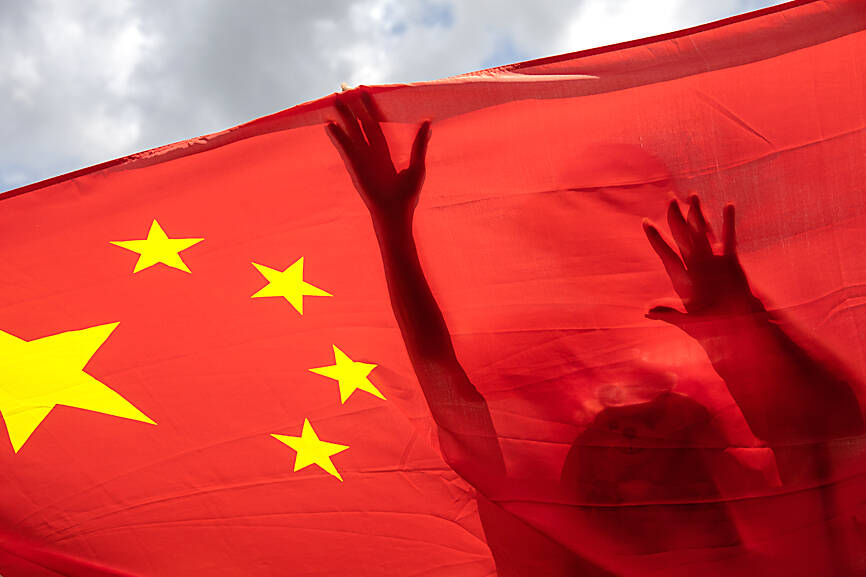
Photo: EPA
Among those named was University of Technology Sydney China studies professor Feng Chongyi (馮崇義).
“It’s certainly ridiculous,” Feng told the Sydney Morning Herald in an interview published yesterday. “They’ve got the power, they’ve got the influence overseas, they want to control everything even overseas.”
Feng told the publication he joined the group as an academic.
“I feel very sad, I’m extremely upset that the autonomous Hong Kong has been destroyed,” he said. “It’s unbearable for me.”
“Hong Kong was such a beautiful, dynamic place — the best part of Chinese culture, the combination of the East and the West,” Feng said.
Hong Kong was handed back to China in 1997 and has seen political dissent quashed since Beijing imposed a sweeping National Security Law in 2020 following huge and at times violent pro-democracy protests.
Feng, who has conducted research into China’s pro-democracy groups, was detained for a week in China in 2017.
At the time, his lawyer said he was “suspected of harming national security and could not leave China.”
Friday’s announcement of bounties was the fourth from Hong Kong authorities, which has previously drawn strong criticism from Western countries. The bounties are seen as largely symbolic, given that they affect people living abroad in nations unlikely to extradite political activists to Hong Kong or China.
Australian Minister of Foreign Affairs Penny Wong (黃英賢) yesterday said she strongly objected to the arrest warrants.
“Freedom of expression and assembly are essential to our democracy,” she wrote on X. “We have consistently expressed our strong objections to China and Hong Kong on the broad and extraterritorial application of Hong Kong’s national security legislation, and we will continue to do so.”
The UK also condemned the move as “another example of transnational repression,” according to a statement from British Secretary of State for Foreign, Commonwealth and Development Affairs David Lammy and British Home Secretary Yvette Cooper.
The Hong Kong government hit back yesterday, calling the UK’s reaction “untrue and biased.”
“Those absconders hiding in the UK and other Western countries are wanted, because they continue to blatantly engage in activities endangering national security,” it said, demanding that the UK “stop interfering in Hong Kong matters which are purely China’s internal affairs.”
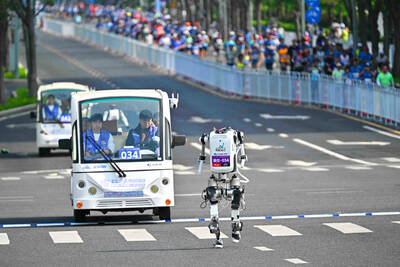
A humanoid robot that won a half-marathon race for robots in Beijing on Sunday ran faster than the human world record in a show of China’s technological leaps. The winner from Honor, a Chinese smartphone maker, completed the 21km race in 50 minutes and 26 seconds, said a WeChat post by the Beijing Economic-Technological Development Area, also known as Beijing E-Town, where the race began. That was faster than the human world record holder, Ugandan Jacob Kiplimo, who finished the same distance in about 57 minutes in March at the Lisbon road race. The performance by the robot marked a significant step forward
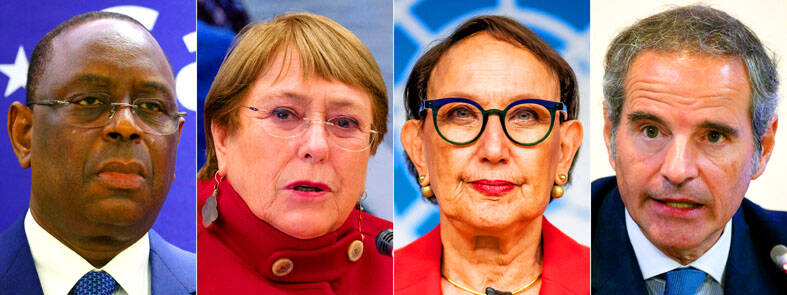
Four contenders are squaring up to succeed Antonio Guterres as secretary-general of the UN, which faces unprecedented global instability, wars and its own crushing budget crisis. Chile’s Michelle Bachelet, Argentina’s Rafael Grossi, Costa Rica’s Rebeca Grynspan and Senegal’s Macky Sall are each to face grillings by 193 member states and non-governmental organizations for three hours today and tomorrow. It is only the second time the UN has held a public question-and-answer, a format created in 2016 to boost transparency. Ultimately the five permanent members of the UN’s top body, the Security Council, hold the power, wielding vetoes over who leads the
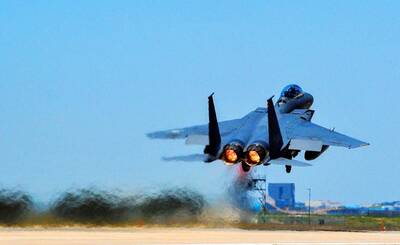
South Korea’s air force yesterday apologized for a 2021 midair collision involving two fighter jets, a day after auditors said the pilots were taking selfies and filming during the flight and held them responsible for the accident. “We sincerely apologize to the public for the concern caused by the accident that occurred in 2021,” an air force spokesman told a news conference, adding that one of the pilots involved had been suspended from flying duties, received severe disciplinary action and has since left the military. The apology followed a report released on Wednesday by the South Korean Board of Audit and Inspection,
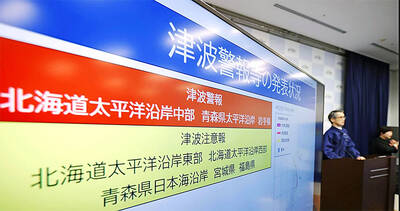
An earthquake registering a preliminary magnitude of 7.7 off northern Japan on Monday prompted a short-lived tsunami alert and the advisory of a higher risk of a possible mega-quake for coastal areas there. The Cabinet Office and the Japan Meteorological Agency said there was a 1% chance for a mega-quake, compared to a 0.1% chance during normal times, in the next week or so following the powerful quake near the Chishima and Japan trenches. Officials said the advisory was not a quake prediction but urged residents in 182 towns along the northeastern coasts to raise their preparedness while continuing their daily lives. Prime


 RSS
RSS