


The trial of an Australian woman accused of murdering three of her estranged husband’s elderly relatives using toxic mushrooms entered its final stages yesterday, with the jury to begin its deliberations in a case that has gripped the nation.
Erin Patterson, 50, is charged with the murders of her mother-in-law, Gail Patterson, father-in-law, Donald Patterson, and Gail Patterson’s sister Heather Wilkinson, along with the attempted murder of Ian Wilkinson, Heather Wilkinson’s husband, in July 2023.
The prosecution accuses her of foraging for poisonous death cap mushrooms and knowingly adding them to individual portions of beef Wellington that she served to her guests at her home in Leongatha, a town about 135km southeast of Melbourne.
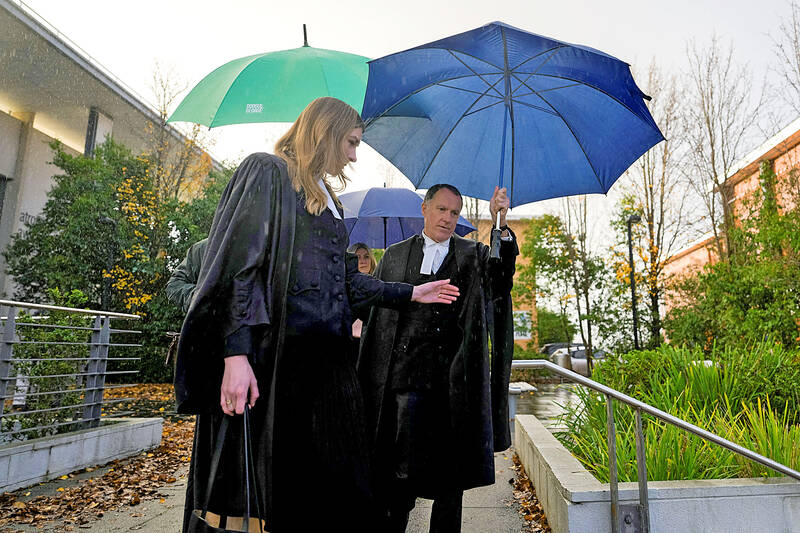
Photo: Reuters
Patterson denies the charges, which carry a life sentence, with her defense calling the deaths a “terrible accident.”
Justice Christopher Beale, the presiding judge, yesterday began his second day of instructions to the jury at the Latrobe Valley Magistrates Court in Morwell, a former coal mining town whose best-known tourist attractions until the trial were a rose garden and a regional art gallery.
Beale said that the process would take until at least the end of the day, meaning that the 14-member jury were to retire to consider their verdict today at the earliest.
Their decision must be unanimous.
Outside, despite the winter cold and rain, members of the public began lining up for the limited seats in the court hours before proceedings began.
“I am a true crime fanatic,” said Philip Mayers, a social worker who got up at 5am and drove two hours from Melbourne, the state capital, to get his place in the court. “It’s the uniqueness of it, you don’t hear it every day.”
The trial has caused a sensation in Morwell, where Patterson requested to be tried rather than Melbourne.
Laura Heller, the owner of Jay Dee’s Cafe across the road from the modest two-story court building, said that business had tripled since the trial began on April 29.
“Even though it’s not great circumstances, it has been very good for our community because it’s brought people from outside the area,” she said.
Journalists, podcasters and documentary crews from domestic and international media have descended on the town for the proceedings, which British magazine The Spectator dubbed “Australia’s trial of the century.”
Public broadcaster ABC’s daily podcast on the trial is currently the most popular in Australia, while streaming platform Stan said it would soon be airing a documentary on the trial and “media frenzy” surrounding the case.
The Cedar Lodge Motel next to the court is fully booked, unusual outside the peak summer season, duty manager John Nicoll said.
“It has been a bit of a boom for the motel and for the area in general,” he said.

SPEAKING OUT: After Siranudh Scott’s allegations surfaced, celebrities and public figures took to social media to share their own experiences of sexual misconduct and abuse A high-profile alleged sexual abuse case within a wealthy Thai beer brewing family has prompted a wave of painful accounts from survivors of unconnected abuse in the conservative nation. Siranudh Scott, a member of the billionaire Thai family that founded the ubiquitous Singha beer brand, posted an emotional video this month accusing his elder brother Sunit of repeatedly abusing him when he was a teenager. Sunit, who is in his 30s, later denied the allegations in a video posted online, but Singha parent Boonrawd dismissed him from his executive role with the company on Tuesday last week. “I felt I needed to speak

A Hong Kong astronaut is to join a Chinese space mission for the first time as part of a three-person crew launching today, as Beijing edges closer to its goal of landing people on the moon. The Tiangong space station — crewed by teams of three astronauts that are typically rotated every six months — is the crown jewel of China’s space program, boosted by billions in state investment in a bid to catch up with the US and Russia. The Shenzhou-23 mission is to blast off at 11:08pm from the Jiuquan Satellite Launch Center in northwestern China, carrying three astronauts to

SEEKING ORDER: Rodrigo Paz said that ‘anyone who wants to destroy the nation will have to deal with this president and the full force of the constitution’ Bolivian President Rodrigo Paz on Wednesday said that the nation was at a “breaking point” after nearly a month of protests that have caused shortages of food, fuel and medicine. Paz, who took office six months ago amid the worst economic crisis there in four decades, is battling a groundswell of fury over his policies. The political capital, La Paz, has been besieged by low-income workers and members of the indigenous majority calling for his resignation. “The country needs order and is reaching breaking point,” the 58-year-old said at a public event in La Paz, renewing his appeal for dialogue. On Tuesday, the Bolivian

UPGRADED ALERT: The risk inside DR Congo is now considered ‘very high,’ while neighboring countries face a ‘high’ threat as the outbreak continues, the WHO said Ebola is spreading faster than responders can track it in eastern Congo, where health workers managed to follow up with barely one in five identified contacts in a single day. Authorities in the Democratic Republic of the Congo (DR Congo) reported 83 confirmed infections, 746 suspected cases and 1,603 identified contacts as of Thursday, but health workers were able to follow up on only 342 contacts that day — about 21 percent of the total under monitoring — data released by the DR Congo Ministry of Public Health on Friday showed. The figures suggest the response is falling behind the outbreak itself,


 RSS
RSS