


A New Zealand court yesterday discharged the husband of an Australian diplomat without convicting him, months after the man pleaded guilty to assault for drunkenly spitting on a teenager during a street altercation on the night of a rugby union match in Wellington.
The man was granted permanent name suppression.
Judge Paul Mabey, presiding at the Wellington District Court, said that he did not accept the man’s arguments that the potential harms to him justified the discharge, but the magistrate agreed that his wife’s diplomatic career could be curbed by an assault conviction and the publication of his name.
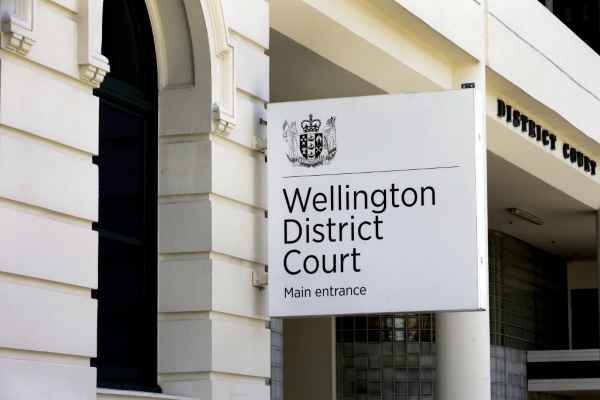
Photo: AP
The man could be barred from travel abroad to her future postings and the family could be split up if the Australian High Commission decided he could not remain in New Zealand to preserve bilateral relations between the countries, the judge said.
The charges arose after an incident in September last year after the man attended a rugby union match between New Zealand and Australia in the capital, which Australia lost 33-13.
He was drunk when he arrived at Wellington’s main nightlife area, where he approached a group of teenagers and became aggressive when they did not want to engage with him, the judge said.
A member of the group punched the man, who responded by spitting on a young woman. He was arrested by police officers who were on patrol.
The case has provoked widespread news coverage in New Zealand and Australia, which featured cellphone footage of the man’s arrest. In the video, he was seen verbally abusing a police officer and claiming to have diplomatic immunity.
He had such immunity, conferred by protocol to the partners of senior envoys to New Zealand, which he later waived voluntarily.
He pleaded guilty to New Zealand’s lowest level of assault charge in January. It is punishable by up to six months in jail and a fine of up to NZ$4,000 (US$2,385).
“For the avoidance of any doubt at all, he is not here to be sentenced for abusing the police or rashly claiming diplomatic immunity,” Mabey said.
“He was right to say he had that immunity,” the judge added. “He was completely stupid to say it at all.”
The magistrate said he would discharge the man because of his wife’s suggestion that the Australian diplomatic service would be unable to ignore the husband’s conviction and the widely distributed cellphone video of his arrest when considering her future.
“If I were not to suppress his name, his offending would be inextricably linked to his wife and she would suffer considerably,” the judge said.
He rejected a bid by the man’s lawyer to suppress the country his wife represented in New Zealand.

PHISHING: The con might appear convincing, as the scam e-mails can coincide with genuine messages from Apple saying you have run out of storage For a while you have been getting messages from Apple saying “your iCloud storage is full.” They say you have exceeded your storage plan, so documents are no longer being backed up, and photos you take are not being uploaded. You have been resisting Apple’s efforts to get you to pay a minimum of £0.99 (US$1.33) a month for more storage, but it seems that you cannot keep putting off the inevitable: You have received an e-mail which says your iCloud account has been blocked, and your photos and videos would be deleted very soon. To keep them you need

For two decades, researchers observed members of the Ngogo chimpanzee group of Kibale National Park in Uganda spend their days eating fruits and leaves, resting, traveling and grooming in their tropical rainforest abode, but this stable community then fractured and descended into years of deadly violence. The researchers are now describing the first clearly documented example of a group of wild chimpanzees splitting into two separate factions, with one launching a series of coordinated attacks against the other. Adult males and infants were targeted, with 28 deaths. “Biting, pounding the victim with their hands, dragging them, kicking them — mostly adult males,

The Israeli military has demolished entire villages as part of its invasion of south Lebanon, rigging homes with explosives and razing them to the ground in massive remote detonations. The Guardian reviewed three videos posted by the Israeli military and on social media, which showed Israel carrying out mass detonations in the villages of Taybeh, Naqoura and Deir Seryan along the Israel-Lebanon border. Lebanese media has reported more mass detonations in other border villages, but satellite imagery was not readily available to verify these claims. The demolitions came after Israeli Minister of Defense Israel Katz called for the destruction of

SUPERFAN: The Japanese PM played keyboard in a Deep Purple tribute band in middle school and then switched to drums at university, she told the British rock band Legendary British rock band Deep Purple yesterday made Japanese Prime Minister Sanae Takaichi’s day with a brief visit to their high-profile superfan as they returned to the nation they first toured more than half a century ago. Takaichi’s reputation as an amateur drummer, and a fan of hard rock and heavy metal has been well documented, and she has referred to Deep Purple as one of her favorite bands along with the likes of Black Sabbath and Iron Maiden. “You are my god,” a giddy Takaichi said in English to Deep Purple drummer Ian Paice, presenting him with a set of made-in-Japan


 RSS
RSS