


Crowds of Israelis on Monday streamed through Jerusalem’s Old City, where some scuffled with residents and hurled insults at Palestinians, as annual celebrations of Israel’s capture of east Jerusalem took place.
Jerusalem Day, as the celebrations are known, commemorates Israeli forces taking east Jerusalem during the 1967 Arab-Israeli war.
Israel considers all of Jerusalem, including the annexed Palestinian-majority east, its indivisible capital, but the international community does not recognize this, and Palestinians want east Jerusalem as the capital of a future state.
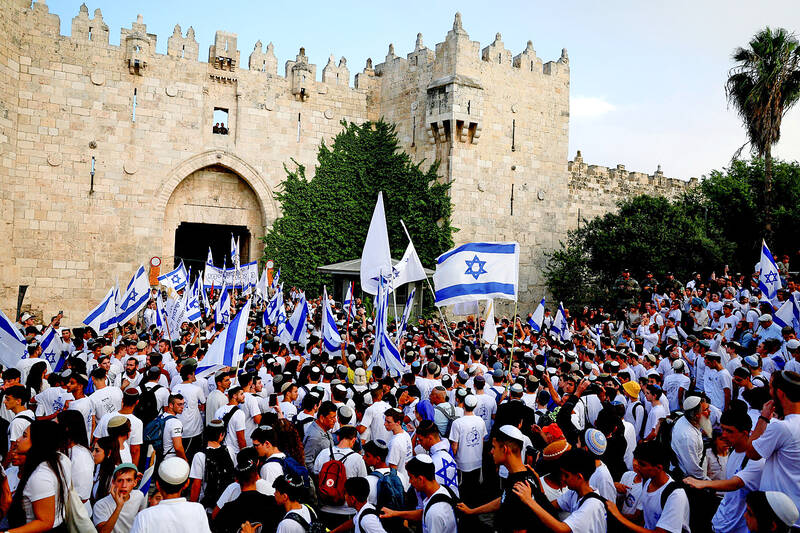
Photo: Reuters
Far-right Israeli Minister of National Security Itamar Ben Gvir on Monday visited the al-Aqsa mosque compound, known to Jews as the Temple Mount, to mark the occasion, which was being held for a second year under the shadow of the war in Gaza.
“I ascended to the Temple Mount for Jerusalem Day, and prayed for victory in the war” and the return of hostages held in Gaza, he said.
His past visits to the site have sparked anger among Palestinians and their supporters.
The al-Aqsa mosque is Islam’s third-holiest site and a symbol of Palestinian national identity. The Temple Mount is Judaism’s holiest place, although Jews are forbidden from praying there.
Every year, thousands of Israeli nationalists, many of them religious Jews, march through Jerusalem and its annexed Old City, including in predominantly Palestinian neighborhoods, waving Israeli flags, dancing and sometimes accosting residents.
The route ends at the Western Wall, the last remnant of the Second Temple destroyed by the Romans in 70AD, the holiest site where Jews are allowed to pray.
“After so many years that the people of Israel were not here in Jerusalem and in the land of Israel, we arrived here and conquered Jerusalem, the Temple Mount and the Western Wall,” said 21-year-old Yeshiva student Yosef Azoulai. “So we celebrate this day in which we won over all our enemies.”
Groups of young Israelis were seen confronting Palestinian shopkeepers, passersby and schoolchildren, as well as Israeli rights activists and police, at times spitting on people, lobbing insults and trying to force their way into houses.
Some chanted “death to Arabs,” “may your village burn” and “Gaza belongs to us,” drawing the occasional uncomfortable look from families making their way to the Western Wall.
As evening settled in, large crowds had congregated to celebrate at the holy site.
Authorities sometimes order Palestinian shops in the Old City to shut, although business owners this year said that they had mostly closed down out of fear of harassment.
Outside the Old City, former Knesset member Moshe Feiglin was advertising his far-right political party Identity.
“Every nation and every religion has its capital ... but for some reason, all the nations want a part of our one and only holy city,” he said. “Jerusalem belongs to the Jews and only to the Jews.”
This year’s Jerusalem Day comes amid renewed calls by some Israeli right-wing figures to annex more Palestinian territory as the war in Gaza rages.
The Israeli army on Monday said that three projectiles were launched from Gaza, two falling inside the territory and one intercepted.
Hamas in 2021 launched rockets toward Jerusalem as marchers approached the Old City, sparking a 12-day war in Gaza, and outbreaks of violence in Israel between Israelis and Palestinians.
Israel banned the UN’s agency for Palestinian refugees, UNRWA, from operating in east Jerusalem earlier this year over accusations that it provided cover for Hamas militants, and on Monday, a group of Israelis forced their way into one of its vacated compounds.
“The group asserted they were ‘liberating’” the facility, UNWRA West Bank director Roland Friedrich said on social media.
Israeli police, who deployed in force, said that over the course of the day “officers have handled numerous cases of suspects involved in public disturbances.”
In the morning, peace activists handed out flowers to challenge what they saw as the main march’s divisive message.
Orly Likhovski of the Israel Religious Action Center said those taking part in the peace event were “not willing to accept that this day is marked by violence and racism,” adding that they hoped to represent “a Jewish voice for a different kind of Jerusalem.”
Some Palestinians accepted the flowers, but one elderly man near Damascus Gate politely refused, saying: “Do you see what is happening in Gaza? I’m sorry, but I cannot accept.”

‘CROSSING THE LINE’: China’s embassy in Seoul criticized US Forces Korea Commander General Xavier Brunson, asking if his ‘hostile’ remarks were authorized by Washington South Korea and the US are in talks over recent public remarks by the commander of US Forces Korea, Seoul’s presidential office said yesterday, after the comments drew sharp criticism from China. In a recent podcast interview, US Forces Korea Commander General Xavier Brunson described South Korea as “the dagger in the heart of Asia” from China’s east coast, prompting the Chinese embassy in Seoul to say that he had “truly crossed the line.” The interview came amid growing speculation that Washington might seek to expand the role of US Forces Korea in countering the growing regional influence of China, a key

SEEKING ORDER: Rodrigo Paz said that ‘anyone who wants to destroy the nation will have to deal with this president and the full force of the constitution’ Bolivian President Rodrigo Paz on Wednesday said that the nation was at a “breaking point” after nearly a month of protests that have caused shortages of food, fuel and medicine. Paz, who took office six months ago amid the worst economic crisis there in four decades, is battling a groundswell of fury over his policies. The political capital, La Paz, has been besieged by low-income workers and members of the indigenous majority calling for his resignation. “The country needs order and is reaching breaking point,” the 58-year-old said at a public event in La Paz, renewing his appeal for dialogue. On Tuesday, the Bolivian

Through the noise of rushing papers and whirring belts at a print factory in Kyoto, two creators watch their photo essay come to life in broadsheet form — part of an effort to win new audiences in the age of artificial intelligence (AI). Despite the decline of the publishing industry, self-publication and handmade “zine” magazines are growing in popularity in Japan, reflecting the nation’s enduring love of paper in the digital era. While speaking to Agence France-Presse at the plant, his hands black with ink, one of the creators, Kazuma Obara, said: “I think [paper] is a medium that engages all five

Australian researchers have trained lab-grown brain cells on a silicon computer chip to play the 1990s shooter game Doom and said they are just scratching the surface of what the neurons could be capable of doing. It is the science-fiction work of biotech boffins at Cortical Labs, who researched and developed the technology that harnesses the workings of the brain’s networking system. Each so-called “biological computer” contains about 200,000 living human brain cells, grown from stem cells that were harvested from blood donations. Having mastered the simple computer game Pong, where a paddle is moved up and down to send a ball


 RSS
RSS