


Russian journalist Ekaterina Barabash resurfaced in Paris on Monday following a daring escape from Moscow last month after being put under house arrest and facing a 10-year prison sentence for posts condemning Russia’s full-scale invasion of Ukraine.
Reporters Without Borders (RSF) said it helped Barabash orchestrate her adrenaline-packed getaway: The outspoken war critic tore off her electronic monitoring tag and “traveled over 2,800km using clandestine routes” to evade surveillance.
“Her escape was one of the most perilous operations RSF has been involved in since Russia’s draconian laws of March 2022,” RSF director-general Thibaut Bruttin told a press conference with Barabash at the RSF headquarters in Paris. “At one point, we thought she might be dead.”
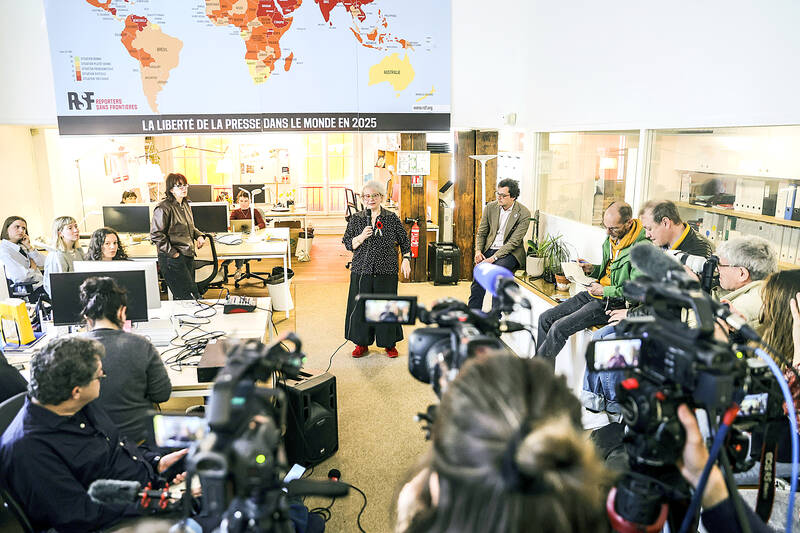
Photo: EPA-EFE
Barabash, 63, vehemently condemned the lack of freedoms in Russia while detailing her escape.
“There is no culture in Russia… There is no politics… It’s only war,” she said, adding that those unwilling to submit to state censorship either lived in exile or were imprisoned.
Barabash said the very concept of a “Russian journalist” no longer made sense. “There are no Russian journalists,” she said. “Journalism cannot exist under totalitarianism.”
The Facebook posts that landed her in legal jeopardy were written between 2022 and 2023, lambasting Russia’s actions in Ukraine.
“So you [expletive] bombed the country, razed entire cities to the ground, killed a hundred children, shot civilians for no reason, blockaded Mariupol, deprived millions of people of a normal life and forced them to leave for foreign countries? All for the sake of friendship with Ukraine?” one post read.
Russian authorities arrested the veteran journalist and film critic, born in Kharkiv, Ukraine, upon her return from the Berlinale film festival in February.
She was charged with spreading “fake news” about Russia’s military, and branded a “foreign agent.”
Barabash was then put under house arrest.
On April 21, she disappeared.
Barabash said she crossed multiple borders, using covert channels coordinated by RSF, and spent two weeks in hiding and then crossed the border on April 26, her birthday.
The hardest part was her inability to contact her 96-year-old mother, whom she had to leave behind.
“I just understood that. I’d never see her,” Barabash said, adding they both decided that not seeing her while being free was better than a Russian prison.
Barabash’s son and grandson remain in the Ukrainian capital, Kyiv. She has not been able to see them since the war started because “I have a Russian passport,” she said.
Still, her spirits remained undefeated.
Brutin said during Barabash’s escape, “she sang George Brassens.”
Barabash thanked the “many people” and the RSF team for helping her gain freedom.
“I don’t know their names,” she said.
Their identities were kept confidential for their protection.
The former Radio France Internationale contributor, who later worked with independent outlet Republic, hopes to seek asylum and resume work with exiled Russian-language media. She does not yet have a French work permit, but RSF says she holds a six-month visa and is in the process of regularizing her status.
“Now I’m here and I think it will not be [an] easy way to begin [a] new life. I’m not very young. I’m young ... but not very,” she said in a self-deprecating way.
Barabash joins a growing wave of Russian journalists in exile — more than 90 media outlets have fled to the EU and neighboring countries since the war began, according to RSF, which ranks Russia 171st out of 180 countries in its 2025 World Press Freedom Index.
After the press conference, Barabash told The Associated Press that for her, a Russian prison was “worse than death.”
“If you want to be a journalist, you have to [live in] exile,” she said. If you want [to] stay in Russia as a journalist, you are not a journalist. That is it. It’s very simple.”
At least 38 journalists remain imprisoned in Russia, and independent reporting is functionally extinct inside the country, RSF said.
Still, “free voices that dare to speak the truth about the war in Ukraine cannot be silenced,” Brutin said.
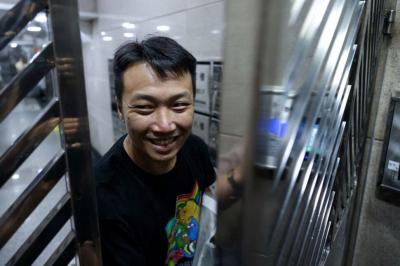
Four people jailed in the landmark Hong Kong national security trial of "47 democrats" accused of conspiracy to commit subversion were freed today after more than four years behind bars, the second group to be released in a month. Among those freed was long-time political and LGBTQ activist Jimmy Sham (岑子杰), who also led one of Hong Kong’s largest pro-democracy groups, the Civil Human Rights Front, which disbanded in 2021. "Let me spend some time with my family," Sham said after arriving at his home in the Kowloon district of Jordan. "I don’t know how to plan ahead because, to me, it feels

‘A THREAT’: Guyanese President Irfan Ali called on Venezuela to follow international court rulings over the region, whose border Guyana says was ratified back in 1899 Misael Zapara said he would vote in Venezuela’s first elections yesterday for the territory of Essequibo, despite living more than 100km away from the oil-rich Guyana-administered region. Both countries lay claim to Essequibo, which makes up two-thirds of Guyana’s territory and is home to 125,000 of its 800,000 citizens. Guyana has administered the region for decades. The centuries-old dispute has intensified since ExxonMobil discovered massive offshore oil deposits a decade ago, giving Guyana the largest crude oil reserves per capita in the world. Venezuela would elect a governor, eight National Assembly deputies and regional councilors in a newly created constituency for the 160,000
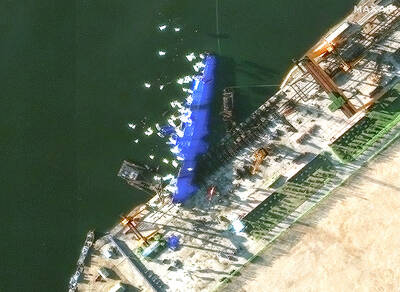
North Korea has detained another official over last week’s failed launch of a warship, which damaged the naval destroyer, state media reported yesterday. Pyongyang announced “a serious accident” at Wednesday last week’s launch ceremony, which crushed sections of the bottom of the new destroyer. North Korean leader Kim Jong-un called the mishap a “criminal act caused by absolute carelessness.” Ri Hyong-son, vice department director of the Munitions Industry Department of the Party Central Committee, was summoned and detained on Sunday, the Korean Central News Agency (KCNA) reported. He was “greatly responsible for the occurrence of the serious accident,” it said. Ri is the fourth person
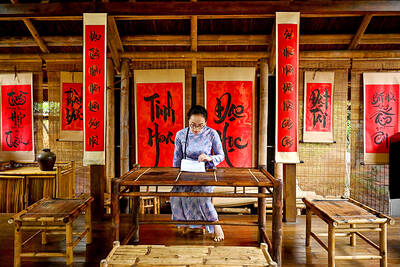
At a calligraphy class in Hanoi, Hoang Thi Thanh Huyen slides her brush across the page to form the letters and tonal marks of Vietnam’s unique modern script, in part a legacy of French colonial rule. The history of romanized Vietnamese, or Quoc Ngu, links the arrival of the first Christian missionaries, colonization by the French and the rise to power of the Communist Party of Vietnam. It is now reflected in the country’s “bamboo diplomacy” approach of seeking strength through flexibility, or looking to stay on good terms with the world’s major powers. A month after Chinese President Xi Jinping (習近平) visited,


 RSS
RSS