


Romania’s liberal interior minister Catalin Predoiu was yesterday appointed prime minister, the presidency announced, a day after Marcel Ciolacu’s resignation deepened political tumult in the EU nation.
Ciolacu, Romania’s pro-EU prime minister, stepped down on Monday after a far-right candidate topped the first round of a tense presidential vote rerun.
Far-right EU critic George Simion topped Sunday’s election first round, while the ruling coalition’s candidate narrowly lost out to Bucharest’s mayor for the second spot.
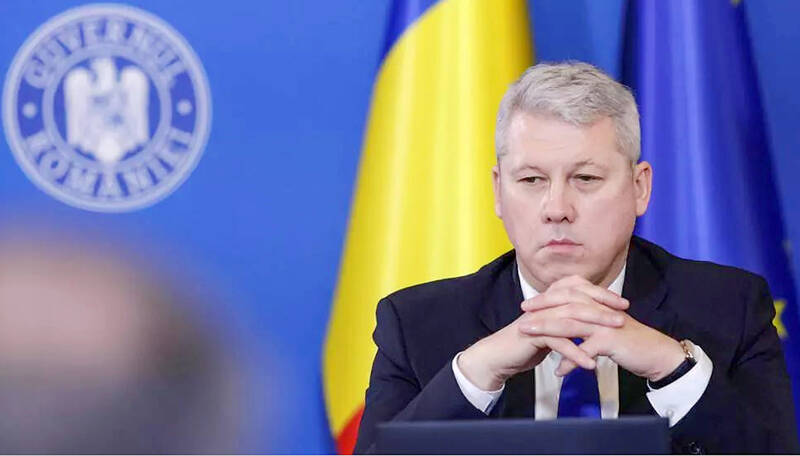
Photo: Reuters
Ciolacu’s resignation comes just two weeks ahead of the presidential runoff on May 18 in the EU and NATO member, which has gained in strategic importance since Russia invaded Ukraine.
Ciolacu said his Social Democrats (PSD) party would leave the ruling coalition, but they are expected to remain in the government on an interim basis until after the election run-off.
Predoiu, 56, is a former justice minister who already served as interim prime minister in 2012.
Predoiu, a lawyer, is also the interim president of the liberals (PNL).
He told reporters on Monday that the liberals have “sworn-in ministers in the government, they will carry out their duties.”
“As long as these mandates are in office, the PNL does its duty,” he said.
In Sunday’s first round, Simion, who leads the nationalist AUR party, gained almost 41 percent of votes, double the score of the pro-EU Mayor Nicusor Dan, an independent.
A far-right victory in the second round — closely watched by Brussels and Washington —could mark a shift in the country’s foreign policy.
The president represents Romania at EU and NATO summits and can veto EU votes. He also appoints the prime minister and other government posts.
Campaigning on a vow to put Romania first, Simion, a fan of US President Donald Trump, has criticized “Brussels’ unelected bureaucrats,” accusing them of having meddled in the Romanian elections.
In December, Romania’s constitutional court in a shock move scrapped the presidential ballot after far-right politician Calin Georgescu unexpectedly won the first round.
The annulment followed allegations of Russian interference and a massive TikTok campaign that emerged in favor of Georgescu.
Simion has called the annulment “a coup d’etat.” Georgescu was barred from the rerun, but two major far-right parties decided to back Simion instead.

In the sweltering streets of Jakarta, buskers carry towering, hollow puppets and pass around a bucket for donations. Now, they fear becoming outlaws. City authorities said they would crack down on use of the sacred ondel-ondel puppets, which can stand as tall as a truck, and they are drafting legislation to remove what they view as a street nuisance. Performances featuring the puppets — originally used by Jakarta’s Betawi people to ward off evil spirits — would be allowed only at set events. The ban could leave many ondel-ondel buskers in Jakarta jobless. “I am confused and anxious. I fear getting raided or even

Eleven people, including a former minister, were arrested in Serbia on Friday over a train station disaster in which 16 people died. The concrete canopy of the newly renovated station in the northern city of Novi Sad collapsed on Nov. 1, 2024 in a disaster widely blamed on corruption and poor oversight. It sparked a wave of student-led protests and led to the resignation of then-Serbian prime minister Milos Vucevic and the fall of his government. The public prosecutor’s office in Novi Sad opened an investigation into the accident and deaths. In February, the public prosecutor’s office for organized crime opened another probe into

RISING RACISM: A Japanese group called on China to assure safety in the country, while the Chinese embassy in Tokyo urged action against a ‘surge in xenophobia’ A Japanese woman living in China was attacked and injured by a man in a subway station in Suzhou, China, Japanese media said, hours after two Chinese men were seriously injured in violence in Tokyo. The attacks on Thursday raised concern about xenophobic sentiment in China and Japan that have been blamed for assaults in both countries. It was the third attack involving Japanese living in China since last year. In the two previous cases in China, Chinese authorities have insisted they were isolated incidents. Japanese broadcaster NHK did not identify the woman injured in Suzhou by name, but, citing the Japanese

RESTRUCTURE: Myanmar’s military has ended emergency rule and announced plans for elections in December, but critics said the move aims to entrench junta control Myanmar’s military government announced on Thursday that it was ending the state of emergency declared after it seized power in 2021 and would restructure administrative bodies to prepare for the new election at the end of the year. However, the polls planned for an unspecified date in December face serious obstacles, including a civil war raging over most of the country and pledges by opponents of the military rule to derail the election because they believe it can be neither free nor fair. Under the restructuring, Myanmar’s junta chief Min Aung Hlaing is giving up two posts, but would stay at the


 RSS
RSS