


In a world of trade wars, tariffs and tensions, foreign diplomats in Zimbabwe found a more lighthearted way to vie for supremacy: a cooking contest.
Ambassadors swapped briefing notes for recipes in the quest to win the second annual #ambassadorscookoff challenge in the southern African country last month. Their task was to produce the most delicious-looking version of a favorite local village dish of chicken with rice in a peanut butter sauce. The public voted online after the diplomats posted photos of their finished meals.
“The atmosphere in international relations these days is a little bit tense,” French Ambassador to Zimbabwe and cook-off competitor Paul-Bertrand Barets said. “We are human beings. As diplomats, we want also to have some fun and to relax.”
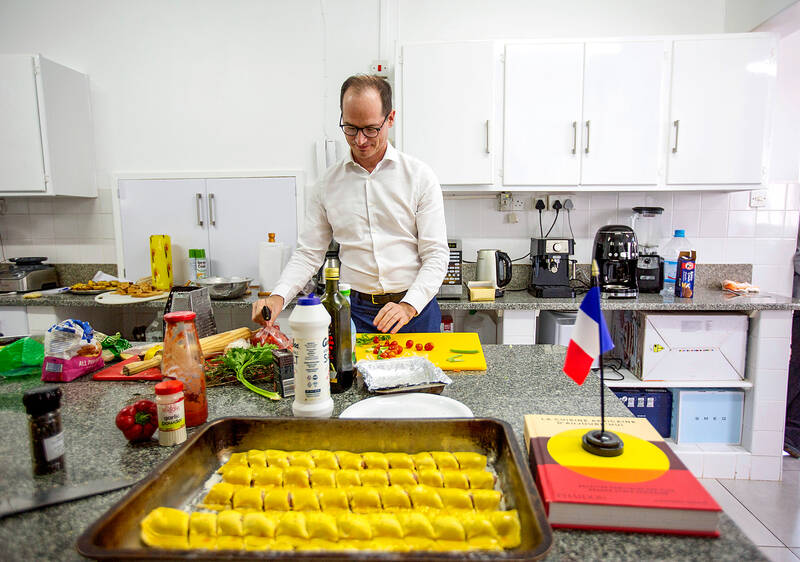
Photo: AP
Barets, in a blow for his food-famous nation, did not win.
The crown went to Dutch Ambassador Margret Verwijk. Other contestants included ambassadors from Canada, the UK, Australia, Turkey and “flavor master” Murad Baseer, the ambassador of Pakistan, whose meal took third place.
The dish the ambassadors were judged on has its own story.
It is made with what are known as “road runner” chickens — hardy free-range birds whose tough, flavorful meat is deemed by many to be tastier than that of commercially bred chickens. Known for scavenging and surviving in harsh rural conditions, the chickens are a staple of Zimbabwe village cuisine and often command high prices in urban restaurants.
The cookoff organized by Zimbabwe’s popular online foodie community TeamFulo encouraged the foreign envoys to do more than just cook a good meal.
They visited rural and township markets to source their ingredients, learned local cooking practices and immersed themselves in Zimbabwean food, humor and culture. From bargaining at the markets in the local Shona language to cooking on open fires with clay or iron pots, and even tossing in some Zimbabwean slang for flair, the contestants dived in and posted their progress on social media.
For Zimbabweans following online, it provided a rare chance to see foreign diplomats embrace local life with seemingly genuine interest and humility. Followers cheered the ambassadors on and assigned them Shona totems — symbols of kinship and respect.
Australian Ambassador Minoli Perera, whose dish took second place, knelt on a reed mat, blowing into a fire. She stirred a huge iron pot similar to those usually used for big rural feasts. Fans dubbed her “Chihera,” a revered totem associated with a lineage of assertive, independent women.
One gushed: “Ambassador, you are truly a daughter-in-law of Africa. I love it, I love it!”
British Ambassador Pete Vowles was a fan favorite. A video of him roasting and pounding peanuts and preparing other ingredients was accompanied by his best Shona commentary for each step. His experience riding home in a packed public minibus while cradling a live road runner chicken like a trophy was a hilarious highlight.
“Send us videos when you cook,” women shouted to him at the market.
He even prompted nostalgic comments from online followers like “now you make me miss my rural home.”
Vowles won the Choice Award, given to the ambassador who best connected with the public online and in person.
“You reminded us of the richness in our culinary traditions. You truly brought the spirit of community to life,” TeamFulo said.
Fulo is local slang for food.
Barets said his social media videos showing him chasing a chicken, shopping at a dusty market and demonstrating his kitchen skills gained attention and boosted interest in more formal posts on France’s diplomatic programs in Zimbabwe, which is enjoying improved relations with the US and the EU following two decades of sanctions that are gradually being removed.
The cookoff provided a unique avenue to connect with ordinary Zimbabweans and “convince them we are human beings and not statutes with neck ties,” Barets said.

Four people jailed in the landmark Hong Kong national security trial of "47 democrats" accused of conspiracy to commit subversion were freed today after more than four years behind bars, the second group to be released in a month. Among those freed was long-time political and LGBTQ activist Jimmy Sham (岑子杰), who also led one of Hong Kong’s largest pro-democracy groups, the Civil Human Rights Front, which disbanded in 2021. "Let me spend some time with my family," Sham said after arriving at his home in the Kowloon district of Jordan. "I don’t know how to plan ahead because, to me, it feels

‘A THREAT’: Guyanese President Irfan Ali called on Venezuela to follow international court rulings over the region, whose border Guyana says was ratified back in 1899 Misael Zapara said he would vote in Venezuela’s first elections yesterday for the territory of Essequibo, despite living more than 100km away from the oil-rich Guyana-administered region. Both countries lay claim to Essequibo, which makes up two-thirds of Guyana’s territory and is home to 125,000 of its 800,000 citizens. Guyana has administered the region for decades. The centuries-old dispute has intensified since ExxonMobil discovered massive offshore oil deposits a decade ago, giving Guyana the largest crude oil reserves per capita in the world. Venezuela would elect a governor, eight National Assembly deputies and regional councilors in a newly created constituency for the 160,000

North Korea has detained another official over last week’s failed launch of a warship, which damaged the naval destroyer, state media reported yesterday. Pyongyang announced “a serious accident” at Wednesday last week’s launch ceremony, which crushed sections of the bottom of the new destroyer. North Korean leader Kim Jong-un called the mishap a “criminal act caused by absolute carelessness.” Ri Hyong-son, vice department director of the Munitions Industry Department of the Party Central Committee, was summoned and detained on Sunday, the Korean Central News Agency (KCNA) reported. He was “greatly responsible for the occurrence of the serious accident,” it said. Ri is the fourth person

Poland is set to hold a presidential runoff election today between two candidates offering starkly different visions for the country’s future. The winner would succeed Polish President Andrzej Duda, a conservative who is finishing his second and final term. The outcome would determine whether Poland embraces a nationalist populist trajectory or pivots more fully toward liberal, pro-European policies. An exit poll by Ipsos would be released when polls close today at 9pm local time, with a margin of error of plus or minus 2 percentage points. Final results are expected tomorrow. Whoever wins can be expected to either help or hinder the


 RSS
RSS