


US President Donald Trump is opening a new salvo in his tariff war, targeting films made outside the US.
In a post on Sunday night on his Truth Social platform, Trump said he has authorized the Department of Commerce and the Office of the US Trade Representative to slap a 100 percent tariff “on any and all Movies coming into our Country that are produced in Foreign Lands.”
“The Movie Industry in America is DYING a very fast death,” he wrote, saying other countries “are offering all sorts of incentives to draw” filmmakers and studios away from the US. “This is a concerted effort by other Nations and, therefore, a National Security threat. It is, in addition to everything else, messaging and propaganda!”
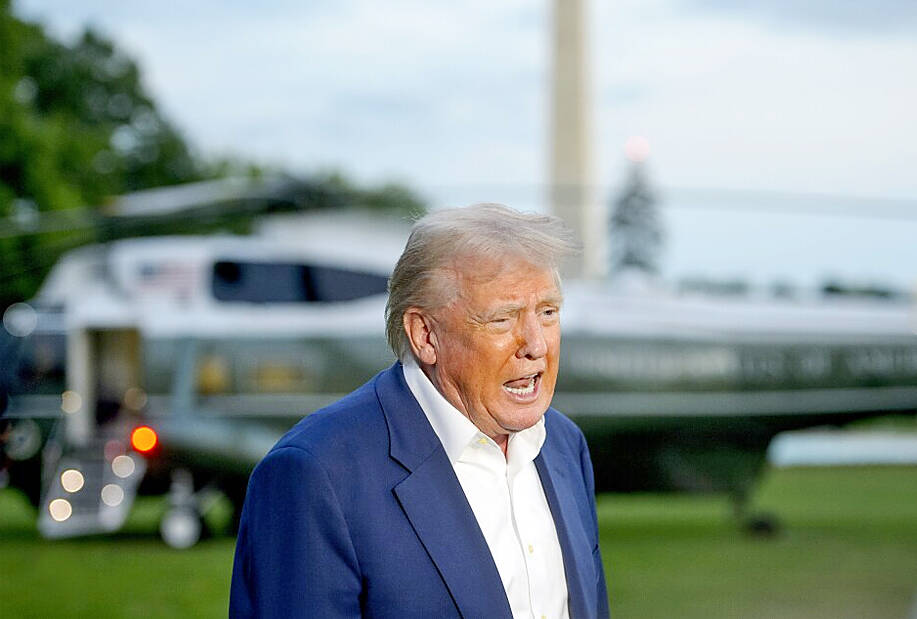
Photo:AP
It was not immediately clear how any such tariff on international productions could be implemented. It is common for both large and smaller films to include production both in the US and other countries. Big-budget movies such as the upcoming Mission: Impossible — The Final Reckoning, for instance, are shot around the world.
Incentive programs for years have influenced where movies are shot, increasingly driving film production out of California and to other states and countries with favorable tax incentives, such as Canada and UK.
Yet tariffs are designed to lead consumers toward US products, and in movie theaters, US-produced movies overwhelming dominate the domestic marketplace.
China has ramped up its domestic movie production, culminating in the animated blockbuster Ne Zha 2 (哪吒2) grossing more than US$2 billion this year. However, its sales came almost entirely from mainland China. In North America, in earned just US$20.9 million.
The Motion Picture Association (MPA) did not immediately respond to messages on Sunday evening. MPA data show how much Hollywood exports have dominated cinemas, with US-produced movies producing US$22.6 billion in exports and US$15.3 billion in trade surplus in 2023.
Trump has long voiced concern about movie production moving overseas. Shortly before he took office, he announced that he had tapped actors Mel Gibson, Jon Voight and Sylvester Stallone to serve as “special ambassadors” to Hollywood to bring it “BACK—BIGGER, BETTER, AND STRONGER THAN EVER BEFORE!”
US film and TV production has been hampered in recent years, with setbacks from the COVID-19 pandemic, the Hollywood guild strikes of 2023 and the recent wildfires in the Los Angeles area. Overall production in the US was down 26 percent last year compared with 2021, according to data from ProdPro, which tracks production.
The group’s annual survey of executives, which asked about preferred filming locations, found no location in the US made the top five, according to the Hollywood Reporter. Toronto, the UK, Vancouver, central Europe and Australia came out on top, with California placing sixth, Georgia seventh, New Jersey eighth and New York ninth.
Meanwhile, Australia and New Zealand yesterday vowed to advocate for their film industries after Trump’s tariff threat.
Australian Minister for Home Affairs Tony Burke said he had spoken to the head of government body Screen Australia, which offers funding to support the development, production and marketing of screen content, about the proposed tariffs.
“Nobody should be under any doubt that we will be standing up unequivocally for the rights of the Australian screen industry,” Burke said in a statement.
New Zealand Prime Minister Christopher Luxon said the government was awaiting further details on the proposed tariffs.
“We’ll have to see the detail of what actually ultimately emerges, but we’ll be obviously a great advocate, great champion of that sector and that industry,” he said.
Additional reporting by Reuters
The Australian film and television sector was worth more than A$4 billion (US$2.6 billion) in 2022, according to the country’s statistics bureau.
Australia was the filming location for the Matrix franchise and is a permanent base for studios including Marvel, while New Zealand is best known as the filming location of the Lord of the Rings trilogy.
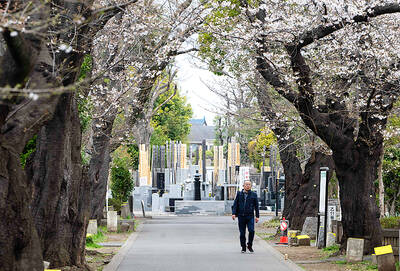
ROCKY RELATIONS: The figures on residents come as Chinese tourist numbers drop following Beijing’s warnings to avoid traveling to Japan The number of Chinese residents in Japan has continued to rise, even as ties between the two countries have become increasingly fractious, data released on Friday showed. As of the end of December last year, the number of Chinese residents had increased by 6.5 percent from the previous year to 930,428. Chinese people accounted for 22.6 percent of all foreign residents in Japan, making them by far the largest group, Japanese Ministry of Justice data showed. Beijing has criticized Tokyo in increasingly strident terms since Japanese Prime Minister Sanae Takaichi last year suggested that a military conflict around Taiwan could
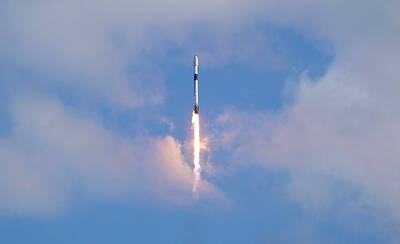
A retired US colonel behind a privately financed rocket launch site in the Dominican Republic sees the project as a response to China’s dominance of the space race in Latin America. Florida-based Launch on Demand is slated to begin building a US$600 million facility in a remote region near the border with Haiti late this year. The project is designed to meet surging demand for the heavy-lift rockets needed to put clusters of satellites into orbit. It is also an answer to China’s growing presence in the region, said CEO Burton Catledge, a former commander of the US Air Force’s 45th Operations

Germany is considering Australia’s Ghost Bat robot fighter as it looks to select a combat drone to modernize its air force, German Minister of Defense Boris Pistorius said yesterday. Germany has said it wants to field hundreds of uncrewed fighter jets by 2029, and would make a decision soon as it considers a range of German, European and US projects developing so-called “collaborative combat aircraft.” Australia has said it will integrate the Ghost Bat, jointly developed by Boeing Australia and the Royal Australian Air Force, into its military after a successful weapons test last year. After inspecting the Ghost Bat in Queensland yesterday,
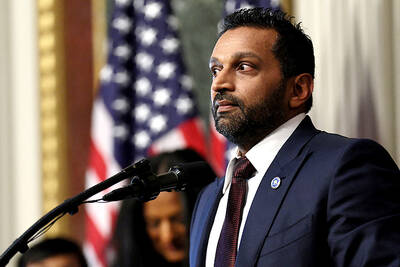
A pro-Iran hacking group claimed to breach FBI Director Kash Patel’s personal e-mail inbox and posted some of the contents online. The e-mails provided by the hacking group include travel details, correspondence with leasing agents in Washington and global entry, and loyalty account numbers. The e-mail address the hackers claim to have compromised has been previously tied to Patel’s personal details, and the leaked e-mails contain photos of Patel and others, in addition to correspondence with family members and colleagues. “The FBI is aware of malicious actors targeting Director Patel’s personal email information,” the agency said in a statement on


 RSS
RSS