


South Korean prosecutors yesterday indicted former president Moon Jae-in for bribery, making him the latest former leader of the country to face legal troubles in a case linked to the appointment of his then-son-in-law to a lucrative no-show job at a Thai airline.
Moon’s indictment adds him to a long list of South Korean leaders who have faced trials or scandals at the close of their terms or after leaving office.
Moon, 72, was indicted for bribery, while in the same case former lawmaker Lee Sang-jik was indicted for bribery and breach of trust, the Jeonju District Prosecutors’ Office said in a statement.
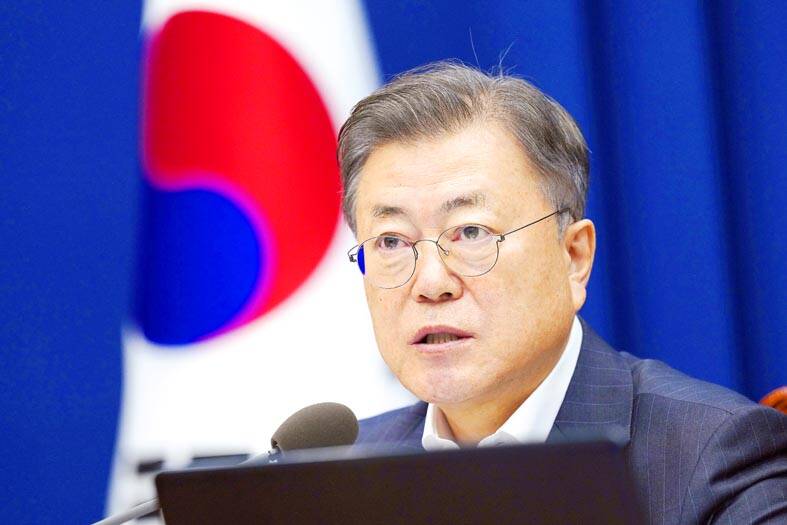
Photo: AP
Prosecutors had been investigating whether Lee’s appointment as the head of the Korea SMEs and Startups Agency was in exchange for Moon’s former son-in-law getting a job and receiving a salary plus living expenses at the budget carrier Thai Eastar Jet, which Lee controlled from 2018 to 2020, the statement said.
The prosecution said that the money Moon’s son-in-law received as an executive director, totaling 5.95 million baht (US$177,633), was irregular and constituted a bribe to the then-president, adding that the son-in-law was hired even though he had no work experience in the airline industry.
He spent only brief periods at the company’s office in Thailand and carried out only minor duties, while claiming to be working remotely from South Korea, it said.
Prosecutors referenced previous bribery cases involving former presidents Park Geun-hye and Lee Myung-bak, both of whom were convicted and jailed, as precedents for Moon’s indictment.
Moon’s party condemned the prosecution, calling the indictment “politically motivated” and “an abuse of unchecked prosecutorial power.”
“So the salary paid to the son-in-law was a bribe to the president? Is this the best logic they could come up with after dragging the case out for four long years?” Democratic Party spokeswoman Park Kyung-mee said in a statement.
The liberal-leaning Moon, a lawyer and a civil rights activist, was president from 2017 to 2022.
Moon’s successor, Yoon Suk-yeol, was removed from office this month after being impeached over his short-lived imposition of martial law last year. The conservative former leader, who had denied wrongdoing, is on trial on criminal charges of insurrection.
South Korea is holding a snap election to pick a new leader on June 3, with the liberal-leaning Lee Jae-myung from the same Democratic Party as Moon the front-runner in opinion polls to win the race.
Additional reporting by AFP

POLITICAL PRISONERS VS DEPORTEES: Venezuela’s prosecutor’s office slammed the call by El Salvador’s leader, accusing him of crimes against humanity Salvadoran President Nayib Bukele on Sunday proposed carrying out a prisoner swap with Venezuela, suggesting he would exchange Venezuelan deportees from the US his government has kept imprisoned for what he called “political prisoners” in Venezuela. In a post on X, directed at Venezuelan President Nicolas Maduro, Bukele listed off a number of family members of high-level opposition figures in Venezuela, journalists and activists detained during the South American government’s electoral crackdown last year. “The only reason they are imprisoned is for having opposed you and your electoral fraud,” he wrote to Maduro. “However, I want to propose a humanitarian agreement that
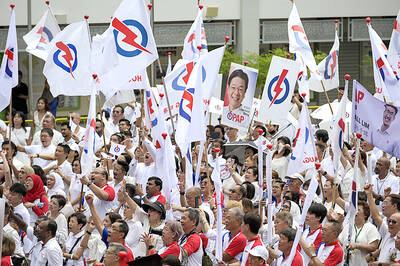
ECONOMIC WORRIES: The ruling PAP faces voters amid concerns that the city-state faces the possibility of a recession and job losses amid Washington’s tariffs Singapore yesterday finalized contestants for its general election on Saturday next week, with the ruling People’s Action Party (PAP) fielding 32 new candidates in the biggest refresh of the party that has ruled the city-state since independence in 1965. The move follows a pledge by Singaporean Prime Minister Lawrence Wong (黃循財), who took office last year and assumed the PAP leadership, to “bring in new blood, new ideas and new energy” to steer the country of 6 million people. His latest shake-up beats that of predecessors Lee Hsien Loong (李顯龍) and Goh Chok Tong (吳作棟), who replaced 24 and 11 politicians respectively

Young women standing idly around a park in Tokyo’s west suggest that a giant statue of Godzilla is not the only attraction for a record number of foreign tourists. Their faces lit by the cold glow of their phones, the women lining Okubo Park are evidence that sex tourism has developed as a dark flipside to the bustling Kabukicho nightlife district. Increasing numbers of foreign men are flocking to the area after seeing videos on social media. One of the women said that the area near Kabukicho, where Godzilla rumbles and belches smoke atop a cinema, has become a “real
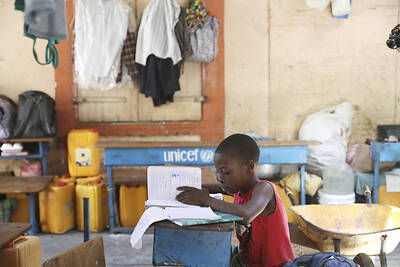
‘POINT OF NO RETURN’: The Caribbean nation needs increased international funding and support for a multinational force to help police tackle expanding gang violence The top UN official in Haiti on Monday sounded an alarm to the UN Security Council that escalating gang violence is liable to lead the Caribbean nation to “a point of no return.” Special Representative of the UN Secretary-General for Haiti Maria Isabel Salvador said that “Haiti could face total chaos” without increased funding and support for the operation of the Kenya-led multinational force helping Haiti’s police to tackle the gangs’ expanding violence into areas beyond the capital, Port-Au-Prince. Most recently, gangs seized the city of Mirebalais in central Haiti, and during the attack more than 500 prisoners were freed, she said.


 RSS
RSS