


The head of Myanmar’s military government granted amnesty to about 4,900 prisoners to mark the country’s traditional new year, state-run media reported yesterday, but it was not immediately clear how many were political detainees locked up for opposing army rule.
Senior General Min Aung Hlaing, the head of the ruling military council, pardoned 4,893 prisoners, MRTV reported.
Thirteen foreigners would also be released and deported from Myanmar, it said in a separate statement.

Photo: AP
Other prisoners received reduced sentences, except for those convicted of serious charges such as murder and rape, or those jailed on charges under other security acts.
If the freed detainees contravene the law again they would have to serve the remainder of their original sentence in addition to any new sentence, according to the terms of their release.
Mass amnesties on the holiday are not unusual in Myanmar. The releases were to occur at prisons nationwide.
Dozens of relatives and friends of prisoners waited early yesterday outside the main gate of Insein Prison, on the northern outskirts of Yangon, the country’s largest city. No details were available about the number of prisoners released from Insein as part of the amnesty.
Myanmar has been under military rule since Feb. 1, 2021, when its army ousted civilian leader Aung San Suu Kyi’s elected government. The takeover was met with massive nonviolent resistance, which has since become a widespread armed struggle.
The country is now in civil war.
As of Friday last week, 22,197 political detainees, including Aung San Suu Kyi, were in detention, according to the Assistance Association for Political Prisoners, an independent organization that keeps detailed tallies of arrests and casualties linked to the nation’s political conflicts.
Many political detainees had been held on a charge of incitement, a catch-all offense widely used to arrest critics of the government or military, and punishable by up to three years in prison.

An American scientist convicted of lying to US authorities about payments from China while he was at Harvard University has rebuilt his research lab in Shenzhen, China, to pursue technology the Chinese government has identified as a national priority: embedding electronics into the human brain. Charles Lieber, 67, is among the world’s leading researchers in brain-computer interfaces. The technology has shown promise in treating conditions such as amyotrophic lateral sclerosis and restoring movement in paralyzed people. It also has potential military applications: Scientists at the Chinese People’s Liberation Army have investigated brain interfaces as a way to engineer super soldiers by boosting
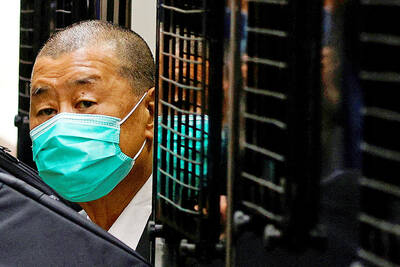
Jailed media entrepreneur Jimmy Lai (黎智英) has been awarded Deutsche Welle’s (DW) freedom of speech award for his contribution to Hong Kong’s pro-democracy movement. The German public broadcaster on Thursday said Lai would be presented in absentia with the 12th iteration of the award on June 23 at the DW Global Media Forum in Bonn. Deutsche Welle director-general Barbara Massing praised the 78-year-old founder of the now-shuttered news outlet Apple Daily for standing “unwaveringly for press freedom in Hong Kong at great personal risk.” “With Apple Daily, he gave journalists a platform for free reporting and a voice to the democracy movement in
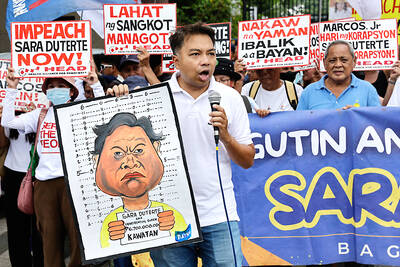
PHILIPPINE COMMITTEE: The head of the committee that made the decision said: ‘If there is nothing to hide, there is no reason to hide, there is no reason to obstruct’ A Philippine congressional committee on Wednesday ruled that there was “probable cause” to impeach Philippine Vice President Sara Duterte after hearing allegations of unexplained wealth, misuse of state funds and threats to have the president assassinated. The unanimous decision of the 53-member committee in the Philippine House of Representatives sends the two impeachment complaints to deliberations and voting by the entire lower chamber, which has more than 300 lawmakers. The complaints centered on Duterte’s alleged illegal use and mishandling of intelligence funds from the vice president’s office, and from her time as education secretary under Philippine President Ferdinand Marcos Jr. Duterte and the

As evening falls in Fiji’s capital, a steady stream of people approaches a makeshift clinic that is a first line of defense against one of the world’s fastest-growing HIV epidemics. In the South Pacific nation — a popular tourist destination of just under a million people — more than 2,000 new HIV cases were recorded last year, a 26 percent increase from 2024. The government has declared an HIV outbreak and described it as a national crisis. “It’s spreading like wildfire,” said Siteri Dinawai, 46, who came to be tested. The Moonlight Clinic, a converted minibus parked in a suburban cul-de-sac in Suva, is


 RSS
RSS