


Serbian university students who say their fight for justice is being overlooked in much of Europe on Tuesday arrived to a hero’s welcome in the heart of the EU. They cycled more than 1,300km from the Balkan country.
About 80 students who set off on bicycles 13 days earlier on a journey to Strasbourg, France, were aiming to draw EU attention to their months-long protests against corruption in the Balkan nation.
Serbia is formally seeking membership in the 27-nation bloc, but has been backsliding in democratic freedoms and the rule of law.
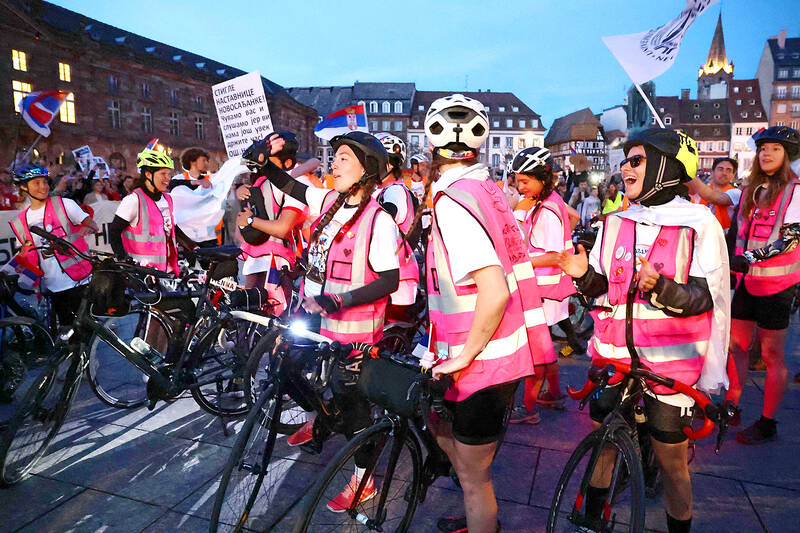
Photo: AFP
They received an emotional welcome from hundreds of people, including members of the Serbian diaspora, and French students and supporters, upon arriving at the main square in Strasbourg where the European Parliament meets.
“I think that this protest action is a full success,” one of the cyclists said in a live N1 TV broadcast from Strasbourg where people gathered. “I think we have woken up Europe.”
Serbian university students have been a key force behind a nationwide anti-graft movement that includes almost daily street demonstrations that have rattled Serbian President Aleksandar Vucic.

Photo: Reuters
While they have garnered huge support at home and throughout the Balkans, many students feel that they have not received enough backing from the EU.
The students cycled 100km to 150km per day through Hungary, Slovakia, Austria and Germany before reaching Strasbourg, where they received a red-carpet welcome from Serbians living abroad and fellow students from the EU.
They braved heavy rain and chilling temperatures along their journey across Europe that included a hero’s welcome by supporters in Budapest, Vienna and in German towns.
The student-led protests in Serbia were triggered by the deaths of 16 people in a deadly train station canopy collapse in November last year, widely blamed on rampant corruption.
They have since come to reflect wider discontent with the state of democratic freedoms in Serbia.
The protesting students have been demanding justice for the people killed in the canopy collapse, and an end to government pressure and violence against protesters.
Vucic and media have accused the students and their professors of working against the state to topple the president together with unidentified Western security services.
The EU’s reaction to the student-led protests has been lukewarm and officials have refrained from criticizing Vucic.
In Strasbourg, the students planned to visit the Council of Europe and the European Parliament.
In Serbia on Tuesday, student-led protesters temporarily blocked the entrances to TV broadcaster RTS in Belgrade and the northern town of Novi Sad to protest its coverage of the events.

South Korea’s air force yesterday apologized for a 2021 midair collision involving two fighter jets, a day after auditors said the pilots were taking selfies and filming during the flight and held them responsible for the accident. “We sincerely apologize to the public for the concern caused by the accident that occurred in 2021,” an air force spokesman told a news conference, adding that one of the pilots involved had been suspended from flying duties, received severe disciplinary action and has since left the military. The apology followed a report released on Wednesday by the South Korean Board of Audit and Inspection,

Young Chinese, many who fear age discrimination in their workplace after turning 35, are increasingly starting “one-person companies” that have artificial intelligence (AI) do most of the work. Smaller start-ups are already in vogue in Silicon Valley and elsewhere, with rapidly advancing AI tools seen as a welcome teammate even as they threaten layoffs at existing firms. More young people in China are subscribing to the model, as cities pledge millions of dollars in funding and rent subsidies for such ventures, in alignment with Beijing’s political goal of “technological self-reliance.” “The one-person company is a product of the AI era,” said Karen Dai

About 240 Indians claiming descent from a Biblical tribe landed at Tel Aviv airport on Thursday as part of a government operation to relocate them to Israel. The newcomers passed under a balloon arch in blue and white, the colors of the Israeli flag, as dozens of well-wishers welcomed them with a traditional Jewish song. They were the first “bnei Menashe” (“sons of Manasseh”) to arrive in Israel since the government in November last year announced funding for the immigration of about 6,000 members of the community from the states of Manipur and Mizoram in northeast India. The community claims to descend from

‘TROUBLING’: The firing of Phelan, who was an adviser to a nonprofit that supported the defense of Taiwan, was another example of ‘dysfunction’ under Trump, a US senator said US Secretary of the Navy John Phelan has been fired, a US official and a person familiar with the matter said on Wednesday, in another wartime shakeup at the Pentagon coming just weeks after US Secretary of Defense Pete Hegseth ousted the Army’s top general. The Pentagon announced his departure in a brief statement, saying he was leaving the administration “effective immediately,” but it did not provide a reason or say whether it was his decision to go. The sources, who spoke on condition of anonymity, said Phelan was dismissed in part because he was moving too slowly to implement reforms to


 RSS
RSS