


US Vice President J.D. Vance was yesterday to visit Greenland at a time when US President Donald Trump is renewing his insistence that Washington should take control of the semi-autonomous Danish territory.
In a scaled-back version of a trip plan that had angered authorities in Greenland and Denmark, Vance was expected to fly to the US military base at nchin the north of the arctic island.
Under the terms of a 1951 agreement, the US is entitled to visit its base whenever it wants, as long as it notifies Greenland and Copenhagen.
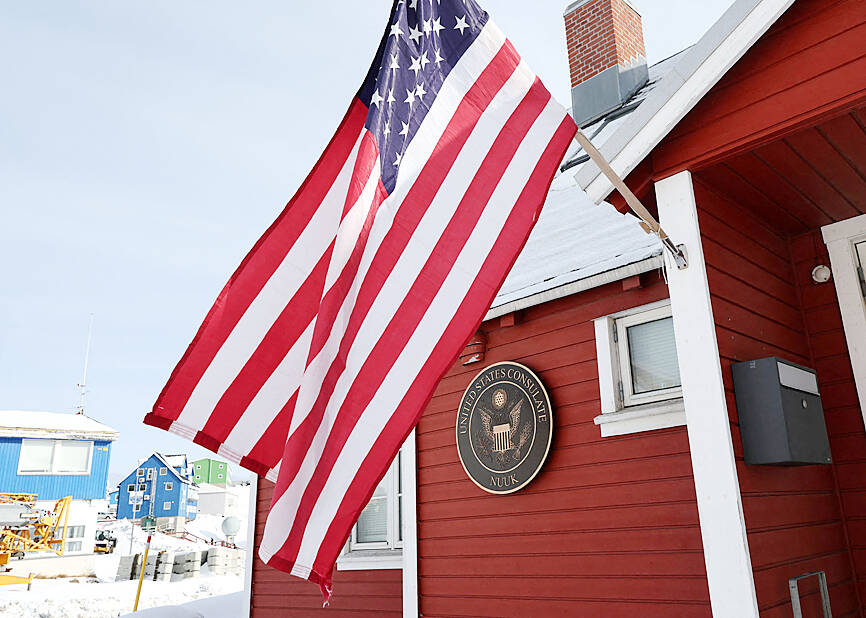
Photo: Reuters
The initial plan had been for Vance’s wife, Usha, to visit a popular dog-sled race together with US National Security Adviser Mike Waltz even though they were not invited by authorities in either Greenland or Denmark.
Waltz, who has faced pressure over Trump administration officials’ discussion of sensitive Houthi attack plans on the Signal messaging app, would still be on the Greenland trip, a White House source said.
Greenland acting prime minister Mute Egede called the visit a provocation as the country had yet to form a new government after a March 11 election.
Local media on Thursday reported that Greenland’s Democrats were to announce a four-party coalition government yesterday.
Danish Prime Minister Mette Frederiksen called the US visit “unacceptable” although Danish Minister of Foreign Affairs Lars Lokke Rasmussen welcomed news of the revised visit as a positive, de-escalating step.
By changing the trip, the Trump administration is seeking to refocus the discussion on the topics it is interested in: the US presence on Greenland, military capabilities available and the wider security of the arctic region, said Catherine Sendak, director of the Transatlantic Defense and Security Program at the Center for European Policy Analysis, a Washington-based think tank.
“A change of course was needed,” Sendak said. “It is positive, given the very public back and forth between the Danish and Greenland governments and the Trump administration about the intent of the initial visit.”
Still, Trump reiterated his desire to take over Greenland, saying the US needs the strategically island for national and international security.
“So, I think we’ll go as far as we have to go. We need Greenland and the world needs us to have Greenland, including Denmark,” he said on Wednesday.
Danish Minister of Defense Troels Lund Poulsen condemned what he called Trump’s escalated rhetoric.
The question now is how far Trump is willing to push his idea of taking over the island, said Andreas Oesthagen, a senior researcher on arctic politics and security at the Oslo-based Fridtjof Nansen Institute.
“It is still unlikely that the United States will use military means to try to get full control over Greenland,” he said.
That would break with many fundamental principles and rules that the US has benefited from and has been a pillar for, Oesthagen said.
However, “it is unfortunately likely that President Trump and Vice President Vance will continue to use other means of pressure, such as ambiguous statements, semi-official visits to Greenland and economic instruments,” he added.
“The real winner in this unnecessary drama is Russia, who gets exactly what they want: discord in the transatlantic relationship,” he said.
Tom Dans, a businessman and former member of the US Arctic Research Commission during Trump’s first presidency, said Vance’s visit would help the Trump administration understand where it can collaborate further with Greenland.
“They’re trying to put the picture together for the future and understand where the best intersections are going to be for US policy and investments to help Greenland,” Dans said.

SPEAKING OUT: After Siranudh Scott’s allegations surfaced, celebrities and public figures took to social media to share their own experiences of sexual misconduct and abuse A high-profile alleged sexual abuse case within a wealthy Thai beer brewing family has prompted a wave of painful accounts from survivors of unconnected abuse in the conservative nation. Siranudh Scott, a member of the billionaire Thai family that founded the ubiquitous Singha beer brand, posted an emotional video this month accusing his elder brother Sunit of repeatedly abusing him when he was a teenager. Sunit, who is in his 30s, later denied the allegations in a video posted online, but Singha parent Boonrawd dismissed him from his executive role with the company on Tuesday last week. “I felt I needed to speak

A Hong Kong astronaut is to join a Chinese space mission for the first time as part of a three-person crew launching today, as Beijing edges closer to its goal of landing people on the moon. The Tiangong space station — crewed by teams of three astronauts that are typically rotated every six months — is the crown jewel of China’s space program, boosted by billions in state investment in a bid to catch up with the US and Russia. The Shenzhou-23 mission is to blast off at 11:08pm from the Jiuquan Satellite Launch Center in northwestern China, carrying three astronauts to

UPGRADED ALERT: The risk inside DR Congo is now considered ‘very high,’ while neighboring countries face a ‘high’ threat as the outbreak continues, the WHO said Ebola is spreading faster than responders can track it in eastern Congo, where health workers managed to follow up with barely one in five identified contacts in a single day. Authorities in the Democratic Republic of the Congo (DR Congo) reported 83 confirmed infections, 746 suspected cases and 1,603 identified contacts as of Thursday, but health workers were able to follow up on only 342 contacts that day — about 21 percent of the total under monitoring — data released by the DR Congo Ministry of Public Health on Friday showed. The figures suggest the response is falling behind the outbreak itself,

SEEKING ORDER: Rodrigo Paz said that ‘anyone who wants to destroy the nation will have to deal with this president and the full force of the constitution’ Bolivian President Rodrigo Paz on Wednesday said that the nation was at a “breaking point” after nearly a month of protests that have caused shortages of food, fuel and medicine. Paz, who took office six months ago amid the worst economic crisis there in four decades, is battling a groundswell of fury over his policies. The political capital, La Paz, has been besieged by low-income workers and members of the indigenous majority calling for his resignation. “The country needs order and is reaching breaking point,” the 58-year-old said at a public event in La Paz, renewing his appeal for dialogue. On Tuesday, the Bolivian


 RSS
RSS