


With members of a trailblazing black Air Force unit passing away at advanced ages, efforts to remain true to their memory carry on despite sometimes confusing orders from US President Donald Trump as he purges federal diversity, equity and inclusion (DEI) programs.
Colonel James Harvey III, 101, is among the last few airmen and support crew who proved that a black unit — the 332nd Fighter Group of the Tuskegee Airmen — could fight as well as any other in World War II and the years after.
He went on to become the first black jet fighter pilot in Korean airspace during the Korean War, and a decorated one after 126 missions. He was one of four Tuskegee Airmen who won the first US Air Force Gunnery Meet in 1949, a forerunner of today’s US Navy “Top Gun” school.
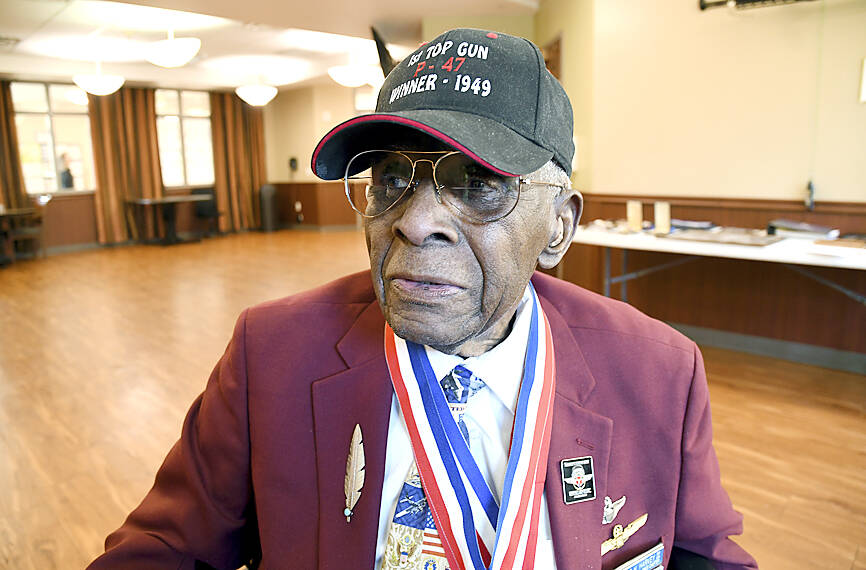
Photo: AP
“They said we didn’t have any ability to operate aircraft or operate heavy machinery. We were inferior to the white man. We were nothing,” Harvey said. “So we showed them.”
Shortly after Trump’s January inauguration, the US Air Force removed new recruit training courses that included videos of the Tuskegee Airmen.
The removal drew bipartisan outrage and the White House’s ire over what US Secretary of Defense Pete Hegseth described as “malicious implementation” of Trump’s executive order.
The Air Force quickly reversed course.
Announcing the reversal, US Air Force Chief of Staff General David Allvin said in a statement that the initial removal was because the service, like other agencies, had to move swiftly to comply with Trump’s executive order with “no equivocation, no slow-rolling, no foot-dragging.”
The videos were shown to troops as part of DEI courses taken during basic military training. Some photographs of Tuskegee Airmen were also among tens of thousands of images in a Pentagon database flagged for removal.
“I thought there was progress in that area, but evidently there isn’t,” said Harvey, who blamed Trump for contributing to what he sees as worsening prejudice in the US.
“I’ll tell him to his face. No problem,” he said. “I’ll tell him, ‘You’re a racist,’ and see what he has to say about that. What can they do to me? Just kill me, that’s all.”
The Tuskegee Airmen unit was established in 1941 as the 99th Pursuit Squadron based at the Tuskegee Institute in Alabama. The 99th became the 332nd Fighter Group, which by war’s end destroyed or damaged more than 400 enemy aircraft in North Africa and Europe during the war and sank a German destroyer in action.
Of the 992 Tuskegee Airmen trained as pilots starting in 1942, 335 were deployed, 66 were killed in action and 32 who were shot down became war prisoners.
In 1949, two months after the airmen’s gunnery meet victory in the propeller-driven class, the US Air Force integrated black and white troops and the Tuskegee Airmen were absorbed into other units.
It took the Air Force almost half a century to recognize 332nd’s last achievement: Its success in aerial bombing and shooting proficiency in the gunnery meet at what is now Nellis Air Force Base in Nevada.
For decades, the winners were listed as “unknown” and their trophy was missing.
“We won them all,” Harvey said. “We weren’t supposed to win anything because of the color of our skin.”
Harvey trained during World War II, but was not deployed to combat before the war ended. In Korea, he flew the F-80 Shooting Star jet and earned medals including the Distinguished Flying Cross.
He retired as a lieutenant colonel in 1965 and received an honorary promotion to colonel in 2023.
Trump in 2020 promoted another of the last surviving Tuskegee Airmen, Charles McGee, to brigadier general. McGee died in 2022 at age 102.
Harvey still regards the Air Force Gunnery Meet as his biggest accomplishment, one the Air Force finally recognized in 1993.
Their missing trophy was found in a museum storeroom not long after.
“We were good, and they couldn’t take it away from us,” Harvey said. “We were good, and I’ll repeat it until I die.”

Nauru has started selling passports to fund climate action, but is so far struggling to attract new citizens to the low-lying, largely barren island in the Pacific Ocean. Nauru, one of the world’s smallest nations, has a novel plan to fund its fight against climate change by selling so-called “Golden Passports.” Selling for US$105,000 each, Nauru plans to drum up more than US$5 million in the first year of the “climate resilience citizenship” program. Almost six months after the scheme opened in February, Nauru has so far approved just six applications — covering two families and four individuals. Despite the slow start —

North Korean troops have started removing propaganda loudspeakers used to blare unsettling noises along the border, South Korea’s military said on Saturday, days after Seoul’s new administration dismantled ones on its side of the frontier. The two countries had already halted propaganda broadcasts along the demilitarized zone, Seoul’s military said in June after the election of South Korean President Lee Jae-myung, who is seeking to ease tensions with Pyongyang. The South Korean Ministry of National Defense on Monday last week said it had begun removing loudspeakers from its side of the border as “a practical measure aimed at helping ease

DEADLY TASTE TEST: Erin Patterson tried to kill her estranged husband three times, police said in one of the major claims not heard during her initial trial Australia’s recently convicted mushroom murderer also tried to poison her husband with bolognese pasta and chicken korma curry, according to testimony aired yesterday after a suppression order lapsed. Home cook Erin Patterson was found guilty last month of murdering her husband’s parents and elderly aunt in 2023, lacing their beef Wellington lunch with lethal death cap mushrooms. A series of potentially damning allegations about Patterson’s behavior in the lead-up to the meal were withheld from the jury to give the mother-of-two a fair trial. Supreme Court Justice Christopher Beale yesterday rejected an application to keep these allegations secret. Patterson tried to kill her

CORRUPTION PROBE: ‘I apologize for causing concern to the people, even though I am someone insignificant,’ Kim Keon-hee said ahead of questioning by prosecutors The wife of South Korea’s ousted former president Yoon Suk-yeol yesterday was questioned by a special prosecutor as investigators expanded a probe into suspicions of stock manipulation, bribery and interference in political party nominations. The investigation into Kim Keon-hee is one of three separate special prosecutor probes launched by the government targeting the presidency of Yoon, who was removed from office in April and rearrested last month over his brief imposition of martial law on Dec. 3 last year. The incident came during a seemingly routine standoff with the opposition, who he described as “anti-state” forces abusing their legislative majority to obstruct


 RSS
RSS