


Activists have called for press freedom to be protected in Indonesia and demanded an investigation after a magazine critical of the government was sent a pig’s head and decapitated rats.
Weekly magazine Tempo, a top Indonesian publication since the 1970s, has been critical of the policies of Indonesian President Prabowo Subianto, an ex-general whom rights groups accuse of abuses under late dictator Suharto.
Cleaners at Tempo’s office on Saturday found a box of six rats with their heads cut off, the magazine said in a statement.
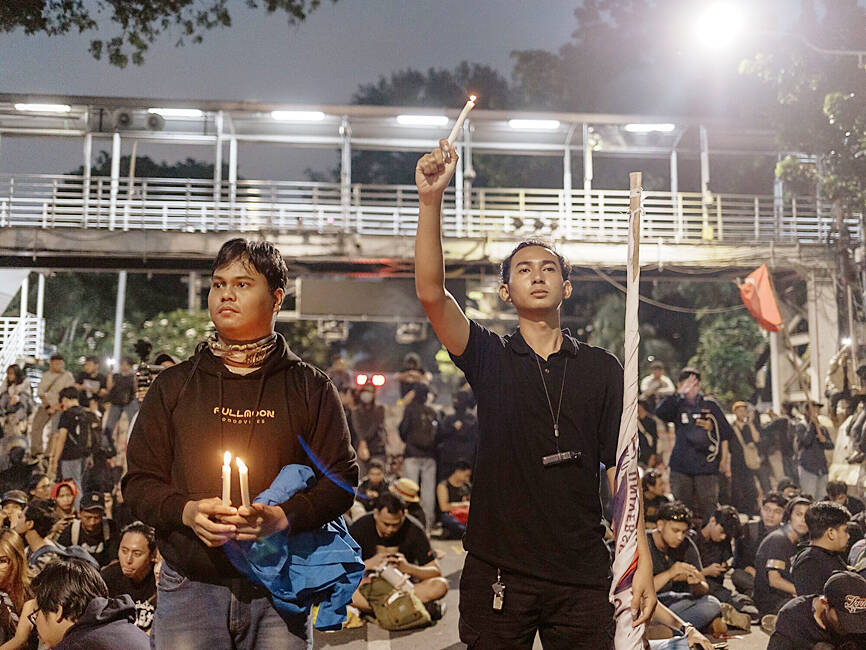
Photo: Bloomberg
A pig’s head without its ears was also found on Thursday, intended for delivery to a reporter.
“This is a dangerous and deliberate act of intimidation,” Beh Lih Yi, head of the Asia program at the Committee to Protect Journalists, said late on Saturday. “Journalists in Indonesia must be able to do their work freely and safely without fear of retaliation.”
Amnesty International Indonesia executive director Usman Hamid said an investigation must be opened, adding that there was a risk that being a journalist in Indonesia would become “like a death sentence.”
Tempo editor-in-chief Setri Yasra said the deliveries sought to undermine the publication’s work, but added it would remain committed to its mission.
“If the intention is to scare, we are not deterred, but stop this cowardly act,” Setri said in a statement.
There was no indication who sent the items, but presidential spokesman Hasan Nasbi played down the incident, telling reporters on Friday that the magazine should “just cook” the pig’s head, Indonesian media reported.
He later clarified his remark, telling news site Kompas on Saturday that press freedom must be upheld and such acts taken “seriously.”
He did not respond to a request for comment.
Setri reported the first package to police and officers visited the magazine’s office after the second package was delivered.
The magazine in the past few recent weeks has published stories criticizing Prabowo’s policies, including widespread budget cuts that stoked protests last month.
Tempo was banned twice — lastly in 1994 — under Suharto, who ruled Indonesia with an iron fist for more than three decades. It resumed publication after his downfall in the late 1990s.
Prabowo was once married to Suharto’s daughter and is accused of ordering the disappearance of democracy activists near the end of his rule, which he denies.

‘CROSSING THE LINE’: China’s embassy in Seoul criticized US Forces Korea Commander General Xavier Brunson, asking if his ‘hostile’ remarks were authorized by Washington South Korea and the US are in talks over recent public remarks by the commander of US Forces Korea, Seoul’s presidential office said yesterday, after the comments drew sharp criticism from China. In a recent podcast interview, US Forces Korea Commander General Xavier Brunson described South Korea as “the dagger in the heart of Asia” from China’s east coast, prompting the Chinese embassy in Seoul to say that he had “truly crossed the line.” The interview came amid growing speculation that Washington might seek to expand the role of US Forces Korea in countering the growing regional influence of China, a key

Through the noise of rushing papers and whirring belts at a print factory in Kyoto, two creators watch their photo essay come to life in broadsheet form — part of an effort to win new audiences in the age of artificial intelligence (AI). Despite the decline of the publishing industry, self-publication and handmade “zine” magazines are growing in popularity in Japan, reflecting the nation’s enduring love of paper in the digital era. While speaking to Agence France-Presse at the plant, his hands black with ink, one of the creators, Kazuma Obara, said: “I think [paper] is a medium that engages all five

Australian researchers have trained lab-grown brain cells on a silicon computer chip to play the 1990s shooter game Doom and said they are just scratching the surface of what the neurons could be capable of doing. It is the science-fiction work of biotech boffins at Cortical Labs, who researched and developed the technology that harnesses the workings of the brain’s networking system. Each so-called “biological computer” contains about 200,000 living human brain cells, grown from stem cells that were harvested from blood donations. Having mastered the simple computer game Pong, where a paddle is moved up and down to send a ball

France experienced its hottest spring on record, the French weather service said on Tuesday, after an exceptional early heat wave that also broke highs for the season in England and Wales. Meteo-France said the average nationwide temperature over March to May was 13.8°C — about 1.7°C above the norm, and surpassing records set in 2011 and 2020. “The warmest spring since records began in 1900,” it said in a bulletin. All three months were warmer than average, but the onset of an “unprecedented heatwave” late last month pushed the mercury to highs typically seen at the height of the summer. “Our country had never


 RSS
RSS