


Legal advocacy groups on Saturday sounded alarms after US President Donald Trump threatened new actions against lawyers and law firms that bring immigration lawsuits and other cases against the government that he deems unethical.
In a memorandum to US Attorney General Pam Bondi late on Friday, Trump said lawyers were helping to fuel “rampant fraud and meritless claims” in the immigration system, and directed the US Department of Justice to seek sanctions against attorneys for professional misconduct.
The order also took aim at law firms that sue the administration in what Trump, a Republican, called “baseless partisan” lawsuits. He asked Bondi to refer such firms to the White House to be stripped of security clearances, and for federal contracts they worked on to be terminated.
Photo: Bloomberg
Ben Wizner, a senior lawyer at the American Civil Liberties Union (ACLU), said the new directive sought to “chill and intimidate” lawyers who challenge the president’s agenda.
Trump has separately mounted attacks on law firms over their internal diversity policies and their ties to his political adversaries.
“Courts have been the only institution so far that have stood up to Trump’s onslaught,” Wizner said. “Courts can’t play that role without lawyers bringing cases in front of them.”
The ACLU is involved in litigation against the administration over immigrant deportations, including the expulsion of alleged Venezuelan gang members.
The Trump administration has been hit with more than 100 lawsuits challenging White House actions on immigration, transgender rights and other issues since the start of the president’s second term. Legal advocacy groups, along with at least 12 major law firms, have brought many of the cases.
“President Trump is delivering on his promise to ensure the judicial system is no longer weaponized against the American people,” White House spokeswoman Taylor Rogers said.
The Department of Justice did not immediately respond to requests for comment on the memorandum, which directed Bondi to assess lawyers and firms that brought cases against the government over the past eight years.
Law firm Keker, Van Nest & Peters, which is working with the ACLU in an immigrant rights case against the administration, said in a statement that it was “inexcusable and despicable” for Trump to attack lawyers based on their clients or legal work opposing the federal government.
Representatives from other prominent law firms that are representing clients in cases against Trump’s administration, including Hogan Lovells, Jenner & Block, Perkins Coie and WilmerHale, did not immediately respond to requests for comment.
Trump issued executive orders this month against law firms Perkins Coie and Paul Weiss, suspending their lawyers’ security clearances and restricting their access to government buildings, officials and federal contracting work.
The president also last month suspended security clearances of lawyers at Covington & Burling, in each case citing the firms’ past work for his political or legal opponents.
The Keker firm on Saturday called on law firms to sign a joint court brief supporting a lawsuit by Perkins Coie challenging the executive order against it.
Paul Weiss on Thursday struck a deal with Trump to rescind the executive order against it, pledging to donate the equivalent of US$40 million in free legal work to support some of the administration’s causes such as support for veterans and combating anti-Semitism.
Lawyers are bound by professional ethics rules that require them to investigate allegations before filing lawsuits and not deceive the courts. Imposing disciplinary sanctions on lawyers who contravene such rules falls on the court system, not federal prosecutors, although prosecutors can charge lawyers with criminal misconduct.
Some lawyers aligned with Trump faced professional discipline over claims that they contravened legal ethics rules in challenging Democrat Joe Biden’s 2020 presidential election win over Trump.
Lawyers for Civil Rights, a legal advocacy group suing the administration over deportations, called Trump’s sanctions threat hypocritical in a statement, adding that Trump and his allies “have repeatedly thumbed their noses at the rule of law.”
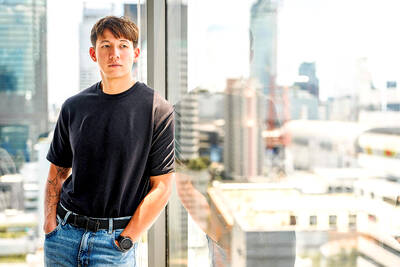
SPEAKING OUT: After Siranudh Scott’s allegations surfaced, celebrities and public figures took to social media to share their own experiences of sexual misconduct and abuse A high-profile alleged sexual abuse case within a wealthy Thai beer brewing family has prompted a wave of painful accounts from survivors of unconnected abuse in the conservative nation. Siranudh Scott, a member of the billionaire Thai family that founded the ubiquitous Singha beer brand, posted an emotional video this month accusing his elder brother Sunit of repeatedly abusing him when he was a teenager. Sunit, who is in his 30s, later denied the allegations in a video posted online, but Singha parent Boonrawd dismissed him from his executive role with the company on Tuesday last week. “I felt I needed to speak

SEEKING ORDER: Rodrigo Paz said that ‘anyone who wants to destroy the nation will have to deal with this president and the full force of the constitution’ Bolivian President Rodrigo Paz on Wednesday said that the nation was at a “breaking point” after nearly a month of protests that have caused shortages of food, fuel and medicine. Paz, who took office six months ago amid the worst economic crisis there in four decades, is battling a groundswell of fury over his policies. The political capital, La Paz, has been besieged by low-income workers and members of the indigenous majority calling for his resignation. “The country needs order and is reaching breaking point,” the 58-year-old said at a public event in La Paz, renewing his appeal for dialogue. On Tuesday, the Bolivian

A Hong Kong astronaut is to join a Chinese space mission for the first time as part of a three-person crew launching today, as Beijing edges closer to its goal of landing people on the moon. The Tiangong space station — crewed by teams of three astronauts that are typically rotated every six months — is the crown jewel of China’s space program, boosted by billions in state investment in a bid to catch up with the US and Russia. The Shenzhou-23 mission is to blast off at 11:08pm from the Jiuquan Satellite Launch Center in northwestern China, carrying three astronauts to

UPGRADED ALERT: The risk inside DR Congo is now considered ‘very high,’ while neighboring countries face a ‘high’ threat as the outbreak continues, the WHO said Ebola is spreading faster than responders can track it in eastern Congo, where health workers managed to follow up with barely one in five identified contacts in a single day. Authorities in the Democratic Republic of the Congo (DR Congo) reported 83 confirmed infections, 746 suspected cases and 1,603 identified contacts as of Thursday, but health workers were able to follow up on only 342 contacts that day — about 21 percent of the total under monitoring — data released by the DR Congo Ministry of Public Health on Friday showed. The figures suggest the response is falling behind the outbreak itself,


 RSS
RSS