


Sudan’s military yesterday said that it had retaken the Republican Palace in Khartoum, the last bastion in the capital of rival paramilitary forces, after nearly two years of fighting.
Social media videos showed soldiers inside giving the date as the 21st day of Ramadan, which was yesterday. A Sudanese military officer wearing a captain’s epaulettes made the announcement in the video, and confirmed the troops were inside the compound.
The palace appeared to be partly in ruins, with soldiers’ steps crunching broken tiles underneath their boots. Soldiers carrying assault rifles and rocket-propelled grenade launchers chanted: “God is the greatest.”
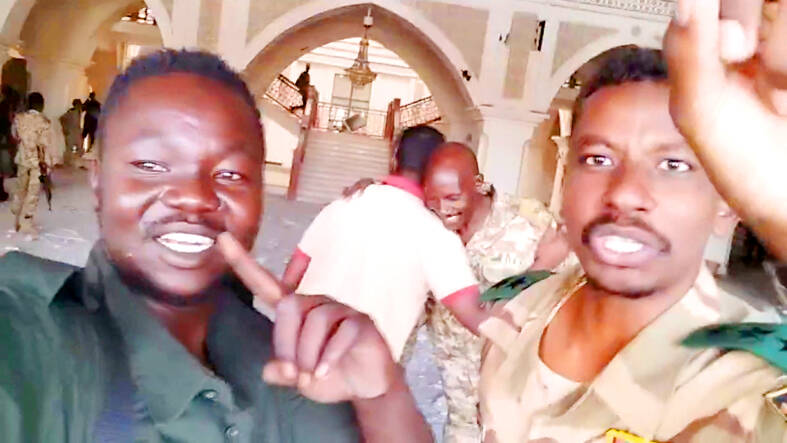
Photo: Social media via Reuters
The fall of the Republican Palace, a compound along the River Nile that was the seat of government before the war erupted and is immortalized on Sudanese banknotes and postage stamps, marks another battlefield gain for Sudan’s military. It has made steady advances under army chief General Abdel-Fattah Burhan.
It means the rival Rapid Support Forces (RSF), under General Mohammed Hamdan Dagalo, have been expelled from the capital after Sudan’s civil war began in April 2023.
The group did not immediately acknowledge the loss, which likely would not stop the fighting as the RSF and its allies still hold territory elsewhere in Sudan.
The RSF late on Thursday said that it had seized control of al-Maliha, a strategic desert city in North Darfur. Sudan’s military has acknowledged fighting around al-Maliha, but has not said it lost the city.
Al-Maliha is about 200km north of the city of El Fasher, which remains held by the Sudanese military despite near-daily strikes by the RSF.
The war has killed more than 28,000 people, forced millions to flee their homes and left some families eating grass in a desperate attempt to survive as famine sweeps parts of the nation. Other estimates suggest a far higher death toll.
The Republican Palace had been the seat of power during the British colonization of Sudan. It also saw some of the first independent Sudanese flags raised over the nation in 1956. It had been the main office of Sudan’s president and other top officials.
The Sudanese military have long targeted the palace and its grounds, shelling and firing on the compound.
The nation has been unstable since a popular uprising forced the removal of longtime autocratic Sudanese President Omar al-Bashir in 2019. A short-lived transition to democracy was derailed when Burhan and Dagalo led a military coup in 2021.
The RSF and Sudan’s military then began fighting each other in 2023.
Burhan’s forces, including Sudan’s military and allied militias, have advanced against the RSF since the start of this year. They retook a key refinery north of Khartoum. They have also pushed in on RSF positions around the capital. The fighting has led to an increase in civilian casualties.
Al-Bashir faces charges at the International Criminal Court over carrying out a genocidal campaign in the early 2000s in the western Darfur region with the Janjaweed, the precursor to the RSF.
Rights groups and the UN accuse the RSF and allied Arab militias of again attacking ethnic African groups in the war.
Since the war began, both the Sudanese military and the RSF have faced allegations of human rights abuses. Before former US president Joe Biden left office, the US Department of State said that the RSF is committing genocide.
The military and the RSF have denied committing abuses.
A ship that appears to be taking on the identity of a scrapped gas carrier exited the Strait of Hormuz on Friday, showing how strategies to get through the waterway are evolving as the Middle East war progresses. The vessel identifying as liquefied natural gas (LNG) carrier Jamal left the Strait on Friday morning, ship-tracking data show. However, the same tanker was also recorded as having beached at an Indian demolition yard in October last year, where it is being broken up, according to market participants and port agent’s reports. The ship claiming to be Jamal is likely a zombie vessel that

Cannabis-based medicines have shown little evidence of effectiveness for treating most mental health and substance-use disorders, according to a large review of past studies published in a major medical journal on Monday. Medical use of cannabinoids has been expanding, including in the US, Canada and Australia, where many patients report using cannabis products to manage conditions such as anxiety, post-traumatic stress disorder and sleep problems. Researchers reviewed data from 54 randomized clinical trials conducted between 1980 and May last year involving 2,477 participants for their analysis published in The Lancet. The studies assessed cannabinoids as a primary treatment for mental disorders or substance-use
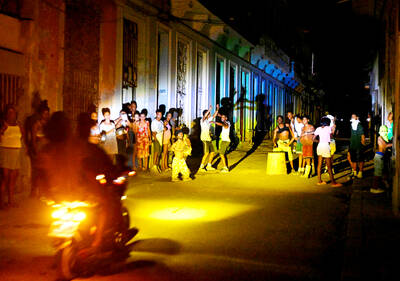
NATIONWIDE BLACKOUT: US President Donald Trump cut off Venezuelan oil shipments to Cuba, strangling the Caribbean island’s already antiquated grid Cuba’s national electric grid collapsed on Monday, the nation’s grid operator said, leaving about 10 million people without power amid a US-imposed oil blockade that has crippled the already obsolete generation system. Grid operator UNE on social media said that it is investigating the causes of the blackout, the latest in a series of widespread outages that last for hours or days and that this weekend sparked a rare violent protest in the communist-run nation. Officials ruled out a major power plant failure, but had still not pinpointed the root cause of the grid collapse, suggesting a problem with transmission. Officials said that

‘HEALTH ISSUE’: More than 250 women are hospitalized every day due to complications from unsafe abortions, and about three die, a study showed Jane had been bleeding heavily for days before finally seeking help, not from a hospital, but from the man who sold her the pills meant to end her six-week pregnancy. Abortions are strictly outlawed in the mainly Catholic Philippines, forcing women to turn to a patchwork of providers operating in the online shadows. While rare in practice, Philippine law allows for prison terms of up to six years for abortion patients and providers, leaving thousands of Filipinas to search for solutions in online forums where unlicensed sellers promote abortifacients. “It was very painful, as if my abdomen was being twisted,” said Jane, whose


 RSS
RSS