


Chinese authorities increased pressure on CK Hutchison Holdings Ltd over its plan to sell its Panama ports stake by sharing a second newspaper commentary attacking the deal.
The Hong Kong and Macau Affairs Office on Saturday reposted a commentary originally published in Ta Kung Pao, saying the planned sale of the ports by the Hong Kong company had triggered deep concerns among Chinese people and questioned whether the deal was harming China and aiding evil.
“Why were so many important ports transferred to ill-intentioned US forces so easily? What kind of political calculations are hidden in the so-called commercial behavior on the surface? Great entrepreneurs are never cold-blooded and speculating profit-seekers, but passionate and proud patriots!” said the opinion piece in the newspaper, a publication that tends to support Beijing’s policies.
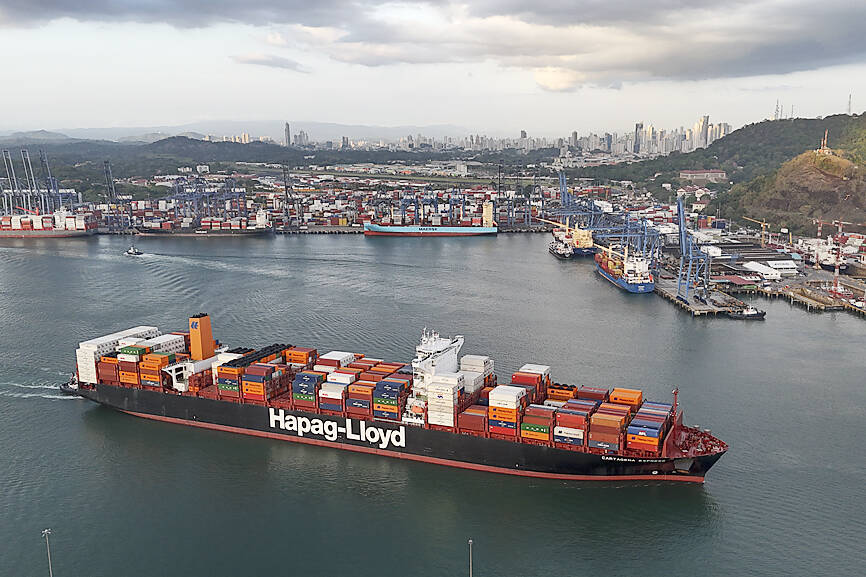
Photo: AP
The Chinese government agency, the country’s top office on Hong Kong affairs, first indicated its displeasure over the transaction last week by sharing an earlier Ta Kung Pao commentary. That post drove CK Hutchison shares down 6.4 percent on Friday, their biggest decline since 2020.
The conglomerate founded by Hong Kong billionaire Li Ka-shing (李嘉誠), this month agreed to sell off the bulk of its global ports business to a consortium led by BlackRock Inc. The sale included a controlling share in ports near the Panama Canal, an apparent victory for US President Donald Trump after he had raised concerns about their ownership.
The first Ta Kung Pao commentary called on companies to be careful about which “side they should stand on.” It said social media users had accused CK Hutchison of “spineless groveling” and “selling out” Chinese people.
Under the agreement, CK Hutchison would sell 43 ports in 23 countries, while keeping facilities in China and Hong Kong. The transaction is set to generate cash proceeds of more than US$19 billion.
Because the deal involves only overseas assets it is unlikely to need Beijing’s sign-off, but the recent attacks have stoked concern that China might somehow try to intervene.
The fresh opinion piece lauded the “heroic actions” of Ren Zhengfei (任正非), founder of Huawei Technologies Co, a Chinese phone and device manufacturer that has long been targeted on national security grounds by the US and other Western nations.
“Both history and reality remind entrepreneurs at the forefront of the storm that in the face of the US’ bullying, only by standing firmly with the country and fighting bravely can they defend their country, win dignity and maintain their reputation,” the commentary said.
Those who choose to do the opposite, it said, might “make a lot of money for a while, but in the end they will have no future and will bear history’s blame.”
Calls and an e-mail sent to CK Hutchison offices in Hong Kong went unanswered outside of office hours yesterday.
The apparent expression of disapproval by Chinese authorities underscores the balancing act facing executives whose companies get caught up in the widening China-US rivalry.
CK Hutchison and sister company CK Asset Holdings Ltd are registered in the Cayman Islands — a move carried out in 2015 as part of a group-wide restructuring. CK Hutchison accrues almost 90 percent of its revenue outside China and Hong Kong.
The potential purchase by BlackRock would be one of the biggest acquisitions of the year.
Before the agreement, Trump said that China had taken over the critical waterway, without providing evidence, and that the US was paying too much for the passage of ships.
He previously demanded the fees charged on US naval and merchant ships be lowered, or else Panama should return the canal to the US.

‘CROSSING THE LINE’: China’s embassy in Seoul criticized US Forces Korea Commander General Xavier Brunson, asking if his ‘hostile’ remarks were authorized by Washington South Korea and the US are in talks over recent public remarks by the commander of US Forces Korea, Seoul’s presidential office said yesterday, after the comments drew sharp criticism from China. In a recent podcast interview, US Forces Korea Commander General Xavier Brunson described South Korea as “the dagger in the heart of Asia” from China’s east coast, prompting the Chinese embassy in Seoul to say that he had “truly crossed the line.” The interview came amid growing speculation that Washington might seek to expand the role of US Forces Korea in countering the growing regional influence of China, a key

Through the noise of rushing papers and whirring belts at a print factory in Kyoto, two creators watch their photo essay come to life in broadsheet form — part of an effort to win new audiences in the age of artificial intelligence (AI). Despite the decline of the publishing industry, self-publication and handmade “zine” magazines are growing in popularity in Japan, reflecting the nation’s enduring love of paper in the digital era. While speaking to Agence France-Presse at the plant, his hands black with ink, one of the creators, Kazuma Obara, said: “I think [paper] is a medium that engages all five

Australian researchers have trained lab-grown brain cells on a silicon computer chip to play the 1990s shooter game Doom and said they are just scratching the surface of what the neurons could be capable of doing. It is the science-fiction work of biotech boffins at Cortical Labs, who researched and developed the technology that harnesses the workings of the brain’s networking system. Each so-called “biological computer” contains about 200,000 living human brain cells, grown from stem cells that were harvested from blood donations. Having mastered the simple computer game Pong, where a paddle is moved up and down to send a ball

France experienced its hottest spring on record, the French weather service said on Tuesday, after an exceptional early heat wave that also broke highs for the season in England and Wales. Meteo-France said the average nationwide temperature over March to May was 13.8°C — about 1.7°C above the norm, and surpassing records set in 2011 and 2020. “The warmest spring since records began in 1900,” it said in a bulletin. All three months were warmer than average, but the onset of an “unprecedented heatwave” late last month pushed the mercury to highs typically seen at the height of the summer. “Our country had never


 RSS
RSS