


Tens of thousands of people in Serbia gathered on Saturday for a huge student-led rally that vowed to turn the troubled, populist-run Balkan country into a free nation of justice and rule of law, while sending a message that “we deserve better.”
University students in the Balkan country that has been ruled firmly by a right-wing, pro-Russia government for more than a decade have been holding nationwide protests since the fatal train station canopy collapse in November last year that killed 15 people and which critics blame on government corruption.
The almost daily protests regularly draw tens of thousands of people and have rattled Serbian President Aleksandar Vucic’s firm grip on power.
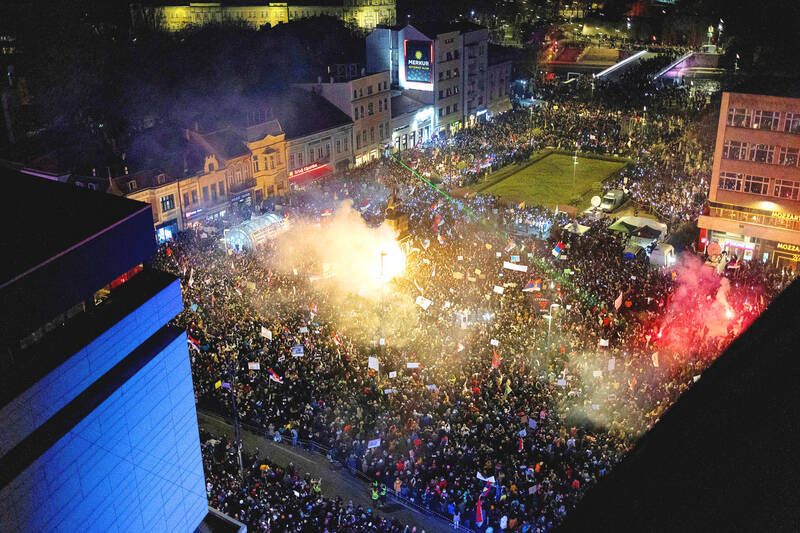
Photo: Reuters
“We want the [state] institutions that work in the interest of all of us and not to our damage,” the students said in a statement. “We want a system that values knowledge and work, and not obedience and silence.”
Protesters from across the country gathered in Nis, about 200km south of Belgrade, for Saturday’s festival-style rally lasting for 18 hours.
“We rally, because we know we deserve better,” the statement said.
The event in Nis passed a symbolic decree that proclaimed the “values for which we fight as a pledge for the future,” and to build a state “in which justice and freedom will be stronger than any individual.”
The next major protest is to be held in the capital, Belgrade, on Saturday next week, organizers said.
Vucic, who has described the protests as a Western-orchestrated attempt to oust him from power, on Saturday dismissed the Nis rally, declaring that “support is falling” and that he thinks “nothing special” of it.
The students have garnered widespread support among the citizens who have largely been disillusioned with mainstream politicians and have lost hope of changes.
Serbia is formally on the path toward EU membership, but Vucic and his right-wing Serbian Progressive Party have been accused of stifling democratic freedoms and fueling rampant corruption since coming to power.
Residents in Nis staged a noisy welcome for the students on Friday evening as they marched into the city after walking for several days in groups from various directions.
These student marches have become a rallying force in Serbia’s rural areas, which are traditionally pro-government. Everywhere students showed up people greeted them with food and refreshments, while many cried and kissed them.
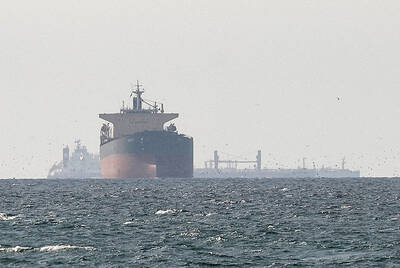
A ship that appears to be taking on the identity of a scrapped gas carrier exited the Strait of Hormuz on Friday, showing how strategies to get through the waterway are evolving as the Middle East war progresses. The vessel identifying as liquefied natural gas (LNG) carrier Jamal left the Strait on Friday morning, ship-tracking data show. However, the same tanker was also recorded as having beached at an Indian demolition yard in October last year, where it is being broken up, according to market participants and port agent’s reports. The ship claiming to be Jamal is likely a zombie vessel that
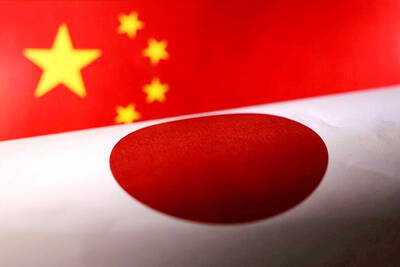
Japan is to downgrade its description of ties with China from “one of its most important” in an annual diplomatic report, according to a draft reviewed by Reuters, as relations with Beijing worsen. This year’s Diplomatic Bluebook, which Japanese Prime Minister Sanae Takaichi’s government is expected to approve next month, would instead describe China as an important neighbor and the relationship as “strategic” and “mutually beneficial.” The draft cites a series of confrontations with Beijing over the past year, including export controls on rare earths, radar lock-ons targeting Japanese military aircraft and increased pressure around Taiwan. The shift in tone underscores a deterioration

LAW CONSTRAINTS: The US has been pressing allies to send warships to open the Strait, but Tokyo’s military actions are limited under its postwar pacifist constitution Japan could consider deploying its military for minesweeping in the Strait of Hormuz if a ceasefire is reached in the war on Iran, Japanese Minister of Foreign Affairs Toshimitsu Motegi said yesterday. “If there were to be a complete ceasefire, hypothetically speaking, then things like minesweeping could come up,” Motegi said. “This is purely hypothetical, but if a ceasefire were established and naval mines were creating an obstacle, then I think that would be something to consider.” Japan’s military actions are limited under its postwar pacifist constitution, but 2015 security legislation allows Tokyo to use its Self-Defense Forces overseas if an attack,

German Chancellor Friedrich Merz’s conservative Christian Democratic Union (CDU) yesterday faced a regional election battle in Rhineland-Palatinate, now held by the center-left Social Democratic Party (SPD). Merz’s CDU has enjoyed a narrow poll lead over the SPD — their coalition partners at the national level — who have ruled the mid-sized state for 35 years. Polling third is the far-right Alternative for Germany (AfD), which spells a greater threat to the two centrist parties in several state elections in September in the country’s ex-communist east. The picturesque state of Rhineland-Palatinate, bordering France, Belgium and Luxembourg and with a population of about 4 million,


 RSS
RSS