


Canada must quickly ramp up its defense spending to reach the NATO target while also weaning itself off US-made equipment, contenders to replace Canadian Prime Minister Justin Trudeau said.
The four candidates — Mark Carney, Chrystia Freeland, Karina Gould and Frank Baylis — sparred over how fast Canada could realistically roll out the billions of dollars in new annual spending it would take to reach NATO’s threshold of 2 percent of GDP.
“We really need to act with the fierce urgency of now,” said Freeland, citing US President Donald Trump’s threats to make Canada the US’ 51st state. “I don’t think any of us wants to be the leader who was asleep at the wheel and didn’t get Canada defended.”
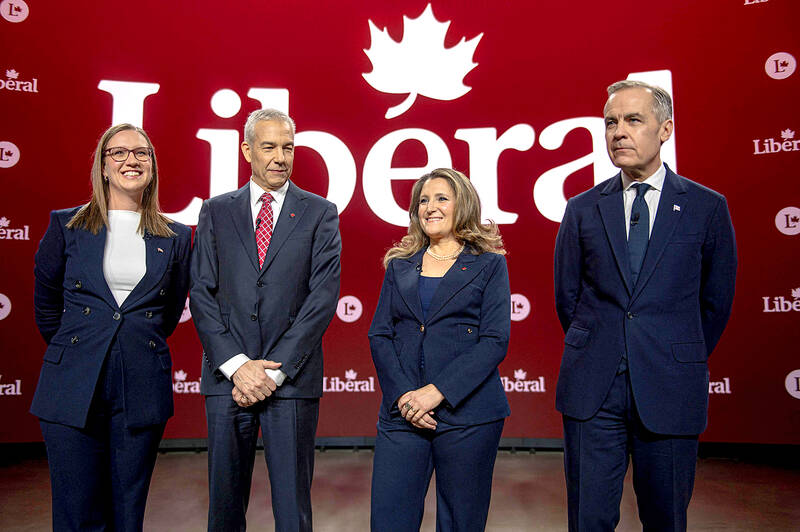
Photo: AFP
The government should spend as much of that money as possible within Canada, she added.
Canada must “protect our arctic, which is under threat not just now from the Russians and the Chinese, but from potential US incursions,” Carney said.
He agreed that Canada must boost its defense spending, but said it should also “leverage all of our assets from critical minerals to clean energy and well beyond to harden those partnerships in Europe and in Asia with like-minded countries.”
The comments came in the second and final debate of the Liberal Party leadership race, which is set to conclude on March 9.
Carney, a former governor of the Bank of Canada and Bank of England, is widely seen as the front-runner.
His chief rival is Freeland, a former finance minister whose resignation in December last year effectively finished Trudeau’s political career.
Canada last year was projected to spend about 1.33 percent of its GDP on defense.
Trudeau in July last year announced that Canada did not plan to reach the 2 percent target until 2032.
Freeland and Gould have promised to accelerate that deadline to 2027 and Gould attacked Carney for his own vow to get there by 2030.
“We don’t have time to wait for this,” she said.
Baylis said that he does not see 2027 as realistic.
“I don’t think that’s doable in an intelligent way,” he said, adding that it is difficult to do major procurement projects — especially if that procurement is restricted to Canadian firms.
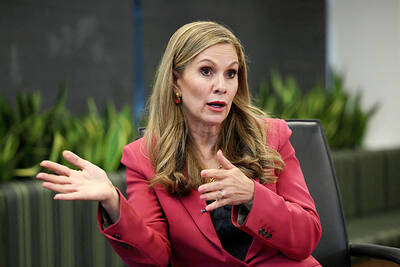
Australians were downloading virtual private networks (VPNs) in droves, while one of the world’s largest porn distributors said it was blocking users from its platforms as the country yesterday rolled out sweeping online age restriction. Australia in December became the first country to impose a nationwide ban on teenagers using social media. A separate law now requires artificial intelligence (AI)-powered chatbot services to keep certain content — including pornography, extreme violence and self-harm and eating disorder material — from minors or face fines of up to A$49.5 million (US$34.6 million). The country also joined Britain, France and dozens of US states requiring
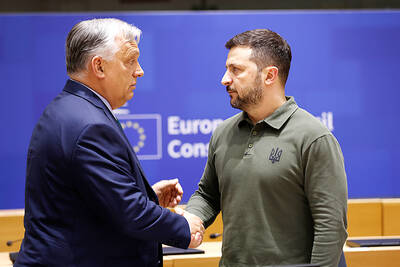
Hungarian authorities temporarily detained seven Ukrainian citizens and seized two armored cars carrying tens of millions of euros in cash across Hungary on suspicion of money laundering, officials said on Friday. The Ukrainians were released on Friday, following their detention on Thursday, but Hungarian officials held onto the cash, prompting Ukraine to accuse Hungary’s Russia-friendly government of illegally seizing the money. “We will not tolerate this state banditism,” Ukrainian Minister of Foreign Affairs Andrii Sybiha said. The seven detained Ukrainians were employees of the Ukrainian state-owned Oschadbank, who were traveling in the two armored cars that were carrying the money between Austria and
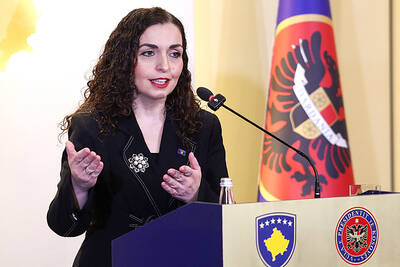
Kosovar President Vjosa Osmani on Friday after dissolving the Kosovar parliament said a snap election should be held as soon as possible to avoid another prolonged political crisis in the Balkan country at a time of global turmoil. Osmani said it is important for Kosovo to wrap up the upcoming election process and form functional institutions for political stability as the war rages in the Middle East. “Precisely because the geopolitical situation is that complex, it is important to finish this electoral process which is coming up,” she said. “It is very hard now to imagine what will happen next.” Kosovo, which declared

ACTIONABLE ADVICE: The majority of chatbots tested provided guidance on weapons, tactics and target selections, with Perplexity and Meta AI deemed to be the least safe From school shootings to synagogue bombings, leading artificial intelligence (AI) chatbots helped researchers plot violent attacks, according to a study published on Wednesday that highlighted the technology’s potential for real-world harm. Researchers from the nonprofit watchdog Center for Countering Digital Hate and CNN posed as 13-year-old boys in the US and Ireland to test 10 chatbots, including ChatGPT, Google Gemini, Perplexity, Deepseek and Meta AI. Eight of the chatbots assisted the make-believe attackers in more than half the responses, providing advice on “locations to target” and “weapons to use” in an attack, the study said. The chatbots had become a “powerful accelerant for


 RSS
RSS